US-Iran conflict: Massive turnout at Khamenei funeral; Trump hints at imminent meeting with Netanyahu
Millions mourn Khamenei as Washington and Tehran brace for next flashpoint
We are closing this coverage now. For the latest updates, click here.
Netanyahu may visit Washington soon, says Trump
Israel's Benjamin Netanyahu could visit the White House as early as next week, US President Donald Trump told Axios on Saturday, adding that the prime minister "knows who the boss is" in their relationship.
The possible meeting comes amid reports of tensions between the two leaders over efforts to end the war against Iran that the US and Israel started in late February.
"We get along very good. (Netanyahu) knows who the boss is," Trump said in a brief phone interview with Axios, referring to himself.
An Israeli official told the US media outlet that next week might be too soon for the visit because Trump will be traveling to Turkey for a NATO summit on July 7-8.
"It might take place the week after," the official told Axios.
Netanyahu's office said the two men spoke on Friday and agreed to meet "soon" in the United States.
The two men last met on February 11 in Washington.
Israeli military says killed armed militant in south Lebanon
The Israeli military said on Saturday that it killed an armed militant in the "security zone" under its control in south Lebanon.
"Earlier today (Saturday), IDF soldiers identified an armed terrorist operating inside the Security Zone, in the Majdal Zoun area in southern Lebanon," the military said in a statement, adding that troops "opened fire at the terrorist" and, after conducting "extensive searches", then "eliminated" him.
Lebanon's state-run National News Agency (NNA) said an Israeli helicopter carried out "a broad sweep operation on the outskirts" of Majdal Zoun and launched five missiles towards the village, without specifying a target or immediately reporting casualties.
The NNA also reported on Saturday that an Israeli strike on the village of Mansouri wounded one person, and reported Israeli artillery shelling elsewhere.
Iran envoy says friendly nations to get 'special' Hormuz fee treatment
Iran's ambassador to China insisted Saturday that new fees would be charged to ships transiting the Strait of Hormuz - an idea rejected by Washington - while assuring that "friendly" nations would receive special treatment.
The initial deal struck between Iran and the United States to end their war stipulated that commercial ships would transit the strait free of charge for 60 days, but it remains unclear what will be in place after that period.
Iranian Ambassador Abdolreza Rahmani Fazli told the World Peace Forum in Beijing that his country was working in "collaboration and cooperation" with Oman on "new arrangements" for the vital waterway.
"As a country where the Hormuz is part of its territorial waters, we will definitely charge service fees," Azli said in translated remarks, while insisting such fees would not be a "toll."
"These new arrangements will be concerning guaranteeing the security of passage through the Straits of Hormuz, supervision of the passage of the vessels... and also guaranteeing and dealing with the environmental consequences of the massive number of ships," he said.
"We will definitely consider special treatment for the countries that were friendly to us and specially stood by us during the hard times," he added.
Hezbollah and Hamas representatives attend Khamenei funeral
Representatives from Tehran-backed militant groups Hezbollah and Hamas attended the funeral ceremonies of late Iranian supreme leader Ali Khamenei on Saturday and met with Iran's Foreign Minister Abbas Araghchi, state media reported.
The Hezbollah delegation included officials and families of killed and wounded members, the group told Lebanese media. It was headed by senior official and former minister Mohammed Fneish.
Hamas, meanwhile, said in a statement that its delegation was led by the head of its political bureau, Mohammed Darwish and included other bureau members such as Bassem Naim.
Lebanese president urges US to 'keep standing' by country
Lebanese President Joseph Aoun on Saturday urged the United States to stand by his country after a recent US-backed framework deal with Israel aiming to permanently end hostilities after the latest Israel-Hezbollah war.
The deal reached in Washington calls for the disarmament of Iran-backed militant group Hezbollah, a gradual Israeli withdrawal from southern Lebanon and the deployment of the Lebanese army there, starting with two "pilot" areas.
Hezbollah has rejected the deal, which does not set a timetable for an Israeli withdrawal.
In a congratulatory message to President Donald Trump marking the United States' 250th anniversary of independence, Aoun urged Washington to "keep always standing beside Lebanon's right and just causes, its institutions, army and people".
Aoun expressed hope that Lebanon could "turn the page on wars... and open a new page of hope, peace and stability".
In a message also marking the independence anniversary, the US embassy in Lebanon said on X that "it is with great pride that we stand with the people of Lebanon as they forge a brighter future - one of peace, prosperity, and promise long overdue".
Tehran province shut until Tuesday
Tehran province will remain closed from Saturday until Tuesday to facilitate funeral arrangements, Governor Mohammad Sadegh Motamediyan said, according to Iran International.
Earlier, government spokesperson Fatemeh Mohajerani said Tuesday had been declared a public holiday in Tehran to allow mourners to leave the city following the farewell of the “martyred leader,” as described by local media.
Israeli forces raid camps in West Bank
Israeli forces have stormed the city of Tubas, the nearby town of Aqaba, and the al-Far’a refugee camp in the occupied West Bank, according to the Palestinian news agency Wafa.
The report said Israeli troops conducted raids and searched several Palestinian homes across the three locations before withdrawing from the areas.
Iran warns UK and France over military moves in Strait of Hormuz
Iran has warned the United Kingdom and France against any military deployment in the Strait of Hormuz, after both countries said they were prepared to support freedom of navigation in the strategically vital waterway.
“As a responsible power and guarantor of the Strait’s security, Iran warns against any military movement in this waterway,” Deputy Foreign Minister Kazem Gharibabadi said in a post on X.
He added: “The security of Hormuz lies with the coastal states.”
'We gave them a week off' in Iran swipe: Trump
Trump, speaking at an event in South Dakota near Mount Rushmore, made strong remarks about Iran, saying the country was “under pressure” and suggesting Tehran was seeking an agreement, according to his address.
“We gave them a week off for a funeral,” he said, referring to recent developments, without providing further detail.
We knocked the hell out of Iran. They're dying to settle. They want to settle so badly. We gave them a week off for a funeral because we're nice.US President Donald Trump
Separately, reports from Iran say authorities have imposed widespread restrictions in Tehran, including road closures, airspace limits and disruptions to daily activity as mourning events continue.
Officials have also arranged for the transport of the remains to multiple cities in Iran and neighbouring Iraq, as part of the ongoing funeral processions, according to local reports.
Photos: Huge crowds gather at Tehran for Ali Khamenei farewell
France and UK ready to deploy military forces in Strait of Hormuz
France and the United Kingdom have said they are ready to deploy a multinational military mission to support freedom of navigation in the Strait of Hormuz, according to a joint statement by French President Emmanuel Macron and UK Prime Minister Keir Starmer.
“The Strait of Hormuz is a vital artery for the global economy. Restoring safe transit for ships of all nations through the Strait is a matter of global concern,” the statement said.
The statement added that the Sultanate of Oman has agreed to cooperate with the two countries to help ensure safe navigation through the strategic waterway. Omani officials have yet to comment on the reported agreement.
Iran officially starts public funeral ceremony for Khamenei: State TV
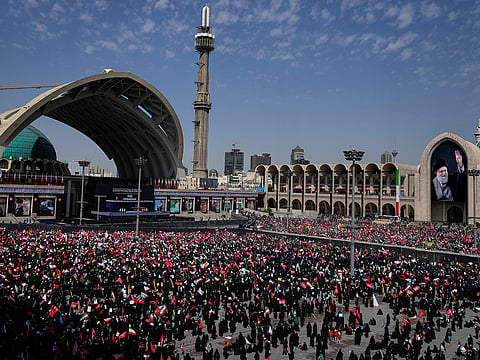
Iran officially began Saturday morning six days of public funeral ceremonies for late supreme leader Ayatollah Ali Khamenei, state television reported, with processions due to continue in Iraq before his burial.
Thousands of mourners carrying red banners, a symbol associated with calls for revenge, gathered in the courtyard of Tehran's Grand Mosalla ahead of the arrival of Khamenei's coffin, according to an AFP journalist at the venue.
Get updated faster and for FREE: Download the Gulf News app now - simply click here.
Crowds enter Khamenei's funeral venue ahead of processions
Thousands of mourners entered Tehran's Grand Mosalla on Saturday for the funeral ceremonies of Iran's late supreme leader Ayatollah Ali Khamenei, AFP journalists witnessed, ahead of its official start.
The main courtyard of the vast complex was filled with people as authorities imposed extensive traffic restrictions across the capital. Another AFP journalist saw mourners walking several kilometres to reach the venue.
'Fake news': Israeli PMO rejects report on alleged threat to Iranian negotiators
The Israeli Prime Minister Benjamin Netanyahu's Office has dismissed a news report alleging that US officials feared that Israel might have targeted senior Iranian negotiators during Islamabad talks earlier this year.
In a post on X on Friday, the Israeli Prime Minister's Office said, "As usual, The New York Times' latest story about Israel and the Iranian negotiators is fake news. A complete fabrication of reality."
According to the NYT news report as cited by the Times of Israel, US officials had allegedly conveyed indirect warnings to Iranian Foreign Minister Abbas Araghchi and Iranian Parliament Speaker Mohammad Bagher Ghalibaf during negotiations earlier this year that Israel might attempt to assassinate them.
The US media report, citing current and former US officials, further alleged that some US officials believed Israel may have been planning to target the two senior Iranian negotiators in the weeks following the April 8 ceasefire that halted fighting in the US-Israel conflict with Iran.
It also claimed that, due to those concerns, US officials asked counterparts in other countries across the region to warn Tehran that Israel might seek to target Araghchi and Ghalibaf.
In response, the Israeli Prime Minister's Office categorically rejected the report on Friday.
Saudi-led Coalition issues stern warning to Houthis
The Joint Forces Command of the Coalition has warned that it will respond with “unprecedented determination and force” to any attempt targeting Saudi Arabia, its citizens, residents, or national assets.
It said such measures would also be taken in line with protecting Yemen’s sovereignty, under customary international humanitarian law.
Coalition spokesperson Maj. Gen. Turki Al-Maliki, cited by the Saudi Press Agency (SPA), said recent Houthi statements against the Kingdom were aimed at diverting attention from what he described as “grave violations” against the Yemeni people.
He added that the remarks reflected continued escalation and hostile behaviour by the group, undermining regional and international security.
Saudi delegation joins Khamenei's funeral in Tehran
The funeral of Iran’s Supreme Leader Ali Khamenei on Friday was attended by senior Iranian officials and foreign delegations, including representatives from Saudi Arabia, Qatar and Oman. Officials paid respects before his coffin at Tehran’s Grand Mosalla, four months after he was assassinated in US-Israeli strikes that triggered a wider Middle East war.
The six-day funeral procession began with an official Iranian delegation led by President Masoud Pezeshkian, Parliament Speaker Mohammad Bagher Ghalibaf and judiciary chief Gholamhossein Mohseni Ejei.
Military commanders also paid tribute, including Ahmad Vahidi, the commander of the Revolutionary Guards, who had not appeared publicly since the start of the US-Israeli war in February, according to footage carried by Iranian media. A Saudi Foreign Ministry delegation joined representatives from Qatar, Egypt and Oman in paying respects.
Get updated faster and for FREE: Download the Gulf News app now - simply click here.
Omani delegation attends Khamenei's funeral in Tehran
Omani delegation attends Khamenei's funeral in Tehran, sent by the Sultan to convey his condolences to Iran's leadership, Oman News Agency shared on X.
Over 600,000 displaced Lebanese return home amid ceasefire
More than 640,000 displaced people in Lebanon have returned home, according to the International Organization for Migration (IOM), as clashes between Hezbollah and Israel have wound down following a deal to end the Middle East war.
Lebanon was drawn into the regional war on March 2 when Tehran-backed militant group Hezbollah fired rockets at Israel to avenge the killing of Iran's supreme leader in US-Israeli strikes.
Israel responded with heavy airstrikes and an invasion of southern Lebanon, where its troops still occupy swathes of territory.
Lebanese authorities say Israeli attacks have killed around 4,300 people and displaced over one million, particularly from southern Lebanon and Beirut's southern suburbs.
Get updated faster and for FREE: Download the Gulf News app now - simply click here.
US‑Israel war on Iran: Recent developments
Day 126: Netanyahu, Trump agree to meet in US 'soon'
Day 125: Iran denounces US-led security summit of 12 nations
Day 124: Iran says Qatar talks with US on war MoU concluded
Day 123: Iran says US blockade stopped oil exports completely
Day 122: IRGC Navy spokesperson Akbarzadeh dies in car 'mishap'
Day 121: Iran warns against attacks from regional territory
Day 120: US–Iran ceasefire under strain as drones target Bahrain
Day 119: Lebanon, Israel, US sign trilateral deal in Washington
Day 118: Oil price spikes after IRGC strike on ship in Hormuz
Day 117: Iran-Gulf reconciliation talks expected in Saudi Arabia


