US-Iran tensions: Tehran mourns Khamenei as Trump urges restraint during rites
Strait of Hormuz tensions rise with new Iranian fees, ‘friendly’ nations promised leniency
Highlights
We are closing this coverage now. For the latest updates, click here.
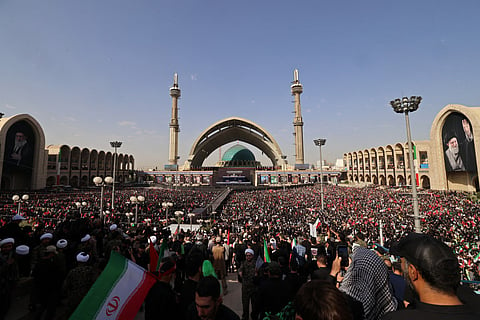
Funeral of slain Iran Supreme Leader Khamenei becomes defiant show of unity — but where is Mojtaba?
In a notable development, while millions flooded Tehran's the sprawling Imam Khomeini Grand Mosalla prayer complex, three of Khamenei's sons — Mostafa, Meysam and Masoud — made a rare public appearance during funeral prayers.
However, there was no sign of his designated successor, Mojtaba Khamenei, fueling continued speculation over his health after reports that he was seriously wounded in the same strike that killed his father.
Reuters reported Mojtaba remains out of public view, while Iranian authorities have not publicly explained his absence.
Senior Iranian leaders, including President Masoud Pezeshkian and Parliament Speaker Mohammad Bagher Ghalibaf, joined military commanders and clerics in leading the ceremonies, underscoring the government's efforts to project stability despite months of war and political uncertainty.
The funeral comes more than four months after Khamenei, who led the Islamic Republic for nearly four decades, was killed alongside several members of his family in a U.S.-Israeli strike at the outset of the war that erupted on Feb. 28. His death marked the most significant leadership change in Iran since he succeeded Ruhollah Khomeini in 1989.
The ceremonies also took on a strongly political tone. Many mourners waved Iranian flags and banners while chanting anti-US and anti-Israel slogans, with some calling for retaliation over Khamenei's assassination.
The funeral has become both a religious observance and a national demonstration of resistance following the conflict that devastated parts of Iran before ending in a fragile ceasefire.
Get updated faster and for FREE: Download the Gulf News app now - simply click here
Some Christian villages in Lebanon want to join Israel: Netanyahu
Israeli Prime Minister Benjamin Netanyahu said on Sunday that some Christian villages in southern Lebanon had asked to be annexed by Israel, in order to be protected from Hezbollah militants.
"Christian villages in Lebanon, some of them have actually asked to be annexed to Israel, because we protect them against the Hezbollah, Hezbollah fanatics who want to kill them, and we do the same things with Christians everywhere," Netanyahu told Fox News's show, The Sunday Briefing.
In a separate speech at a state ceremony on Sunday, Netanyahu reiterated that Israel's military would maintain its presence in southern Lebanon "as long as necessary in order to protect the residents of the north and all the citizens of Israel."
During his interview with Fox News, Netanyahu also addressed reported disagreements with US President Donald Trump over the deal that halted the war with Iran.
"Let me say that we have an excellent relationship, which is defined, as I said, between allies," Netanyahu said.
"Ninety-nine per cent of the time, we see eye-to-eye, but as any, in any family, in any close friendship, there are sometimes differences of opinion, and we discuss them openly," Netanyahu said.
"I can tell you, in a free spirit, and usually we resolve them too."
Tehran claims US pushed 13 countries to skip funeral
Iran's Tasnim news agency claimed that a total of 13 countries have reportedly withdrawn or scaled down their participation in the funeral ceremony of Iran's former Supreme Leader Ayatollah Ali Khamenei in Tehran, following diplomatic pressure from the US. The news agency cited a senior source.
The source claimed that Washington, prior to the ceremony, ran an extensive diplomatic campaign over the past several days aimed at discouraging foreign participation in the event, which was attended by delegations from multiple countries at Imam Khomeini Grand Musalla in central Tehran.
Tasnim reported that US Secretary of State Marco Rubio had issued confidential instructions on June 26 to US embassies and diplomatic missions, directing them to use all available means to persuade host countries that attending the ceremony would be viewed as an "unfriendly act" with potential consequences for bilateral relations with Washington.
The source further told Tasnim that US ambassadors in several African countries warned that participation could result in cuts to US development assistance and also noted that Rubio personally discussed the matter with counterparts in at least five Arab countries, based on statements attributed to two unnamed Arab diplomats.
Citing assessments, the report said at least 13 countries - -including three Eastern European countries, five African countries, two Arabian Gulf countries, and two major East Asian countries -- either withdrew or reduced their level of representation at the ceremony under US pressure.
Get updated faster and for FREE: Download the Gulf News app now - simply click here
Israel army chief vows to act 'decisively' against Hezbollah
Israel's military chief visited forces deployed around Beaufort castle in southern Lebanon on Sunday, vowing to push ahead with the campaign against Hezbollah.
"The IDF will continue to operate decisively to remove threats from Lebanese territory and is prepared to transition rapidly to offensive operations should the ceasefire be violated," Lieutenant General Eyal Zamir told soldiers during the visit, according to a statement issued by the military.
Israeli forces seized the crusader-era castle and the area around it recently, giving the military a strategic toehold it previously occupied for nearly two decades.
Israel says it uncovered a tunnel network beneath the castle, saying it was built to give fighters of Lebanese militant group Hezbollah a fortified strike hub just kilometres from Israeli territory.
"Our troops' activities at the Beaufort Ridge and throughout southern Lebanon are being carried out in accordance with the framework of the agreement and the mechanisms established under it," Zamir said on Sunday, referring to the recent US-brokered agreement between Israel and Lebanon intended to permanently halt hostilities.
But Zamir said that "any threat directed at our troops or the Israeli civilians will be struck immediately and eliminated".
"The Lebanese Armed Forces are required to fulfil their commitments under the historic agreement that was signed and act to clear the area of Hezbollah terrorists and terrorist infrastructure," he added.
Get updated faster and for FREE: Download the Gulf News app now - simply click here.
OPEC+ raises quotas again as Middle East calms
Seven OPEC+ members decided on Sunday to again raise oil production quotas as Gulf countries reel from the Middle East war.
Ministers from key OPEC+ countries Saudi Arabia, Russia, Iraq, Kuwait, Kazakhstan, Algeria, and Oman met virtually on Sunday and "decided to implement a production adjustment of 188 thousand barrels per day," a statement from the organisation said, adding that "this adjustment will be implemented in August 2026".
Gulf countries had to cut output after the near-paralysis of the Strait of Hormuz orchestrated by Iran during the war in the Middle East, which blocked their oil exports for several months.
Between the first quarter of 2026 and May, combined production by Saudi Arabia, Iraq, and Kuwait - three of the seven countries raising their quotas - fell by some six million barrels per day, OPEC data have shown.
Iran's top officials attend prayer for the late Supreme Leader
Iran's top officials and brothers of the country's new supreme leader emerged into public view Sunday to attend the funeral prayers for the late Ayatollah Ali Khamenei, signalling a new confidence in their safety.
Their presence before hundreds of thousands of people in the capital Tehran would have been unthinkable during the Iran war.
Ayatollah Jafar Sobhani, a 97-year-old Shiite cleric, led the prayers at Tehran's Grand Mosalla for Khamenei and his late family members.
On hand were Khamenei's sons Masoud, Meysam and Mostafa, who haven't been seen since the war. Revolutionary Guard head Gen. Ahmad Vahidi, who only had been photographed for the first time since the war on Thursday, could be seen in the crowd by Associated Press journalists, flanked by plainclothes security forces as he wore a black baseball cap.
Iran's President Masoud Pezeshkian, Parliament speaker Mohammad Bagher Qalibaf and Esmail Qaani, who leads the Guard's expeditionary Quds Force, also attended.
Get updated faster and for FREE: Download the Gulf News app now - simply click here.
Attack by Yemen's Houthis kills 14 government troops
Yemen's Iran-backed Houthi rebels killed 14 troops in an attack south of the port city of Hodeidah, two military officials aligned with the country's internationally-recognised government told AFP on Sunday.
An officer with pro-government forces in the Jabal Dubas in Hays district, where the clashes took place, confirmed 14 troops were killed and 23 injured in "fierce fighting".
The officer said the Houthis briefly took control of pro-government positions in the clashes, which began late on Friday, before a counterattack to retake them concluded at dawn on Saturday.
"This was the deadliest Houthi attack in years," the officer said on condition of anonymity because he was not authorised to speak to the media.
He described how the Iran-backed rebels had attacked with snipers, which accounted for most of the casualties, before launching drone and mortar salvos.
Earlier a military official also said 14 troops had been killed and pro-government forces had repelled the Houthi attack in Hays district in "clashes lasting for several hours".
He added "fighting resulted in dead and wounded among (Houthi) ranks," without specifying the number killed in the opposing force.
Get updated faster and for FREE: Download the Gulf News app now - simply click here
UKMTO reports attack on cargo ship off Yemen coast
A cargo vessel is under attack by unknown armed assailants off Yemen’s Red Sea coast, according to the United Kingdom Maritime Trade Operations (UKMTO).
UKMTO said it received a distress alert from the ship located around 56km (30 nautical miles) southwest of Yemen’s port city of Hodeidah.
Authorities are investigating the incident. The agency has advised vessels in the area to exercise caution and report any suspicious activity while transiting through the region.
No group has immediately claimed responsibility for the attack.
Iran reiterates support for Palestinian cause
Iran’s Foreign Minister Abbas Araghchi has reaffirmed Tehran’s continued support for the Palestinian cause, stressing that the country would not spare any effort in backing what he described as the Palestinian people’s struggle for liberation.
Araghchi said Iran remains committed to supporting Palestinians, underlining that Tehran will continue its backing through all available means.
The remarks come as Iran maintains its longstanding political position on the Palestinian issue, reiterating support at the diplomatic level.
Iranian leaders attend funeral prayers for Khamenei
Video footage from Iranian state media showed senior Iranian leaders offering prayers over coffins during the second day of Supreme Leader Ayatollah Ali Khamenei’s funeral ceremonies.
Among those present were Iranian President Masoud Pezeshkian, Parliament Speaker Mohammad Bagher Ghalibaf, and Gholam-Hossein Mohseni-Eje’i, the head of Iran’s judiciary.
Ghalibaf, who has also served as Iran’s chief negotiator in talks with the United States, was seen joining other officials in the funeral proceedings.
The footage broadcast by Iranian state media captured leaders and officials gathered in solemn prayer as part of the ongoing funeral rituals for the late supreme leader.
Attack by Yemen's Houthis kills 14 government troops
Yemen's Iran-backed Houthi rebels killed 14 troops in an attack south of the port city of Hodeidah, a military official aligned with the country's internationally-recognised government told AFP on Sunday.
The official said pro-government forces had repelled the attack in Hays district, south of Hodeidah, in "clashes lasting for several hours at dawn on Saturday".
He added "fighting resulted in dead and wounded among (Houthi) ranks," without specifying the number killed in the opposing force.
Khamenei’s sons attend funeral prayers
The sons of the late supreme leader, Masoud, Meysam and Mostafa Khamenei, attended the funeral prayers held in his honour, the Associated Press reported.
According to the report, Islamic Revolutionary Guard Corps (IRGC) commander Ahmad Vahidi also took part in the ceremony.
At least eight ships U-turn during Strait of Hormuz crossing attempt
At least eight vessels were forced to reverse course while attempting to transit the Strait of Hormuz, with tracking data indicating sudden U-turns as ships initially hugged the Omani coastline.
According to MarineTraffic data cited by CNN, five of the vessels—including vehicle carriers, chemical and oil products tankers, and a bulk carrier—abandoned their crossings in the morning local time, underscoring continued disruption in the strategic waterway.
The Strait, which typically handles around one-fifth of global oil and liquefied natural gas flows, remains a flashpoint as Iran insists vessels require permission to pass through designated routes.
However, increasing traffic is shifting toward the Omani side, seen as an attempt to avoid Iranian-controlled waters. In a separate development, three additional vessels that initially turned back later resumed transit, passing closer to the Iranian side of the strait.
In pictures: Tehran mourners pay tribute to Khamenei
Get updated faster and for FREE: Download the Gulf News app now - simply click here.
Iran warns against foreign military presence in Hormuz Strait
A senior Iranian diplomat warned that the Strait of Hormuz is not a "theater" for transregional powers' military display.
"Iran, as the responsible authority and guarantor of security in the strait, warns against any military movement in the sensitive waterway," Iran's Deputy Foreign Minister for Legal and International Affairs Kazem Gharibabadi wrote on social media platform X.
The strait's security is the sole responsibility of Iran and Oman, Gharibabadi said, dismissing a joint statement on Friday by outgoing British Prime Minister Keir Starmer and French President Emmanuel Macron, Xinhua news agency reported.
In their statement, Starmer and Macron described the waterway as a "vital artery" for the global economy, adding, "Restoring safe transit for ships of all nations through the strait is a matter of global concern."
They said Oman has agreed to work with Britain and France to ensure "its sovereign territorial waters are safe for navigation," stressing that Britain and France "also stand ready to deploy the wider Multinational Military Mission to support freedom of navigation" in the strait.
Meanwhile, Iran's semi-official Fars news agency, citing the latest maritime tracking data, reported Saturday that eight vessels seeking to cross the waterway along the coast of Oman were turned back.
Bloomberg reported the same day that some of the vessels "had made it as far as the tip of the Musandam Peninsula that sticks out into the chokepoint, before making sharp reversals."
"One crude tanker, two products tankers, and one bulk carrier then sailed northward to take an outbound route" as directed by Iran, it reported.
Iran has tightened its grip on the strait since February 28, when it barred safe passage of vessels belonging to or affiliated with Israel and the United States following their joint strikes on Iranian territory.
Trump says Netanyahu 'knows who the boss is'
US President Donald Trump said Israeli Prime Minister Benjamin Netanyahu has requested a meeting at the White House that could take place as early as next week after his return from the NATO summit, Axios reported.
"We get along very good. [Netanyahu] knows who the boss is," Trump said in a brief phone interview with Axios, referring to himself.
According to the report, the proposed meeting would be the first between the two leaders since their February meeting in the White House Situation Room, where Netanyahu presented a plan for a joint war against Iran.
An Israeli official told Axios that next week could be too soon for the visit because of Trump's trip to Turkey for the NATO summit scheduled for July 7-8, adding, "It might take place the week after."
The Israeli Prime Minister's Office said Netanyahu called Trump on Friday to congratulate him on the 250th Independence Day of the United States.
"During their conversation, the Prime Minister said that the United States is a guarantor of global freedom, and that Israel greatly values the close relationship between the two nations. Prime Minister Netanyahu and President Trump agreed to meet soon in the United States," Netanyahu's office said.
The report said people within Trump's inner circle have become increasingly sceptical of Netanyahu in the months following their February meeting.
"Many of Trump's closest advisers think that Bibi was wrong about everything," a US official told Axios.
Iran’s Pezeshkian slams global silence over Israel actions
Iranian President Masoud Pezeshkian on Saturday (local time) condemned Israel's actions in the region and criticised the United States for supporting them, alleging that the region has witnessed the targeted killing of intellectuals, scientists and other influential figures, IRNA reported.
Speaking at the international conference "Imam Khamenei; The Eternal Leader of Resistance" in Tehran, he also questioned the effectiveness of international institutions, saying they had failed to prevent such actions despite claiming to uphold human rights, IRNA reported.
Pezeshkian said that if "Muslim nations acted collectively, conflicts and humanitarian crises in Gaza, Lebanon and Palestine could not continue unchecked." He also warned that divisions among Islamic sects and ethnic groups create opportunities for external actors to exploit regional tensions, as reported by IRNA.
Iranian FM expresses gratitude to over 70 nations for attending funeral
Iranian Foreign Minister Seyed Abbas Araghchi thanked representatives from more than 70 countries for attending the funeral ceremonies of Supreme Leader Ayatollah Ali Khamenei, saying their participation would remain "an everlasting memory" in the history of Iran's relations with those nations.
In a post shared on X, Araghchi said, "Iran is pleased to have received representatives from more than seventy countries who chose to participate in honouring our Supreme Leader, the martyr, Grand Ayatollah Khamenei, including our loyal Arab brothers among them."
"And this historic commemoration will remain an everlasting memory in the course of our shared relations," he added.
The remarks came as Iran continued funeral ceremonies for Khamenei, with thousands of mourners gathering in Tehran to pay their final respects.
Iran envoy says friendly nations to get 'special' Hormuz fee treatment
Iran's ambassador to China insisted that new fees would be charged to ships transiting the Strait of Hormuz - an idea rejected by Washington - while assuring that "friendly" nations would receive special treatment.
The initial deal struck between Iran and the United States to end their war stipulated that commercial ships would transit the strait free of charge for 60 days, but it remains unclear what will be in place after that period.
Iranian Ambassador Abdolreza Rahmani Fazli told the World Peace Forum in Beijing that his country was working in "collaboration and cooperation" with Oman on "new arrangements" for the vital waterway.
"As a country where the Hormuz is part of its territorial waters, we will definitely charge service fees," Azli said in translated remarks, while insisting such fees would not be a "toll."
"These new arrangements will be concerning guaranteeing the security of passage through the Straits of Hormuz, supervision of the passage of the vessels... and also guaranteeing and dealing with the environmental consequences of the massive number of ships," he said.
"We will definitely consider special treatment for the countries that were friendly to us and specially stood by us during the hard times," he added.
Get updated faster and for FREE: Download the Gulf News app now - simply click here.
US‑Israel war on Iran: Recent developments
Day 127: Massive turnout at Khamenei funeral
Day 126: Netanyahu, Trump agree to meet in US 'soon'
Day 125: Iran denounces US-led security summit of 12 nations
Day 124: Iran says Qatar talks with US on war MoU concluded
Day 123: Iran says US blockade stopped oil exports completely
Day 122: IRGC Navy spokesperson Akbarzadeh dies in car 'mishap'
Day 121: Iran warns against attacks from regional territory
Day 120: US–Iran ceasefire under strain as drones target Bahrain
Day 119: Lebanon, Israel, US sign trilateral deal in Washington
Day 118: Oil price spikes after IRGC strike on ship in Hormuz
Day 117: Iran-Gulf reconciliation talks expected in Saudi Arabia


