Iran's power struggle: Is Mojtaba Khamenei sidelining Pezeshkian over the Strait of Hormuz, dispute over approach to US?
Warning to Pezeshkian signals hard line on Iran’s stance toward Washington
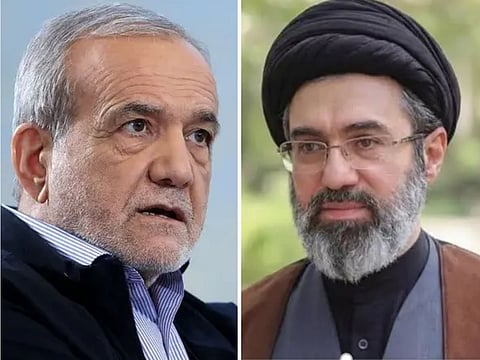
Iran's wartime leadership is showing a united front toward the US, but behind that facade, a potentially consequential struggle is emerging over who controls Iran's strategy — and how far Tehran should go in using the Strait of Hormuz as leverage against Washington.
The latest sign came Monday (August 3), when senior cleric Mohammad Bagher Kharrazi, who has family ties to Supreme Leader Mojtaba Khamenei, said Khamenei had warned President Masoud Pezeshkian that he would accept the president's resignation if Pezeshkian threatened to quit again.
The claim, reported by the Institute for the Study of War (ISW), has not been independently confirmed by Iran's government.
Get it: Fast, verified news for FREE ... download the Gulf News app — simply click here
Kharrazi said Pezeshkian had threatened to resign repeatedly, while Iranian officials previously denied reports in May that the president had formally resigned.
President Pezeshkian, a former heart surgeon, is seen as belonging to the camp of “pragmatists”, according to ISW.
"Mojtaba may have made this warning to prevent Pezeshkian from using the threat of his resignation to influence regime policies," the report stated.
Kharrazi’s comments come as a contingent of pragmatist regime officials has directly and indirectly questioned how much effort the regime should exert to control the Strait of Hormuz.
Former Iranian Foreign Affairs Minister Mohammad Javad Zarif, who played a central role in the 2015 Joint Comprehensive Plan of Action (JCPOA) negotiations, warned on August 3 that a prolonged closure or “short-term exploitation” of the Strait of Hormuz could generate an international consensus against Iran, including from the People’s Republic of China (PRC).
If Mojtaba's warning is genuine, it could reveal something important about Iran's wartime politics: Mojtaba Khamenei may be trying to remove one of Pezeshkian's few remaining political levers — the threat of resignation — as competing factions fight over negotiations with the United States and control of Hormuz.
Why Pezeshkian matters
Pezeshkian is generally associated with the more pragmatic wing of Iran's political establishment.
That does not make him pro-American or a liberal reformer. His faction still supports the Islamic Republic's core interests, including maintaining Iran's strategic capabilities.
The difference is over how those interests should be pursued.
Pezeshkian and allies such as Foreign Minister Abbas Araghchi and Parliament Speaker Mohammad Bagher Ghalibaf have favoured using military pressure and Iran's leverage as bargaining chips for a negotiated settlement with Washington.
What ultra-hardliners want
AP reported that the pragmatic camp sees continued military pressure as a way to obtain a deal, while ultra-hardliners oppose negotiations altogether and want a more uncompromising confrontation with the US.
That division has become particularly important because of Hormuz.
Why the Strait of Hormuz is the battleground
The Strait of Hormuz is Iran's most powerful economic and military lever.
It is the narrow maritime gateway connecting the Persian Gulf with the Gulf of Oman and Arabian Sea. A huge share of the world's seaborne oil and LNG passes through it.
Iran does not necessarily need to physically "close" the strait to exercise leverage. It can threaten shipping, restrict particular vessels, conduct inspections, impose security conditions or otherwise make commercial traffic more expensive and risky.
That gives Tehran a potent bargaining chip against the United States and its Gulf allies.
The problem is that the same weapon can hurt Iran.
A prolonged disruption threatens:
access to imported goods;
regional economies;
Asian energy consumers;
global shipping;
and Iran's remaining economic relationships with countries such as China and India.
That is where the pragmatists and hardliners increasingly appear to differ.
But there is an important caveat: Kharrazi is not Mojtaba Khamenei himself.
His statement is evidence of a reported internal message, not independent proof that the supreme leader actually issued it.


