Iran’s hardliners vs pragmatists — 'soft coup', betrayal, charges of capitulation amid war, uncertainty
Power struggle after Khamenei: Iran’s future torn between ideology and survival
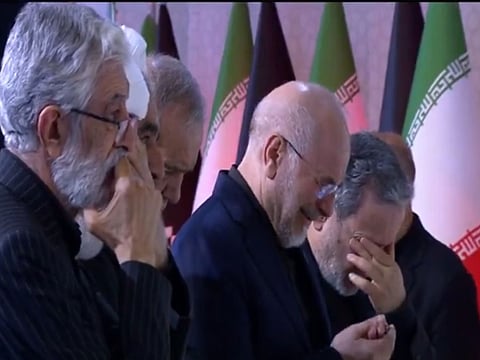
In the days since Supreme Leader Ali Khamenei's death, Iran's ruling establishment has descended into its deepest internal crisis since the 1979 Islamic Revolution.
A bitter power struggle has erupted into the open in Iran's tightly-controlled political establishment, with rival factions using the funeral ceremonies for Ali Khamenei to signal competing visions for the country's future.
Hard-line clerics and Islamic Revolutionary Guard Corps (IRGC) loyalists have accused some of the country's most prominent civilian leaders and veteran diplomats of "betrayal", "capitulation" and even orchestrating a "soft coup" to dismantle the Islamic Republic from within.
What began as a succession battle has evolved into an open political war.
Hard-liners vs reformists
Hard-liners believe reformist politicians and pragmatists are exploiting the leadership vacuum to push Iran toward "rapprochement" with the West, curb the power of the Islamic Revolutionary Guard Corps (IRGC) and dilute the revolutionary principles laid down by Ayatollah Ruhollah Khomeini nearly five decades ago.
Public feud
It's an open-ended feud fanned by fear, uncertainty and doubt in the midst of military threats and sanctions.
The pragmatists' camp, counter that Iran can no longer survive under decades of international isolation, crippling sanctions and military confrontation.
They argue the country needs sweeping political and economic reforms to avert further instability after Khamenei's death.
The increasingly public feud has exposed fractures that had long simmered beneath Iran's veneer of control and unity, but were largely kept out of public view while Khamenei, the country's supreme authority for more than three decades, remained alive.
The infighting comes as Iran grapples with mounting economic pressure, international sanctions, regional security challenges and uncertainty over who will ultimately consolidate power in the post-Khamenei era.
Revolutionary ideology vs 'pragmatic' course
Analysts say the outcome of the struggle could determine not only the identity of Iran's next supreme leader but also whether the Islamic Republic doubles down on revolutionary ideology — or charts a more pragmatic course after one of the most consequential leadership transitions in its modern history.
Suzanne Maloney, director of Foreign Policy at the Brookings, reckons that the transition could redefine the balance between ideology and pragmatism inside the Islamic Republic.
The think-tank argues that given "unprecedented" internal and external pressures on Iran, the real question is whether Mojtaba Khamenei, who succeeded his father, can preserve the balance among Iran's competing centres of power — the clerical establishment, the IRGC, and civilian institutions.
Brookings sees the IRGC playing a "decisive" role, potentially shifting Iran toward a more security- and military-dominated system.
'Atypical leadership'
The Institute for the Study of War (ISW) and the Critical Threats Project (CTP) say Iran is experiencing an "atypical" distribution of power following the death of Supreme Leader Ali Khamenei, with authority dispersed among the Supreme National Security Council (SNSC), senior military commanders and political leaders, rather than concentrated in a single supreme authority.
According to ISW, Foreign Minister Abbas Araghchi revealed that a special SNSC committee made key decisions on negotiations with the United States without the direct involvement of the new supreme leader, suggesting traditional chains of command have been weakened during the leadership transition.
ISW assesses that the new supreme leader, Mojtaba Khamenei, has maintained a low profile and appears to wield limited direct influence, while major decisions are being driven by the SNSC and hardline Islamic Revolutionary Guard Corps (IRGC) figures, including Major General Ahmad Vahidi.
The resulting power vacuum has created space for rival factions to compete for influence.
ISW says pragmatists, led by President Masoud Pezeshkian, have temporarily gained room to pursue de-escalation with the US and manage a wartime economy, while hardliners push for a more confrontational approach.
The think-tanks also note that Iranian officials have been forced to publicly deny reports of presidential resignations and accusations of internal "betrayal," underscoring growing tensions over whether Tehran should seek accommodation with Washington or maintain its hardline stance.
At the heart of the conflict are President Pezeshkian, labelled by hardliners as a “compromiser,” and top diplomat Abbas Araghchi, derided as a “traitorous sellout.”
Both played central roles in negotiating and securing a ceasefire with the Trump administration that included sanctions relief — moves hardliners view as a fundamental “betrayal” of the late supreme leader’s legacy and the directives of his successor, Mojtaba Khamenei.
The hostility erupted visibly at Khamenei’s funeral.
The hardliners’ view: A 'coup' against the Islamic Revolution
Mourners chanted “death to the compromiser” directly at Pezeshkian as he walked beside the coffin.
Nearby, Araghchi was forced to flee after a mob pelted him with rocks.
These were not isolated incidents but reflections of a deeper narrative gaining traction among radical factions.
Iran’s most uncompromising groups, often associated with the Jebhe-ye Paydari (Endurance Front) or self-described “Super Revolutionaries,” see themselves as guardians of the 1979 Islamic Revolution.
‘Submission’ to Washington
They argue that instead of avenging Khamenei’s killing in Israeli-US strikes, Iran’s pragmatic leadership has chosen submission by signing an agreement with Washington.
With Mojtaba Khamenei largely absent from public view — neither speaking directly to the nation nor visibly exercising authority — hardliners claim the visible leadership (Pezeshkian, Araghchi and parliamentary speaker Mohammad Bagher Ghalibaf) is exploiting the vacuum to consolidate power.
Accusations vs Pezeshkian, Araghchi, Ghalibaf
They accuse these figures of sidelining parliament, defying the new supreme leader’s red lines, and suppressing grassroots rallies that bolster radical influence.
"Warning to the people of Iran: Is a coup on the way??" Mahmoud Nabavian, a vocal hard-line lawmaker, posted on X before the funeral.
In a later message, he declared: “In these moments of farewell to the martyred Imam (Khamenei), we raise the banner of vengeance for his blood and stand firm against the coup.”
The rhetoric has turned overtly threatening.
‘Blade on your throat’
At a public ceremony, security-linked religious singer Mohammad Ali Bakhshi warned Pezeshkian: “Mr President, if the leader’s conditions are not fulfilled, then it will be us, the blade and your throat. We will bring hell upon you.”
Hardliners have also criticised efforts to elevate the Supreme Council for National Security at the expense of the supreme leader and parliament.
“This is the political coup they have designed and are carrying out step by step,” said parliamentarian Kamran Ghazanfari.
Efforts to marginalise the radicals
Iran’s pragmatic leaders appear to be pushing back.
Nabavian was recently removed from parliament’s National Security Commission alongside another deal opponent.
Analysts say figures like Ghalibaf are actively working to sideline hard-line elements they view as destabilising.
“We’re seeing Ghalibaf exerting influence to sideline these hardline elements,” Hamidreza Azizi, a visiting fellow at the German Institute for International and Security Affairs, told CNN.
“They are too costly for the system and they’re bringing their rivalries out in the open especially as the situation in Iran becomes unstable.”
Though small in number, these hardliners wield influence in parliament, state media and segments of the Revolutionary Guards.
Their power base includes figures like former nuclear negotiator Saeed Jalili, who drew millions of votes in past elections. They continue to push for renewed confrontation, including attacks on US targets.
Enduring divisions
A fragile US-Iran ceasefire has already frayed after Revolutionary Guards actions in the Strait of Hormuz triggered American retaliation.
Hardliners have reportedly seized on the instability to demand the deal’s collapse and a return to war.
Yet broader regime unity persists on core goals: securing sanctions relief while maintaining control over strategic chokepoints.
As Iran expert Arash Azizi noted, Mojtaba Khamenei’s absence has left hardliners without direct access to the supreme leader, allowing Ghalibaf, Pezeshkian and their allies to steer the country — at least for now.
Brookings notes that Iran's future depends heavily on whether elite factions remain united or split as it works through a war economy.
The think-tank says that while Iran has historically survived crises because rival factions ultimately rallied around preserving the Islamic Republic, today's pressures — including economic hardship, regional setbacks, war and public dissatisfaction — have made the stakes much higher.
If the political and security elite fractures, Brookings states the post-Ali Khamenei order could reshape the nature of the regime itself.
Ideology vs survival
The open fractures, amplified during national mourning, reveal a regime balancing revolutionary ideology against the practical demands of survival after a damaging war.
Whether the hardliners’ aggressive agenda will prevail — or whether the “compromisers” can stabilise Iran — remains one of the Islamic Republic’s most volatile uncertainties.


