Treasury Secretary Scott Bessent speaks during a television interview
US threatens unprecedented economic isolation for Iran as Gulf shipping attacks mount
UAE condemns attacks on ADNOC vessels as tensions rise over the Strait of Hormuz
Last updated:
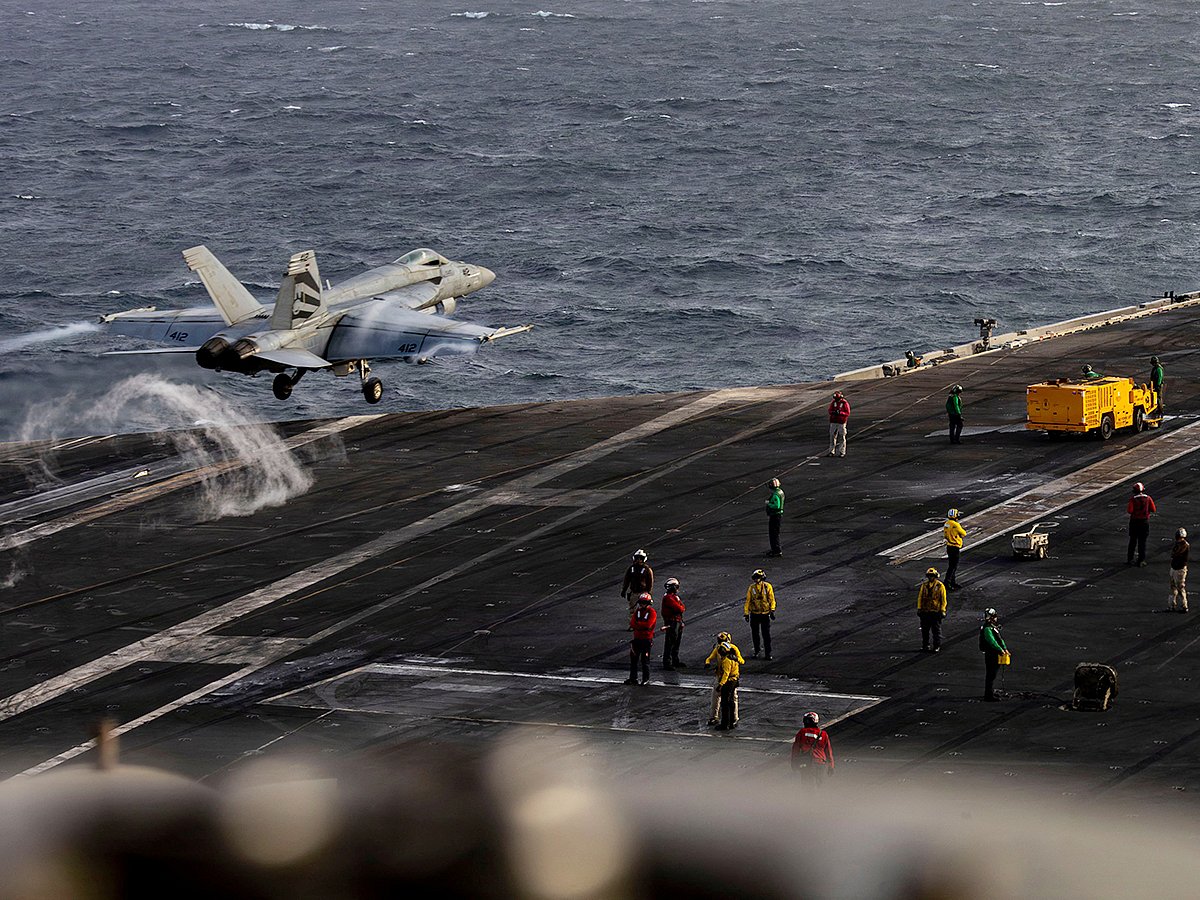
File photo: An F/A-18E Super Hornet launching from the flight deck of Nimitz-class aircraft carrier USS Abraham Lincoln.
US Navy/AFP
Tensions between the US and Iran are escalating as Washington threatens tougher economic measures and the Strait of Hormuz remains at the centre of the crisis. The UAE has condemned attacks on two ADNOC vessels while commercial shipping faces growing risks in the vital waterway. Follow our live coverage for the latest updates on the conflict, diplomatic efforts, shipping and energy markets:
US‑Israel war on Iran: Recent developments
Day 160: Tehran reshuffles military
Day 159: Netanyahu rejects Gaza plan
US military launches Falcon Strike, first-ever drone force
On Aug. 13, US Central Command (CENTCOM) announced efforts to establish the first-ever multi-domain, multinational attack drone task force.
The unit, called Task Force Falcon Strike, will employ one-way attack drones consisting of unmanned systems from above, on, and below the sea operated by military support staff from the United States and regional partners.
Falcon Strike’s launch occurs nine months after CENTCOM established Task Force Scorpion Strike, the US military's first dedicated one-way attack drone squadron in the Middle East.
Get updated faster and for FREE: Download the Gulf News app now - simply click here.
Trump announces tariffs of up to 100% on imported drones
President Donald Trump announced on Thursday tariffs of up to 100 percent on imports of unmanned drones and their components to reduce US reliance on imports in an industry dominated by China.
The US president justified the decision on national security grounds, according to a White House statement, detailing a 100 percent duty rate on the import of certain unmanned aircraft systems, including those with a take-off weight of more than 25 kilograms and with national security capabilities such as thermal imagers and docking stations.
Smaller drones face a 25 percent tariff.
US sends USS George Washington to Middle East
The US Navy is preparing to send the aircraft carrier USS George Washington to the Middle East to relieve the USS Abraham Lincoln, whose deployment has stretched to more than eight months as the Iran war continues. The rotation, reported by the Wall Street Journal, was planned before the latest concerns about conditions aboard the Lincoln, but its timing has put a spotlight on the extraordinary strain of keeping a carrier and its crew at sea for so long.
The Lincoln has gone roughly 200 days without a port call, far longer than the typical 30-to-45-day interval often expected between port visits. The USS George Washington has been operating in the Western Pacific and was recently in Vietnam. It has since moved west through the Strait of Malacca toward the Indian Ocean and Middle East, according to US Navy tracking and reporting.
Two ADNOC vessels attacked in Strait of Hormuz; no injuries
ADNOC confirmed that two of its vessels were attacked while transiting the Strait of Hormuz in the evening of Thursday, August 13, according to official news agency WAM.
The incident resulted in no injuries, and the situation has been brought under control. In a statement, ADNOC stressed the importance of protecting the safety and well-being of seafarers, while safeguarding freedom of navigation and maritime security.
The company urged the public to obtain information solely from official sources and to avoid circulating rumors or unverified information.
Get updated faster and for FREE: Download the Gulf News app now - simply click here.
Saudi Crown Prince, US Admiral Brad Cooper discuss defence cooperation
Saudi Crown Prince and Prime Minister Mohammed bin Salman met with US Central Command (CENTCOM) Commander Admiral Brad Cooper, the official state news agency SPA reported early Thursday. They discussed Saudi-US defence cooperation, recent regional developments, and efforts to de-escalate tensions while enhancing security and stability in the region. SPA issued the statement confirming the meeting in Jeddah. The Saudi embassy in the US also relayed the SPA statement.
39 countries join Saudi-led maritime defence coalition
Representatives from 39 countries took part in the third planning meeting of the Saudi-led Multinational Maritime Defence Coalition (MMDC) in Jeddah on Thursday, as the group moves closer to becoming an operational maritime security force.
The meeting at the Western Fleet Command brought together countries involved in the coalition's formation. Fifteen have signed a joint statement, while 13 have completed their domestic procedures, signed the MMDC charter and formally joined the coalition, according to Saudi state news agency SPA.
The remaining participating countries are still completing national approval procedures. The development marks a shift from designing the coalition to building its operational command and integrating military personnel and capabilities, the agency reported.
Pakistan government hikes petrol, high-speed diesel prices
The Pakistan government has increased the prices of petrol and high-speed diesel (HSD), with the revised rates coming into effect from Friday, according to Pakistan-based daily DAWN.
Petrol prices have been raised by Rs 0.45 per litre to Rs 325.43 per litre, while HSD prices have gone up by Rs 1.16 per litre to Rs 383.95 per litre.
The government continues to levy Rs 114 per litre in taxes and duties on petrol and Rs 100 per litre on diesel, according to the Petroleum Division's notification cited by DAWN.
The latest revision comes amid continued fluctuations in international oil prices following renewed hostilities involving Iran and the United States.
HSD prices have declined significantly from their peak of Rs 520.35 per litre recorded on April 3. The price had risen from Rs 281 per litre after the US-Iran conflict broke out on February 28. Similarly, petrol prices had peaked at Rs 458.41 per litre on April 3, after beginning their upward trajectory from Rs 266 in the first week of March.
Earlier, Pakistan Petroleum Minister Ali Pervaiz Malik had announced that fuel prices would be determined on a daily basis in view of volatility in international markets.
The minister said the Cabinet and Prime Minister had decided to give the Oil and Gas Regulatory Authority (OGRA) the responsibility of determining fuel prices daily based on international market trends.
The decision to shift to daily pricing was opposed by the All Pakistan Dealers Association, which said it would consider a protest plan.
US vows Iran will face ‘unprecedented’ economic isolation
US Treasury Secretary Scott Bessent threatened to subject Iran to economic isolation "like the world has never seen before," adding that new measures are expected next week.
"It will be a combination of economic isolation, like the world has never seen before," Bessent told conservative television network Newsmax, adding that "the continued blockade in the Strait of Hormuz... will keep anything from going in or out of the Iranian ports."
Get updated faster and for FREE: Download the Gulf News app now - simply click here.
US says Hormuz oil flows higher than tracked
US Energy Secretary Chris Wright said 8 million to 9 million barrels of oil are still moving through the Strait of Hormuz each day, disputing estimates that traffic has collapsed during the Iran conflict. He said many vessels are travelling under military escort with their tracking systems switched off, making commercial estimates incomplete.
Wright said about 14 million to 15 million barrels of oil a day are currently leaving the Arabian Gulf region, compared with around 20 million before the conflict, with another six million barrels diverted through pipelines. He said Iran’s ability to disrupt shipping is declining as US escorts expand, but acknowledged petrol prices remain high at about $4 a gallon.
Bahrain condemns attack on UAE-linked ADNOC tankers
Bahrain has condemned the Iranian attack on two tankers affiliated with the UAE’s ADNOC company in the Strait of Hormuz.
Bahrain said it strongly rejects the targeting of commercial vessels and described the attack as a threat to maritime security and the safe passage of ships through the strategic waterway.
The condemnation comes amid heightened tensions in the Strait of Hormuz, a key route for global energy shipments.
Strait of Hormuz sees slight rise in ship traffic: Report
Shipping traffic through the Strait of Hormuz remained below its August average amid continued US-Iran tensions, Reuters reported. Kpler data showed nine commodity vessels crossed the strait on Thursday, up from five the previous day but below the daily average of 12.
Meanwhile, 19 vessels with active transponders passed through Bab el-Mandeb, compared with 20 the previous day. The figures exclude vessels travelling with their transponders switched off.
Tanker struck by drone while transiting Strait of Hormuz
A tanker was struck by an uncrewed aerial vehicle (UAV) while travelling outbound through the Strait of Hormuz, the UK Maritime Trade Operations (UKMTO) said on Friday.
According to a warning issued by UKMTO, the incident was reported by military authorities. The vessel sustained minor damage, while all crew members were reported safe and accounted for.
No environmental impact was reported following the incident.
UKMTO advised vessels transiting the Strait of Hormuz to exercise caution and report any suspicious activity to the maritime security organisation.
US sailors hit by strain of long aircraft carrier deployment
Some sailors have reportedly tried throwing themselves into the sea, basic supplies can run short and sanitation is going awry: life on America's giant Abraham Lincoln aircraft carrier is increasingly difficult as the Iran war drags on.
The ship - now in its ninth month of deployment - is expected to be replaced in the Middle East by another carrier, the George Washington, in a move sure to be welcomed by the Lincoln's crew and their loved ones.
But concerns about conditions on the Lincoln have prompted lawmakers to demand answers from Pentagon chief Pete Hegseth, who insists the situation has been "misrepresented."
Jonathan Schroden, chief research officer at the Center for Naval Analyses, said the warship's sailors face significant challenges from their long time at sea.
"Even in peacetime conditions, the quarters are cramped, the workdays are long, the food is not great, and it's difficult to get fresh air, exercise and even a decent night's sleep," Schroden said.
"Add to that the stress that comes with being involved in combat operations - in which your ship is constantly threatened - and you can see how difficult life becomes for these sailors," he said.
Schroden noted that carrier strike groups are generally designed for six-month deployments for reasons "including sailor welfare."
Going beyond that "creates all kinds of compounding problems that the Navy then has to deal with down the line."
This includes increased maintenance costs and decreased readiness windows while ships are prepared to deploy again, he said.
Of special concern are accounts of suicide attempts aboard the Lincoln, with the Navy Times reporting this week that two sailors tried to jump off the ship.
Schroden said he had seen "reports of similar events occasionally over the past couple of decades" and that "it's rare but not unheard of, though tragic in every case."
The US Navy did not immediately provide answers to questions from AFP, but US Central Command posted on X that the crew "remain resilient and resolved after more than 260 days at sea."
It added that no service members aboard the carrier have died and one sailor who fell overboard on August 3 "was quickly and safely recovered."
Iran President Pezeshkian to travel to Delhi for BRICS Summit
Iranian President Masoud Pezeshkian will travel to New Delhi to attend the upcoming BRICS Summit, Iranian sources said.
Pezeshkian's participation in the summit is scheduled to be held in the national capital in September.
The visit assumes significance as India is hosting the 18th BRICS Summit under its 2026 chairship. The summit will be held under India's theme of "Building for Resilience, Innovation, Cooperation and Sustainability". India assumed the BRICS chairship from Brazil at the beginning of 2026.
In October 2024, Pezeshkian met Prime Minister Narendra Modi on the sidelines of the BRICS summit in Kazan, Russia, where the two leaders discussed bilateral and regional issues.
Iran became a full member of BRICS in 2024, along with Egypt, Ethiopia and the United Arab Emirates. Indonesia joined the grouping in 2025, taking the total number of full members to 11.
Get updated faster and for FREE: Download the Gulf News app now - simply click here.
GCC condemns Iranian attack on ADNOC vessels
Jasem Mohamed Albudaiwi, Secretary-General of the Gulf Cooperation Council (GCC), has condemned the Iranian attack on two ADNOC tankers in the Strait of Hormuz.
In a statement, Albudaiwi said the GCC “strongly condemns the brutal Iranian attack”, warning that repeated attacks on maritime navigation, facilities and property represent an unacceptable escalation and a serious violation of international law.
He also stressed the need to protect maritime security and uphold international law amid rising tensions in the strategic waterway.
Pakistan deputy PM says Islamabad MoU is ‘only way forward’
Pakistan’s Deputy Prime Minister and Foreign Minister Ishaq Dar has told US Chargé d’Affaires Natalie Baker that implementing the Islamabad Memorandum of Understanding (MoU) “in letter and spirit” is the only way forward.
Dar said discussions with Baker in Islamabad focused on Pakistan-US bilateral cooperation and recent regional developments.
According to Dar’s office, he welcomed the positive trajectory in relations between the two countries and stressed the importance of dialogue and diplomacy in achieving lasting peace.
Baker, meanwhile, appreciated Pakistan’s constructive role in promoting regional peace and stability, according to the statement.
Saudi Arabia strongly condemns targeting of ADNOC tankers
Saudi Arabia has strongly condemned and denounced the targeting of two ADNOC tankers while transiting the Strait of Hormuz, describing the incident as an unacceptable recurrence of Iranian attacks targeting commercial vessels and tankers.
In a statement carried by the Saudi Press Agency (SPA), the Saudi Ministry of Foreign Affairs said that the recurrence of such attacks represents a dangerous escalation and a direct threat to the security and safety of maritime navigation and global energy supplies.
The ministry said the attacks constitute a grave violation of international laws and norms and a blatant challenge to UN Security Council Resolution 2817, which affirmed the need to respect the rights and freedom of navigation of commercial vessels through the Strait of Hormuz and condemned any measures or threats that could impede such navigation.
Saudi Arabia held Iran fully responsible for the consequences of continuing these attacks, calling on the country to immediately halt such violations and respect relevant international law. The Kingdom stressed that regional security and the safety of international navigation are a shared responsibility, adding that the continuation of such attacks is unacceptable and cannot be tolerated.
The Kingdom reiterated its full solidarity with the United Arab Emirates and its support for the measures taken by the UAE to safeguard its sovereignty, security and national assets.
Only 13 vessels crossed Strait of Hormuz on Thursday: Kpler
Shipping traffic through the Strait of Hormuz remains severely limited, with just 13 vessels crossing the strategic waterway on Thursday, according to maritime intelligence firm Kpler.
The figure was slightly higher than the nine vessels recorded on Wednesday, but remains far below normal levels and contrasts with US President Donald Trump’s recent claims that the strait is “open” and under US control.
Of the 13 vessels recorded on Thursday, nine used an Iranian-approved shipping route, despite US warnings against taking the route. The remaining four had their tracking transponders switched off, making their routes unclear.
Get updated faster and for FREE: Download the Gulf News app now - simply click here.
Qatar condemns targeting of ADNOC tankers
Qatar has strongly condemned the Iranian attack targeting two Emirati oil tankers affiliated with ADNOC while they were transiting the Strait of Hormuz.
The Qatari authorities denounced the targeting of the commercial vessels, amid growing concerns over the safety of maritime navigation and energy shipments through the strategic waterway.
Qatar’s condemnation comes after similar statements from several Gulf and Arab countries following the attacks on the UAE-linked vessels.
Jordan condemns attack on ADNOC tankers
Jordan condemned on Friday the Iranian attack targeting two tankers operated by ADNOC while transiting the Strait of Hormuz, describing it as a flagrant violation of international law and a threat to the security and safety of maritime navigation.
In a statement carried by the Jordan News Agency (Petra), the Ministry of Foreign and Expatriates Affairs affirmed Jordan's rejection and condemnation of the attack, stressing the Kingdom's full solidarity with the United Arab Emirates and its complete support for all measures taken by the UAE to safeguard its security, stability and national resources.
Stocks mixed as oil climbs, dollar drops
Major stock markets traded mixed in sparse summer trading Friday, with oil prices edging higher and the dollar slipping as investors assess the outlooks for US interest rates and the war in the Middle East.
Data this week showing cooler inflation in the United States has bolstered expectations that the Federal Reserve will not rush to raise borrowing costs, potentially crimping growth.
But with the US-Iran conflict showing little sign that it could soon end, worries about stubborn inflation dominated attention across markets.
Energy prices on markets have in recent weeks swung between big gains and losses as resurgent strikes in the Middle East give way to hopes of a peace deal, and vice versa.
Away from the war, the technology sector continues to occupy the attention of stock markets.
Seoul gained more than two per cent Friday as shares in the chipmakers SK hynix and Samsung recovered further following last month's selloff.
Friday also saw gains for Tokyo, where tech giants Kioxia, Advantest and Sony rallied along with the technology investment titan SoftBank.
Singapore, Jakarta, Bangkok, Manila and Wellington were also up, while Hong Kong, Sydney, Taipei and Mumbai slipped and Shanghai ended little changed.
In European midday deals, London dipped while Paris and Frankfurt rose, following gains on Wall Street on Thursday that saw the S&P 500 again hit a record high.
Arab League condemns Iranian attack on two UAE tankers
The League of Arab States condemned Iran's targeting of two tankers belonging to the United Arab Emirates while they were transiting the Strait of Hormuz on Thursday evening, describing it as a blatant and unacceptable violation of international law and UN Security Council Resolution 2817.
In a statement on Friday, the League stressed that the recurrence of such Iranian violations poses a direct threat to freedom of maritime navigation and carries serious repercussions for international trade and global energy security.
It emphasised the need to respect the rules of international law and the law of the sea, calling on Iran to halt such escalatory actions and refrain from any practices that could threaten the security and safety of maritime navigation.
Arab Parliament condemns Iranian attack on two UAE tankers
Mohammed Ahmed Al Yamahi, President of the Arab Parliament, strongly condemned Iran's blatant targeting of two tankers belonging to UAE company ADNOC while they were transiting the Strait of Hormuz.
He stressed that repeated attacks on commercial vessels and international maritime routes constitute a dangerous escalation, a threat to regional security and stability and global energy security, and a flagrant violation of international law and relevant UN Security Council resolutions.
In a statement on Friday, Al Yamahi stressed that the security of international maritime routes, freedom of navigation and safe passage are not subject to compromise or political pressure.
Get updated faster and for FREE: Download the Gulf News app now - simply click here.
He warned that continued targeting of commercial vessels in the Strait of Hormuz would threaten the safety of international navigation and have serious repercussions for global trade, energy security and market stability, with consequences extending beyond the region.
Al Yamahi reiterated the Arab Parliament's full solidarity with the United Arab Emirates and its support for the country in confronting any attacks targeting its security, sovereignty and interests.
He also affirmed support for all legitimate measures taken by the UAE to protect its security and the safety of its citizens and property, stressing that the security and stability of the Arab Gulf states are an integral part of the security and stability of the Arab region.
Iraqi daily oil exports in August highest since start of war
Iraq's average daily oil exports since the beginning of August are the highest since the outbreak of the Middle East war between Iran and the United States, which has choked off the Strait of Hormuz, the oil ministry said Friday.
Iraqi Oil Minister Bassem Mohammed Khudair told a press conference that "exports since the beginning of the month have reached a rate of two million barrels" per day, for a total of around 26 million barrels, saying the daily rate was achieved "for the first time since the crisis began".
US loses nearly 25% of Reaper drone fleet in Iran war
The US lost a minimum of 45 MQ-9 Reaper surveillance and attack drones during its conflict with Iran, representing nearly one-fourth of its operational fleet and potentially incurring a financial loss exceeding $1.3 billion for taxpayers, according to a report by The Washington Post, citing US officials.
Clarifying the losses, an official told the newspaper that not all aircraft were downed by hostile fire, as a number of them crashed following a breakdown in the communication link between the drone and its operators.
As per the report, the US possessed nearly 185 Reapers when the conflict commenced on February 28, with 165 units assigned to the Air Force and 20 to the Marine Corps. Notably, no losses were recorded among the Marine Corps fleet, which primarily operates across the Asia-Pacific region.
Engineered by General Atomics, the MQ-9 Reaper serves as a remotely piloted platform employed for reconnaissance and targeted strikes. Since its induction by the US armed forces in 2007, the unmanned aerial vehicle has seen widespread deployment in counterterrorism missions alongside operations in the Middle East, Afghanistan and Iraq.
The unit cost of an individual Reaper ranges from $30 million to $50 million, contingent upon installed hardware and armaments. International export bundles can cost significantly more when incorporating ground control networks, satellite linkages and munitions.
The Post reported that several Reapers were shot down while operating mainly over the Strait of Hormuz. US officials were reportedly surprised by the precision of the attacks.
US consumer sentiment drops as Iran war fuels inflation fears
US consumer sentiment dropped sharply in August, new data showed Friday, ending months of recent gains as prolonged inflation and uncertainty over the US war against Iran hit the economy.
"Consumer sentiment fell about 8 per cent this August, ending two consecutive months of improvement," said University of Michigan survey director Joanne Hsu.
Preliminary data showed consumer sentiment came in at 51.0 points, down from 55.2 and well off from market expectations.
The war has sent inflation - already elevated from the US Federal Reserve's long-term two-percent target - surging, and has hit US households battered by years of high prices hard.
Expectations for inflation in the year ahead ticked up from 4.2 per cent in July to 4.3 per cent in August, the survey showed.
Get updated faster and for FREE: Download the Gulf News app now - simply click here.
Oil spill reaches Qeshm Island’s coast and mangroves
About 3.2 hectares of coastline and nine hectares of coastal waters around Iran’s Qeshm Island have been affected by oil pollution, state news agency IRNA reported on Friday.
Earlier this week, reports said oil had reached mangrove forests along the island’s southern coast. Iranian authorities said the source of the pollution was still under investigation.
US forces redirect 62 vessels amid blockade
US Central Command said on Friday that its forces had redirected 62 commercial vessels, disabled three and boarded two others as of August 14 while enforcing the US blockade against Iran.
Houthis target Saudi Aramco oil facility with drone
Yemen's Houthi rebels said on Friday that they had targeted an oil facility belonging to Saudi Arabia's state petroleum company Aramco with a drone, the group's Saba press agency reported.
A military source quoted by the agency said the Iran-backed group had attacked a site in Najran, in southwest Saudi Arabia, "by means of a drone, and the operation achieved its objective".
Iran calls on US to accelerate withdrawal from Middle East
Iranian parliament’s National Security and Foreign Policy Committee Chairman Ebrahim Azizi said on Friday that the United States should “leave the region” and speed up its withdrawal, Iranian media reported.
“The Americans should leave the region without any doubt and accelerate this withdrawal,” Azizi said before Friday prayers in Shiraz, southern Iran.
He also urged regional countries not to rely on Washington for security, saying the US military presence in the region had brought “nothing but insecurity”.
We are closing this live coverage. For the latest updates, click here:
Sign up for the Daily Briefing
Get the latest news and updates straight to your inbox
Network Links
GN StoreAbout Gulf NewsTerms & ConditionsReach by GNSitemapContact usPrivacy PolicyGN FocusHave your sayWork with usAdvertise with usGulf News epaperPrinting Services
Download our app
© Al Nisr Publishing LLC 2026. All rights reserved.