Houthis claim drone attack on Saudi Aramco refinery, US unveils drone task force
Iran rejects Donald Trump’s ‘total control’ claim as US blockade redirects more vessels
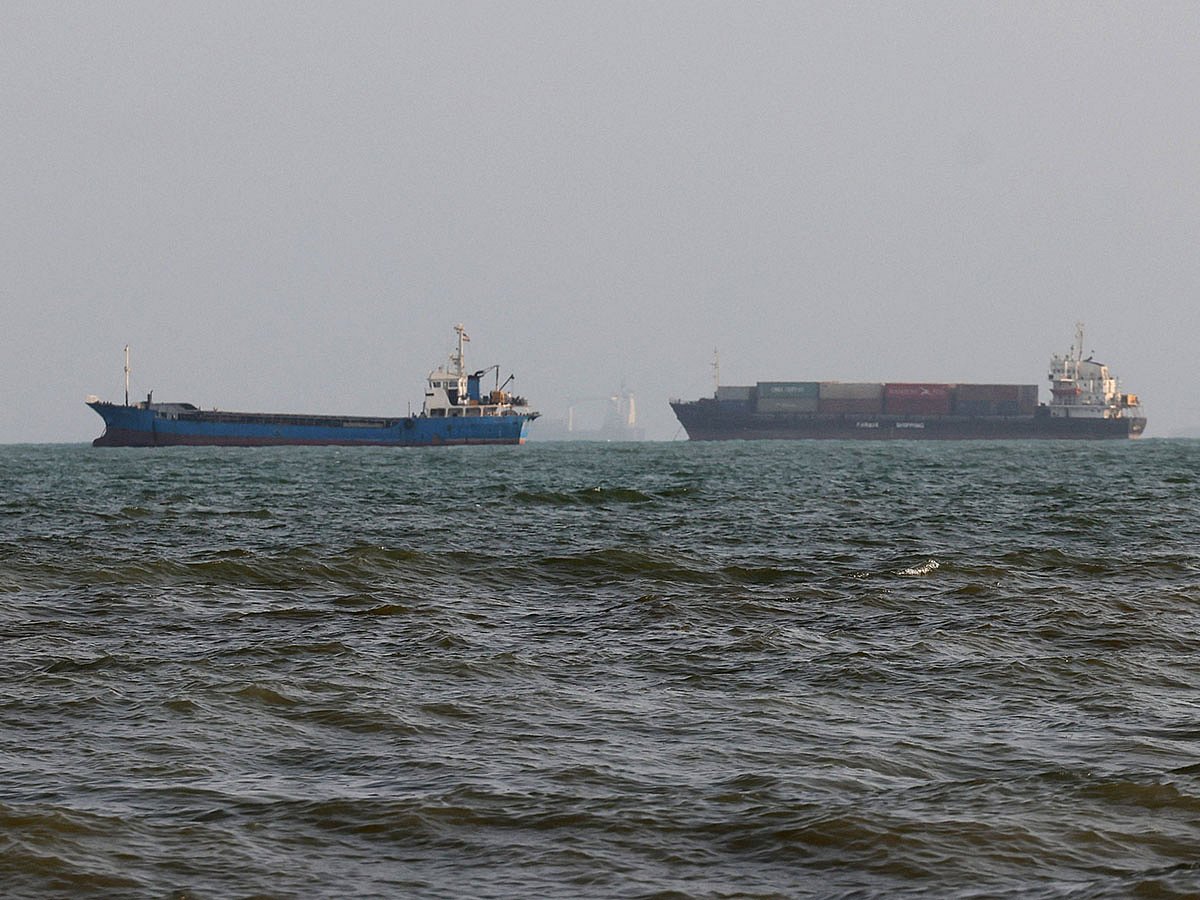
Israeli strikes killed two in Gaza in a second day of bombardment, as the Arab League warned of a widening conflict. Iran rejected Trump's claim of "total control" over the Strait of Hormuz and demanded compensation for the Qeshm oil spill, while Houthis claimed a drone strike on a Saudi Aramco refinery. Kuwait foiled an IS-linked mosque plot, and the US military unveiled its first multinational drone task force. Stay with us for the latest.
Day 160: Tehran reshuffles military
Day 159: Netanyahu rejects Gaza plan
US President Donald Trump was secretly moved from the Air Force One after US officials identified a specific and credible threat involving an Iranian-linked group in Turkey, US media reported.
New details from the New York Times reported just how serious the Iranian threat was to Air Force One, including a surface-to-air missile threat against the plane. CNN, meanwhile, reported that the threat involved a shoulder-fired missile and was serious enough to prompt the Secret Service and military to devise a covert evacuation plan. Another report stated the Iranians knew where he was staying in Ankara.
Trump switched planes via catering truck on his way back from Turkey via the UK.
The US Central Command (CentCom) said that US forces have redirected 59 commercial vessels, disabled three and boarded two others as part of efforts to enforce a blockade against Iran.
The command stated: "As of August 12, US forces have redirected 59 commercial vessels, disabled 3 and boarded 2 to ensure full compliance with the blockade." Earlier in the day, President Donald Trump claimed that the US exercised "total control" over the Strait of Hormuz, and he "will keep it" amid stalled negotiations with Iran regarding the reopening of the strategic conduit.
World oil demand is forecast to decline by 1.6 mb/d in 2026, 510 kb/d more than estimate in last month’s report, as the ongoing closure of the Strait of Hormuz and elevated fuel prices continue to weigh on oil consumption, according to the International Energy Agency (IEA) Oil Market Report (OMR) for August, released on Wednesday (August 12, 2026). The monthly report noted that annual contractions will nevertheless ease from 4.9 mb/d in 2Q26 to 2.8 mb/d in 3Q26, before returning to growth in the final quarter. Global oil demand is projected to expand by 2.4 mb/d in 2027.
US natural gas production is on track to hit a new annual record in 2026, with output forecast to average 122.5 billion cubic feet per day (Bcf/d), according to the latest Short-Term Energy Outlook (STEO) from the US Energy Information Administration (EIA). That would eclipse the previous annual record of 118.5 Bcf/d set in 2025, marking an increase of about 4 Bcf/d, or 3.4%, in just one year.
Iran has rejected President Donald Trump's claim that the United States has "total control" over the Strait of Hormuz, saying the strategic waterway remains blocked and will not be reopened until Tehran's conditions are accepted. The Iranian regime said Trump's claims and repeated statements by US officials that the Strait of Hormuz was no longer blocked did not change the situation. "Claims and repeated posts by US officials that the Strait of Hormuz is no longer blocked do not change the reality: the Strait of Hormuz remains blocked and will not be reopened until Iran's conditions are accepted," the PGSA said.
Four more Iran-linked ships were "redirected" by the US Central Command on Wednesday as American forces continue to enforce the “steel wall” naval blockade against Iran.
This brings the total of ship redirections to 59 commercial vessels, 3 “disabled”, and 2 boarded as of August 12, 2026.
The previous day’s figures (August 11) stood at 55 redirected, 3 disabled, and 2 boarded, indicating continued interdiction activity.
The blockade targets vessels attempting to enter or leave Iranian ports and coastal areas. CentCom has repeatedly stated that the Strait of Hormuz itself remains open for neutral transit to or from non-Iranian destinations, with US forces assisting commercial traffic through the waterway while enforcing restrictions solely on Iran-bound or Iran-origin shipping.
Yemen's Houthis announced new military operations targeting Saudi assets, including a direct strike on a military transport vessel in the Red Sea and coordinated strikes on key Saudi-backed positions inland, according to Press TV.
The military spokesperson of the Houthis said in a statement that the rebel group "successfully targeted Saudi enemy troop concentrations, weapons depots, and command centres in the Mocha area and the Tadawin camp in Marib Governorate with a large number of ballistic missiles and drones. The strikes were precise and resulted in dozens of casualties, including Saudis".
It further added that the "group will continue their operations targeting all Saudi troop concentrations through which they seek to escalate tensions and seize control of our beloved country".
Congressional Democrats demanded answers Wednesday about conditions aboard the USS Abraham Lincoln, following reports of food shortages, broken plumbing and mental health crises during the aircraft carrier's record-setting deployment.
In a letter to Defense Secretary Pete Hegseth Wednesday, Senator Richard Blumenthal called for the Navy to account for conditions aboard the aircraft carrier, which "has been deployed more than 250 days" without coming ashore "in over 200 days, setting a record for consecutive days at sea."
Blumenthal voiced concern for such extended deployments, noting "widespread reports of shortages of basic supplies, water contamination, plumbing issues, deteriorating mental health, deck safety concerns" and other problems aboard the Lincoln.
Senator Ruben Gallego called for "an official oversight visit with the bipartisan Senate Delegation to the USS Lincoln to investigate the reported alarming conditions," in a post on X.
The USS Abraham Lincoln departed San Diego, California on November 21, 2025 for duty in the South China Sea and was rerouted to the Middle East before US-Israeli attacks on Iran that began February 28.
In two recent meetings, family members clashed with Navy leadership over the difficult conditions - including food shortages - faced by the 5,000 sailors and Marines aboard the Lincoln and demanded to know when loved ones would return home, MSNOW reported.
Some reported severe mental health issues and attempted suicides on board.
"The stories of crew members threatening to jump off the ship are a frightening alarm bell as to how bad the situation has become: moldy showers, sporadic hot water, rationed meals and soap, broken toilets, and grueling 12- to 16-hour shifts with no days off," Gallego wrote in his post Wednesday, adding that he has served in active duty himself.
"The way (US President Donald Trump) is treating our service members as he carries out this illegal war is not just disgusting, it's dangerous."
More than 30 nations, including France, Britain and Canada, have condemned Iran's use of capital punishment, saying in a joint statement on Wednesday the Islamic republic was executing protesters to "silence dissent".
The countries, joined by the European Union's top diplomat, "condemn in the strongest terms the ongoing executions of protesters and use of the death penalty" by Iran.
"The use of capital punishment to silence dissent, intimidate communities, and punish individuals exercising their human rights can never be justified," the statement said.
"The people of Iran must be free to exercise their rights to freedom of expression and peaceful assembly without fear."
After the initial 26 countries and the EU foreign policy chief Kaja Kallas, "other countries joined this declaration", bringing the number of signatories to 32, the French foreign ministry told AFP.
Australia, New Zealand, Ireland, Italy, Germany and numerous other European nations were among those calling for Iran "to immediately end the use of the death penalty and release all those arbitrarily detained".
Iran's foreign minister brushed off the criticism, saying: "Countries like France should stop lecturing the world about 'human rights' and international law. The hypocrisy is blatant and embarrassing.
"Your backing of Israel's genocide in Gaza - and aggression against Iran - has destroyed whatever moral high ground you imagined you had," Abbas Araghchi posted on X.
The joint statement joins growing alarm from the United Nations and rights groups over a surge in executions in recent months, after Iran was rocked by nationwide anti-government protests earlier in the year and the start of the Middle East war in February.
Iranian Foreign Minister Seyed Abbas Araghchi on Thursday hit back at France, 25 other countries and the European Union after their condemnation of the alleged executions of protesters in Iran, accusing them of hypocrisy and saying their support for Israel amid the Gaza conflict and its military action against Iran had undermined their claims to the moral high ground.
In a post on X, Araghchi said that France should refrain from lecturing others on human rights and international law, accusing them of "blatant" hypocrisy.
"Countries like France should stop lecturing the world about "human rights" and international law. The hypocrisy is blatant and embarrassing. Your backing of Israel's genocide in Gaza--and aggression against Iran--has destroyed whatever moral high ground you imagined you had," the post read.
US intelligence officials had low confidence in an Iranian threat against US President Donald Trump before he was secretly moved to an alternate aircraft while departing Turkey after the NATO Summit last month, according to a report by The Washington Post.
The alleged assassination threat was reportedly relayed to the CIA by Israel, but agency analysts did not consider the intelligence compelling and communicated their reservations to officials in the Trump administration, The Washington Post reported.
One US official described the reports as "Israeli-derived, not US-generated, and viewed as low confidence," according to The Washington Post.
Despite the doubts over the credibility of the intelligence, the US Secret Service proceeded with an elaborate security operation during Trump's departure from the NATO summit in Ankara on July 8.
According to The Washington Post report, Trump initially boarded a legacy Air Force One aircraft before secretly being moved to an Air Force C-32A.
Get updated faster and for FREE: Download the Gulf News app now - simply click here.
Iranian Foreign Minister Seyed Abbas Araghchi on Thursday hit back at US President Donald Trump's claim that Washington has "total control" over the Strait of Hormuz, accusing the US of repeated intelligence failures and warning against what he described as a bigger miscalculation over the strategic waterway.
In a post on X, Araghchi accused the US of repeatedly making miscalculations due to intelligence failures, citing the war with Iran as an example.
He warned that Washington could be making an even bigger mistake over the Strait of Hormuz and urged caution, saying that "fake intelligence" could be more dangerous than fake news.
"The US has long miscalculated due to intelligence failures. Case in point: The war on Iran. Now, an even bigger miscalculation on the Strait of Hormuz. Worse than fake news is fake intelligence. Be careful. Allah is Great, Greater than ANY power on Earth. In Allah we trust," the post read.
Kuwait has arrested three Islamic State group members accused of plotting attacks on a Shia mosque as well as "vital facilities", a security source told AFP.
The trio belonged to a single IS cell and included minors, the Kuwaiti source said, requesting anonymity. They had intended to target the mosque and unspecified sites deemed vital to the country.
Earlier this week Kuwait's interior ministry said it had arrested two minors who had been in touch with IS and received training on making explosives to target a place of worship.
A day later, the ministry said it had arrested a Kuwaiti member of IS who had built a drone to attack a "vital facility".
Since the start of the Middle East war, Gulf countries including Kuwait have arrested dozens of people from cells suspected of links to Iran, mostly Shia Muslims, as the region came under Iranian bombardment.
About one-third of Kuwait's population belongs to the Shia branch of Islam, as do most Iranians, while Gulf natives are largely Sunnis.
Iran's military on Thursday rejected as "lies" remarks by US President Donald Trump claiming control of the Strait of Hormuz, saying the strategic waterway was fully under Iranian control.
"The false claims of the United States that ships are passing through the Strait of Hormuz normally ... are nothing more than lies and fabrications," said Ebrahim Zolfaghari, the spokesperson for Iran's central military command, Khatam-al Anbiya.
"The Strait of Hormuz is, as in the past, under the complete management and control of the Islamic Republic of Iran, and no commercial ship or tanker without the permission and supervision of the powerful Iranian armed forces has had and will have the possibility of safe passage through this strait," he said in a video carried by state television.
Iran warned on Thursday of environmental degradation in the Strait of Hormuz after an oil spill reached its southern Qeshm island, calling for compensation from those responsible.
Foreign ministry spokesman Esmaeil Baqaei said the slick had "degraded the waters" of the Gulf and Sea of Oman, claiming "preliminary evidence indicates a foreign bulk carrier as the source".
TankerTrackers, a US-hosted website that monitors shipping movements worldwide, said however that the spill seemed to derive from an Iranian attack on bulk carrier Minoan Pioneer in Omani waters on August 3.
"The spillage then drifted across the strait over to Iran," it said.
Baqaei wrote on X that such spills have in "recent decades imposed trillions of dollars in damage on Iran's coastal areas", calling for compensation.
"Every party that benefits from commercial shipping through the Strait of Hormuz carries both a legal and a moral obligation to remediate the environmental harm inflicted," he added.
Yemen's Houthi rebels on Thursday claimed a drone attack on an Aramco refinery in southern Saudi Arabia, the group's affiliated news agency Saba reported.
"A military source confirmed that the Yemeni Armed Forces targeted an Aramco refinery in the Jizan region using two drones, achieving a precise hit by the grace of God," Saba reported, referring to Houthi forces.
The agency reported that the source said the strike was a response to a Saudi "violation of Yemeni airspace and the country's sovereignty in the Saada and Hajjah governorates".
Nabil Fahmy, Secretary-General of the League of Arab States, condemned the Israeli escalation in the occupied Palestinian territories and southern Lebanon, warning that its continuation could lead to a widening of the conflict and threaten regional security and stability.
In a statement issued today, Fahmy affirmed that raids, arrests, home demolitions, and settler violence in the West Bank and Jerusalem, along with repeated incursions into Al-Aqsa Mosque, are aimed at imposing a new reality and thwarting the establishment of an independent Palestinian state. He held the Israeli government responsible for these attacks.
Israeli strikes in Gaza killed two people including a senior police officer on Thursday, health officials said, the second straight day of bombardment after a lull due to a US peace push.
The Israeli military said it struck a Hamas commander in the Khan Yunis area who it said had been planning attacks against troops, in the second such targeting in as many days.
"The terrorist was struck in an aerial strike in order to remove the threat to IDF troops," the military said, adding that "steps were taken to mitigate harm to civilians."
Gaza's civil defence agency, which operates as a rescue service under Hamas, said an airstrike west of Khan Yunis killed one person, with the city's Nasser Hospital confirming the arrival of a body following the attack.
On Aug. 13, US Central Command (CENTCOM) announced efforts to establish the first-ever multi-domain, multinational attack drone task force.
The unit, called Task Force Falcon Strike, will employ one-way attack drones consisting of unmanned systems from above, on, and below the sea operated by military support staff from the United States and regional partners.
Falcon Strike’s launch occurs nine months after CENTCOM established Task Force Scorpion Strike, the US military's first dedicated one-way attack drone squadron in the Middle East.
President Donald Trump announced on Thursday tariffs of up to 100 percent on imports of unmanned drones and their components to reduce US reliance on imports in an industry dominated by China.
The US president justified the decision on national security grounds, according to a White House statement, detailing a 100 percent duty rate on the import of certain unmanned aircraft systems, including those with a take-off weight of more than 25 kilograms and with national security capabilities such as thermal imagers and docking stations.
Smaller drones face a 25 percent tariff.
The US Navy is preparing to send the aircraft carrier USS George Washington to the Middle East to relieve the USS Abraham Lincoln, whose deployment has stretched to more than eight months as the Iran war continues. The rotation, reported by the Wall Street Journal, was planned before the latest concerns about conditions aboard the Lincoln, but its timing has put a spotlight on the extraordinary strain of keeping a carrier and its crew at sea for so long.
The Lincoln has gone roughly 200 days without a port call, far longer than the typical 30-to-45-day interval often expected between port visits. The USS George Washington has been operating in the Western Pacific and was recently in Vietnam. It has since moved west through the Strait of Malacca toward the Indian Ocean and Middle East, according to US Navy tracking and reporting.
ADNOC confirmed that two of its vessels were attacked while transiting the Strait of Hormuz in the evening of Thursday, August 13, according to official news agency WAM.
The incident resulted in no injuries, and the situation has been brought under control. In a statement, ADNOC stressed the importance of protecting the safety and well-being of seafarers, while safeguarding freedom of navigation and maritime security.
The company urged the public to obtain information solely from official sources and to avoid circulating rumors or unverified information.
Saudi Crown Prince and Prime Minister Mohammed bin Salman met with US Central Command (CENTCOM) Commander Admiral Brad Cooper, the official state news agency SPA reported early Thursday. They discussed Saudi-US defence cooperation, recent regional developments, and efforts to de-escalate tensions while enhancing security and stability in the region. SPA issued the statement confirming the meeting in Jeddah. The Saudi embassy in the US also relayed the SPA statement.
Representatives from 39 countries took part in the third planning meeting of the Saudi-led Multinational Maritime Defence Coalition (MMDC) in Jeddah on Thursday, as the group moves closer to becoming an operational maritime security force.
The meeting at the Western Fleet Command brought together countries involved in the coalition's formation. Fifteen have signed a joint statement, while 13 have completed their domestic procedures, signed the MMDC charter and formally joined the coalition, according to Saudi state news agency SPA.
The remaining participating countries are still completing national approval procedures. The development marks a shift from designing the coalition to building its operational command and integrating military personnel and capabilities, the agency reported.
We are closing this live coverage. For the latest updates, click here
Sign up for the Daily Briefing
Get the latest news and updates straight to your inbox
Network Links
GN StoreDownload our app
© Al Nisr Publishing LLC 2026. All rights reserved.