An E-2D Hawkeye attached to “Bear Aces” of Airborne Command and Control Squadron (VAW) 124 prepares to land on Gerald R. Ford’s flight deck in the Eastern Mediterranean Sea.
US commanders defend Iran strikes as senators clash over strategy, economic risks
Military claims Iran threat reduced, but lawmakers cite economic, regional risks
Last updated:
2 MIN READ
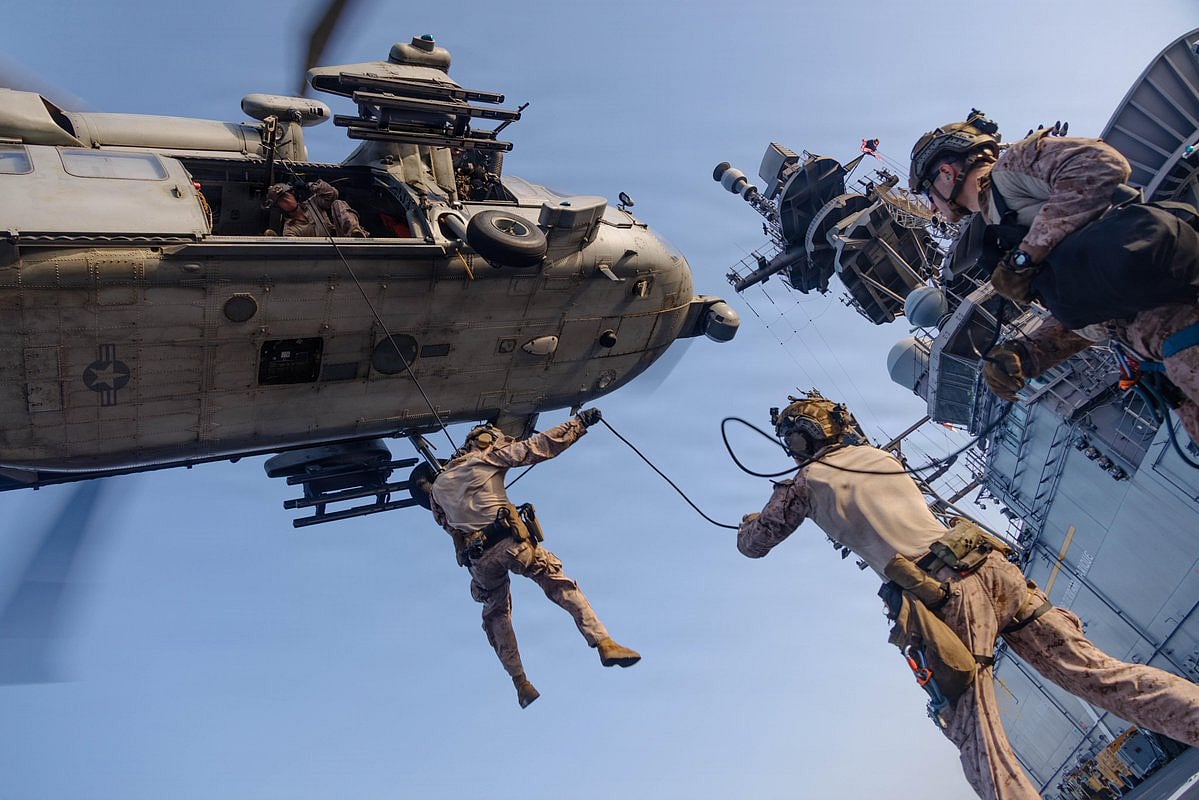
U.S. Marines from the 31st Marine Expeditionary Unit rappel out of an MH-60S Sea Hawk during scheduled training aboard USS Tripoli (LHA 7). Tripoli is one of more than 20 warships supporting the U.S. blockade against Iran. Since the start of the blockade, CENTCOM forces have redirected 72 commercial ships, and disabled 4.
@CentCom | X
Washington: The Trump administration’s Iran campaign came under intense scrutiny at a Senate hearing, with US military commanders claiming Tehran’s military capabilities had been severely degraded even as lawmakers warned of rising economic and regional risks.
Appearing before the Senate Armed Services Committee, Admiral Charles Cooper II defended Operation Epic Fury and said US forces had successfully crippled Iran’s ability to project military power across the Middle East.
“In less than 40 days, Centcom forces achieved our military objectives,” Cooper told lawmakers. “We degraded Iran’s ability to project power outside its borders and threaten the region and threaten our interests.”
Cooper said Iran’s missile, drone and naval industrial infrastructure had been degraded by nearly 90 per cent. He added that Tehran’s navy may not recover to its earlier strength “for a generation.”
Republican lawmakers strongly backed the administration’s military campaign.
Iran's support for terror
Senator Roger Wicker said Iran had spent decades supporting terrorism, attacking US interests and developing nuclear and ballistic missile capabilities.
“The Iranian regime has terrorised the region and made hostility to the United States a core tenet of its rule,” Cooper said during his testimony.
Senator Tom Cotton argued that Iran was now “significantly less of a threat” than before the operation began. Cooper agreed and said Tehran could no longer carry out the kind of mass missile and drone attacks seen in recent years.
But Democrats repeatedly questioned the administration’s strategy and the long-term consequences of the conflict.
Senator Jack Reed said there was “no purely military solution” to the Iranian nuclear issue and criticised the administration for lacking “a credible strategy to win.”
Senator Tim Kaine accused the administration of abandoning diplomacy and warned against another prolonged conflict in the Middle East.
“If you make diplomacy impossible, you will make war inevitable,” Kaine said.
During the hearing, several senators focused on the closure of the Strait of Hormuz and its impact on global trade and oil prices. Lawmakers warned that disruptions in the strategic waterway were already increasing costs for American consumers.
Cooper acknowledged Iran retained “some residual capability” to threaten shipping and infrastructure, though he insisted those capabilities had been “dramatically degraded.”
The hearing also turned to Africa, where General Dagvin Anderson warned that the continent had become “the epicenter of global terrorism.”
Anderson said ISIS and Al Qaeda affiliates were expanding across parts of the Sahel and Somalia while China and Russia were increasing their strategic influence through infrastructure projects, military ties, and information campaigns. He also warned of growing intelligence gaps across parts of Africa.
Sign up for the Daily Briefing
Get the latest news and updates straight to your inbox
Network Links
GN StoreAbout Gulf NewsTerms & ConditionsReach by GNSitemapContact usPrivacy PolicyGN FocusHave your sayWork with usAdvertise with usGulf News epaperPrinting Services
Download our app
© Al Nisr Publishing LLC 2026. All rights reserved.