Pezeshkian
Who is running Iran now? Inside the power shift after Khamenei’s death
Interim council takes charge as IRGC and clerical elite shape succession
Last updated:
4 MIN READ
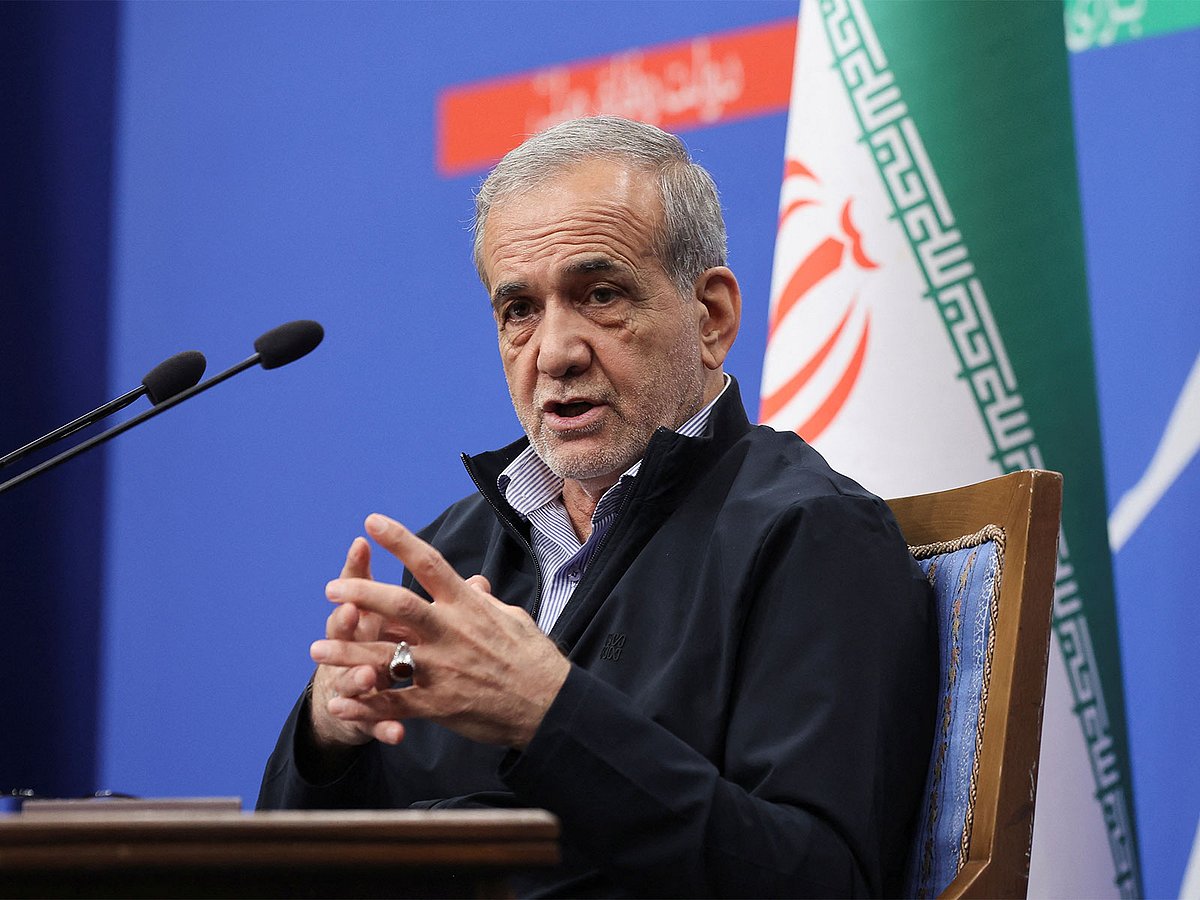
Pezeshkian announced Sunday that a new leadership council “has begun its work,” signaling the start of an interim arrangement to steer the Islamic Republic until a new supreme leader is chosen.
Gulf News file
Dubai: Iran has entered a volatile new chapter following the killing of Supreme Leader Ali Khamenei in joint US–Israeli strikes — a development that has triggered the activation of a constitutional transition mechanism in Tehran.
President Masoud Pezeshkian announced Sunday that a new leadership council “has begun its work,” signaling the start of an interim arrangement to steer the Islamic Republic until a new supreme leader is chosen.
The interim leadership council
Under Iran’s constitution, if the supreme leader dies or becomes incapacitated, authority passes temporarily to a three-member council comprising:
The president
The head of the judiciary
A senior jurist from the Guardian Council
That council now includes:
Masoud Pezeshkian, the reformist president who took office in 2024
Gholamhossein Mohseni Ejei, judiciary chief and longtime regime insider
Alireza Arafi, senior cleric, Guardian Council member and vice president of the Assembly of Experts
Together, they are tasked with ensuring continuity of state operations, security control and oversight of the succession process.
At a glance
President Masoud Pezeshkian confirms interim leadership council has begun work
Council includes the president, judiciary chief, and senior cleric Alireza Arafi
Assembly of Experts must formally choose next supreme leader
IRGC expected to play decisive behind-the-scenes role
Security chief Ali Larijani emerging as key transition figure
The President: Masoud Pezeshkian
At 71, Pezeshkian is the political face of the interim leadership.
A reformist heart surgeon-turned-politician, he took office in June 2024 after his predecessor died in a helicopter crash.
Born in Mahabad to a father of Turkic origin and a Kurdish mother, Pezeshkian has cultivated a reputation as a technocrat with a calm demeanour.
But he now faces the most severe crisis of his presidency.
Since taking office, he has navigated a 12-day war with Israel and widespread protests over rising living costs.
On Sunday, he described Khamenei’s killing as a “declaration of war against Muslims,” framing Iran’s response as a “legitimate duty and right.”
While constitutionally part of the leadership council, Iran’s presidency traditionally wields less authority than the supreme leader — meaning Pezeshkian’s role is significant, but not dominant.
Gholamhossein Mohseni Ejehi
The Judiciary chief: Gholamhossein Mohseni Ejei
Mohseni Ejei, about 68, represents the regime’s hardline institutional backbone.
Born in Isfahan province, he has spent decades inside Iran’s judiciary and security apparatus. Appointed head of the judiciary in 2021 by Khamenei, he previously served as intelligence minister.
In 2010, he was sanctioned by the United States over alleged human rights abuses linked to the crackdown following the disputed 2009 presidential election.
Following Khamenei’s death, Ejei adopted an uncompromising tone, vowing that Iran would never forgive the killing of its “heroic leader.” His presence on the council signals continuity with the security-driven core of the Islamic Republic.
Alireza Arafi
The cleric: Alireza Arafi
At 65, Arafi is the least internationally known of the three — but potentially the most institutionally pivotal.
"The Expediency Discernment Council has elected Ayatollah Alireza Arafi as a member of the interim leadership council," said expediency council spokesman Mohsen Dehnavi in a post on X earlier in the day.
Arafi heads Iran’s centre for managing seminaries, serves as second vice president of the Assembly of Experts, and sits on the Guardian Council — the powerful body that vets candidates and oversees legislation.
His clerical credentials give the interim council religious legitimacy. Having studied in Qom since 1971 and once imprisoned under the Shah, Arafi embodies the ideological continuity of the Islamic Revolution.
Though generally cautious in tone, he struck a defiant note after Khamenei’s death, promising that the nation would “continue along the path of the revolution.”
The security power behind them: Ali Larijani
While not formally a member of the interim trio, Larijani — head of the Supreme National Security Council — is widely viewed as a central power broker.
Born in Najaf in 1957 into a prominent clerical family close to the Islamic Republic’s founder Ruhollah Khomeini, Larijani has held senior posts across Iran’s military, legislature and media establishment.
He is believed to have enjoyed Khamenei’s confidence for years.
On Sunday, Larijani outlined transition plans and vowed forceful retaliation against the United States and Israel, signaling that Iran’s security establishment remains firmly in control during the transition.
But who really holds power?
Formally, the next supreme leader must be chosen by the 88-member Assembly of Experts — a clerical body elected by the public but vetted by regime institutions.
In practice, however, the decisive weight lies with the Islamic Revolutionary Guard Corps.
The IRGC controls:
Elite military forces
Iran’s ballistic missile programme
Key intelligence arms
Vast business and energy interests
In moments of instability, the Guard has historically acted as the regime’s stabilising spine. Its position will likely determine whether Iran moves swiftly toward selecting a single successor — or extends governance under a strengthened transitional structure.
What happens next?
Iran’s constitution gives the Assembly of Experts authority to select a new supreme leader.
But the political choreography will likely unfold through negotiations among:
Senior clerics in Qom
The IRGC command structure
Security institutions
Influential political families
Whether Iran transitions smoothly or faces factional struggle will depend largely on whether these centers align behind a consensus candidate.
For now, the country is being run by a constitutionally mandated interim council — but ultimate authority is resting in the hands of Iran’s entrenched security and clerical elite.

A Senior Associate Editor with more than 30 years in the media, Stephen N.R. curates, edits and publishes impactful stories for Gulf News — both in print and online — focusing on Middle East politics, student issues and explainers on global topics. Stephen has spent most of his career in journalism, working behind the scenes — shaping headlines, editing copy and putting together newspaper pages with precision. For the past many years, he has brought that same dedication to the Gulf News digital team, where he curates stories, crafts explainers and helps keep both the web and print editions sharp and engaging.
Sign up for the Daily Briefing
Get the latest news and updates straight to your inbox
Network Links
GN StoreAbout Gulf NewsTerms & ConditionsReach by GNSitemapContact usPrivacy PolicyGN FocusHave your sayWork with usAdvertise with usGulf News epaperPrinting Services
Download our app
© Al Nisr Publishing LLC 2026. All rights reserved.