How the Iran strike unfolded: Inside the operation that killed Khamenei
Intelligence, timing and precision combined in operation that eliminated Khamenei
Dubai: Confirmation that Iran’s Supreme Leader Ayatollah Ali Khamenei was meeting his top advisers triggered the Israeli-US air and naval operation that ultimately killed him, according to Reuters, citing sources familiar with the planning.
A US official told the agency the operation hinged on striking first and fast to preserve the element of surprise.
There were concerns Khamenei would disappear into one of Iran’s secure networks of underground facilities if he had advance warning.
Khamenei had originally been expected to convene the meeting on Saturday evening in Tehran, US sources said.
But Israeli intelligence detected the gathering taking place earlier — on Saturday morning — prompting commanders to move the strikes forward.
The precise location of the meeting was not immediately disclosed.
Intelligence trail and execution
According to The New York Times, the CIA had tracked Ayatollah Ali Khamenei’s movements for months and became aware of a meeting of senior Iranian officials scheduled for Saturday morning at a leadership compound in central Tehran.
Citing officials familiar with the operation, the newspaper reported that Washington and Tel Aviv had initially planned to strike at night. But after receiving updated intelligence confirming the timing and location of the meeting, the operation was advanced.
The United States shared the intelligence with Israel, which prepared the strike targeting Iran’s top leadership, the Times reported.
The operation began around 6am local time in Israel. Roughly two hours later, long-range missiles fired by Israeli Air Force jets struck the compound in Tehran.
Senior national security officials were reportedly gathered in one building, while Khamenei was in a nearby structure.
The Wall Street Journal reported that approximately 30 bombs were dropped on the compound during the assault.
Larijani survives
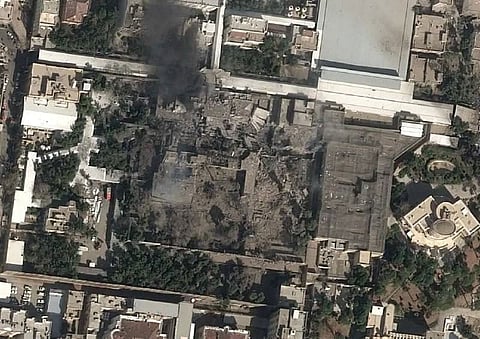
At the outset of the operation, Khamenei’s high-security compound in Tehran was hit. Satellite imagery later confirmed the complex had been destroyed, marking a dramatic turning point in Iran’s 46-year clerical rule.
Israel said Khamenei was killed alongside several senior figures, including Ali Shamkhani, the influential former secretary of Iran’s Supreme National Security Council and Mohammad Pakpour, commander of the Islamic Revolutionary Guard Corps (IRGC).
Two Iranian sources told Reuters that Khamenei had been meeting Shamkhani and current Supreme National Security Council Secretary Ali Larijani shortly before the strikes began.
Larijani survived.
“The brave soldiers and the great nation of Iran will teach an unforgettable lesson to the international oppressors,” he declared in a statement, vowing retaliation.
Martyrdom narrative
Ayatollah Khamenei, successor to revolutionary founder Ruhollah Khomeini, had ruled since 1989 and built his legacy on defiance of Western influence and resistance to Israel and the United States.
Within hours of his death, Iranian state television broadcast archive footage draped in black banners. Official outlets framed his killing as the “martyrdom of the Guardian,” portraying it not as a defeat but as a sacrifice for national sovereignty.
The official Farsi-language account linked to Khamenei posted a Quranic verse on X shortly after midnight. Tasnim News Agency reported he was killed at his workplace in the early hours of Sunday.
Iranian media also reported that his daughter, son-in-law and granddaughter were killed in the strike.
Shockwaves across the region
The killing immediately escalated tensions across the Middle East, triggering waves of retaliation and raising fears of a wider conflict.
Just hours earlier, US President Donald Trump had written on his Truth Social platform: “Khamenei, one of the most evil people in History, is dead.”
Iran had already been grappling with renewed unrest. Last month, protests over soaring inflation convulsed several cities, with authorities reportedly responding with force.
Now, with the supreme leader gone and senior commanders killed, the Islamic Republic faces its most profound moment of uncertainty since 1989.