Oman port and tanker hit as Iran strikes Gulf states
Attacks mark first strikes on the sultanate which mediated US-Iran talks
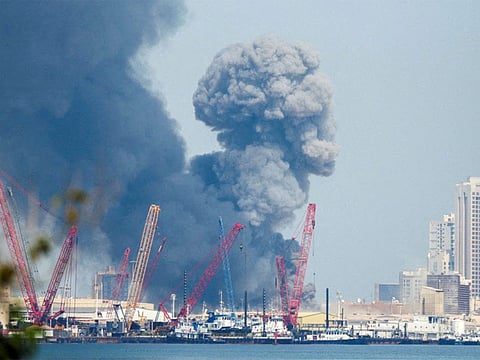
MUSCAT Iran expanded its retaliation campaign across the Gulf on Sunday, striking Oman for the first time since the conflict began and targeting an oil tanker off its coast, in a dramatic escalation that threatens to widen the regional war.
The attack on Duqm commercial port marks the first direct Iranian strike on the sultanate — a long-time mediator in US-Iran talks that had until now avoided becoming a battlefield in the crisis.
Explosions were also reported in Bahrain, Qatar and Saudi Arabia, as Tehran pressed a second day of missile and drone attacks in response to US and Israeli operations that killed Iran’s supreme leader and other top officials.
According to Oman’s state news agency, one drone hit mobile workers’ accommodation, injuring a foreign worker, while debris from a second fell near fuel tanks without causing casualties.
Shortly after, authorities said an oil tanker off Oman’s coast was also targeted. Its crew was evacuated, and four members were reported injured, AFP reported.
The strikes mark the first direct attacks on the sultanate since Iran launched its retaliatory campaign following US and Israeli operations that killed Iran’s supreme leader and other senior officials.
Strikes spread across the Gulf
Explosions were heard early Sunday in Doha and Manama, with blasts later reported in Riyadh, as Iran pressed a second day of attacks targeting US-linked military sites and critical infrastructure across the region.
In Bahrain, authorities said a drone struck near the airport, causing minor damage. On Saturday, drones and falling shrapnel damaged residential buildings in Manama, with smoke seen rising from high-rise structures. The US embassy in Bahrain warned citizens to avoid hotels in the capital after one property, the Crowne Plaza, was hit.
Iran’s Islamic Revolutionary Guard Corps (IRGC) claimed it had struck the headquarters of the US Navy’s Fifth Fleet in Bahrain. Witnesses reported plumes of smoke rising near the base.
Qatar — home to the region’s largest US military installation — said Iran launched 65 missiles and 12 drones toward the country on Saturday. Most were intercepted, but falling debris injured eight people, one of them critically.
Smoke was also seen near US-linked sites in other Gulf states which confirmed intercepting multiple projectiles.
Civilian infrastructure hit
Airports, ports, residential buildings and commercial facilities have been affected across the Gulf, raising fears of a broader regional war.
“The Gulf countries right now are really on the front lines of this brutal war,” said Gulf security analyst Anna Jacobs. While Gulf governments have consistently pushed for de-escalation and diplomacy, she warned that continued attacks could make restraint increasingly difficult.
“If Iran continues to escalate, it will be very difficult for them to simply sit and do nothing,” she told AFP.
Mediation efforts tested
The attacks are particularly significant for Oman, which has historically served as a discreet channel between Tehran and Washington and had until now avoided direct involvement in the conflict.
Gulf states including Qatar, Bahrain, Jordan and Kuwait — all hosting US military bases — had sought to lower tensions in recent years and resisted allowing offensive operations from their territories. But the strikes suggest that diplomatic positioning has not insulated them from the fallout.
A region on edge
Iran’s bombardment comes amid heightened uncertainty following the violent death of its supreme leader and the deepening confrontation with the United States and Israel.
Whether the escalation broadens further — or diplomatic efforts regain traction — may determine the next phase of a conflict that is already testing the Gulf’s resilience.
-- With AFP inputs


