Marine traffic in the Hormuz Strait as of 3.30pm Gulf Standard Time.
'No deal, no passage': Dual blockade deadlock rocks global shipping, diplomacy
Iran reviews US proposal: Blockade chokes Iran’s oil trade, pushes regime to the brink
Last updated:
5 MIN READ
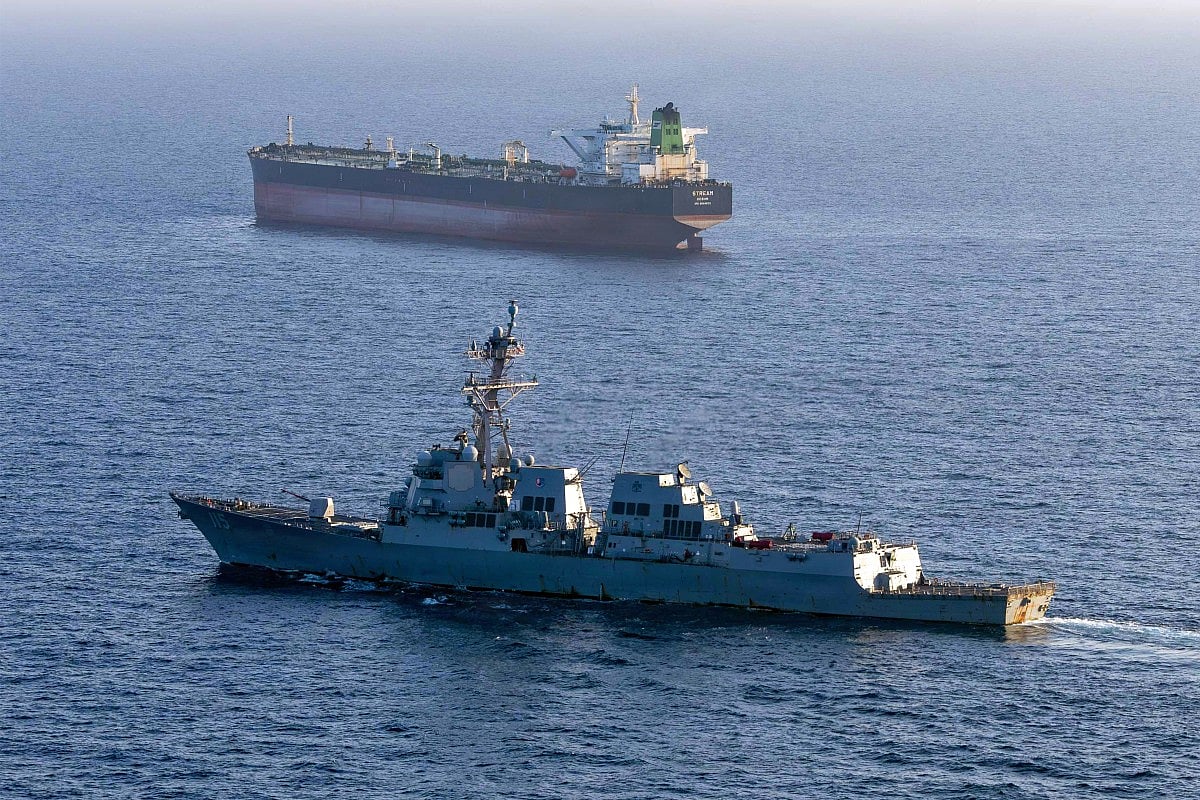
This US Navy handout photo released on May 7, 2026 by US Central Command Public Affairs, shows the Arleigh Burke-class guided-missile destroyer USS Rafael Peralta (DDG 115) implementing a maritime blockade against the Iran-flagged crude oil tanker vessel Stream while the latter was attempting to sail toward an Iranian port, on April 26, 2026.
AFP
As US-Iran talks continue to stall and regional tensions intensify, uncertainty surrounding Iran’s political and economic future deepens.
Recent diplomatic efforts have some progress, but both sides remain divided over key security and strategic issues, while clashes and pressure campaigns continue to destabilise the region.
Some observers believe mounting economic strain, domestic unrest, and geopolitical isolation could eventually weaken the Iranian regime.
Others caution that any sudden collapse could trigger severe instability with far-reaching humanitarian and regional consequences.
Historical comparisons to post-war Iraq, Libya, and Syria continue to shape concerns over what a painful transition might look like.
Noose tightens on Iran crude oil trade
Meanwhile, the US Central Command continues to impose a tighter noose: blowing up fast-attack boats, hitting Iranian launch sites near Hormuz in response to attacks on 3 US Navy ships, and stalling Iran-linked vessels, including incoming empty or unladen tankers.
Unverified reports have emerged that Iran, now running out of storage capacity, is dumping excess oil into the Gulf waters.
Beyond sanctions already in place, turning away these “ballasts” as they head back to Iranian ports rachets up US economic pressure on the regime, depriving them of billions.
Upsides of US blockade
There are upsides to the US blockade, among others:
It avoids open war
Cuts the regime’s key funding source
Limits its ability to propel its rule and support proxies.
Downsides of blockade
There are two major downsides to this pressure, among others:
Ordinary Iranians bear the brunt of economic pain.
Uncertainty keeps crude prices elevated.
Uncertainty stays as the regime rachets up psychological control over Hormuz – imposing toll fees, launching missiles and drones on vessels that attempt “unauthorised” transit, and keeping crude prices elevated.
As of 6.44 am CDT (3:44 pm Gulf), WTI crude stood was up 0.64% at $95.42 while Brent rose 1.23% to $101.29; Murban Crude jumped2.23% $98.82.
The Americans are currently going it alone to break Iran’s grip over the waterway, amid reports that Iran has managed to ship their oil despite the US blockade, which the CentCom has denied.
FRAGILE CEASEFIRE: Forbes reported that the US has fired at Iran at least four times, downing at least 10 vessels, and Iran has attacked US assets at least 11 times since the supposed ceasefire began on April 7, 2026. President Donald Trump claimed the ceasefire is holding and told US lawmakers the war has been “terminated” to avoid a law requiring congressional approval to continue it past 60 days.
Amid the deadlock, and Trump’s withdrawal of “Project Freedom”, Iran is reportedly leaning more heavily on floating oil storage, even as war analysts say the paused mission risked a wider war.
What the latest moves show
As Tehran keeps its strategic “red line” over Hormuz, the issue is no longer only military – it is economic, political and psychological, as per the Institute for the Institue for the Study of War (ISW).
By showing it can seize a vessel such as the Jin Li in the Gulf of Oman and by publicising its control over traffic, Iran is trying to convince shipowners, insurers and foreign governments: access to the strait depends on Tehran’s approval.
US Central Command, meanwhile, said it has redirected dozens of vessels and disabled Iranian tankers trying to reach amid the economic blockade on Iran.
On Friday, May 8 CentCom confirmed that US forces have “disabled” the Iranian tankers Sea Star III and Sevda after both tried to enter an Iranian port on the Gulf of Oman.
As the “dual blockade” continues to raise freight costs, it deters maritime traffic and keeps oil prices elevated, even if no tanker is actually hit, say industry trackers.
The timing matters.
Already, the US Navy turned back 70 Iranian-linked tankers from entering or leaving Iranian ports.
US Army Apache attack helicopters and Navy Seahawks fly armed patrols over the Strait of Hormuz as part of a broader US-led naval blockade to enforce sanctions and protect commercial shipping, targeting Iranian fast craft and deterring attempts to break the maritime cordon in one of the world’s most strategic waterways.
Hardliners vs moderates
The heightened US blockade comes as Iranian hardliners continue to signal that they prefer confrontation over compromise – if negotiations require it to give up control of the strait, according to assessments by the ISW and Critical Threats.
To relieve the pressure on its oil system, Iran is ramping the use of older crude tankers and repurposed vessels to hold oil while port access remains constrained.
Satellite-based estimates cited by shipping industry trackers show roughly 21 million barrels of Iranian crude in floating storage in the Gulf of Oman.
This indicates the blockade is not only affecting exports but also forcing Tehran to improvise how it stores and moves crude.
Military analysts say the pattern fits Iran’s broader strategy: use seizures, drones, mines and mobile missile threats to create friction, even if it cannot dominate the sea in conventional terms.
What happens to fully-laden Iran-linked tankers?
ISW says that while Iran is trying to show strong grip on Hormuz, the US blockade ramps up the pressure.
For one, it prevents empty tankers from reaching loading terminals, posing a huge problem for Iran’s sea-borne oil trade, now coming to a complete stop.
Because Iran can’t ship its stuff out, this hits the regime’s funding hardest while ordinary people bear the brunt through economic pain (sanctions, but more immediate due to physical enforcement).
How the blockade works
Fully laden Iran-linked tankers are largely turned back, intercepted, or unable to exit due to the blockade in the Strait of Hormuz/Gulf of Oman area.
The goal remains disrupting the full logistics loop:
No empties (ballasts) in
Limited loading capacity
Filled storage
Forced production cuts or shutdowns.
Loaded vessels face high risk if they attempt to run the blockade.
Pressure
This strategy is already intensifying severe pre-existing economic strain in Iran from sanctions, prior conflict damage, and inflation:
Oil revenue collapse: Iran’s main hard currency source (oil exports ~1.5–2+ million barrels per day pre-blockade) is effectively choked.
Losses estimated in hundreds of millions per day.
Storage is filling rapidly (onshore + floating), forcing production cuts.
This cascades into government budget shortfalls.
Hyperinflation and shortages: Inflation already at 50–70%+ (food staples much higher). Currency (rial) collapsing further.
Reports of people struggling with basics, selling assets, unpaid wages, mass layoffs (millions of jobs at risk across sectors), and even cross-border smuggling of cooking oil.
Human costs: Widespread hardship for ordinary Iranians — middle class erosion, poverty spikes (additional millions pushed below the line), unemployment, and social media accounts of exhaustion and rage.
The regime has faced protests before over economic hardships; this amplifies risks of unrest.
What happens next?
Amid the ‘dual’ blockade, the answer lies somewhere in between: Both sides say they are still working out a “deal”.
On Saturday (May 9) Iran said Washington’s proposal for a peace deal is “under review with no deadline pressure" – and that Tehran's response will come at an “appropriate time”.
As the world waits for what happens next, military think-tank Critical Threats reported that the deal “framework” would tie reopening the waterway to an end to the conflict, lifting of sanctions and Iran’s nuclear programme.
Iranians have shown resilience but also deep wariness of chaos after decades of conflict.
The situation remains fluid. However, negotiations – or even partial easing – could change trajectories.
Sign up for the Daily Briefing
Get the latest news and updates straight to your inbox
Network Links
GN StoreAbout Gulf NewsTerms & ConditionsReach by GNSitemapContact usPrivacy PolicyGN FocusHave your sayWork with usAdvertise with usGulf News epaperPrinting Services
Download our app
© Al Nisr Publishing LLC 2026. All rights reserved.