A satellite view of the Hormuz Strait.
New Hormuz toll fee? A 'beautiful thing’, says Trump — could change global rules
Trump floats ‘joint venture’ with Iran to manage strait, charge for passage
Last updated:
4 MIN READ
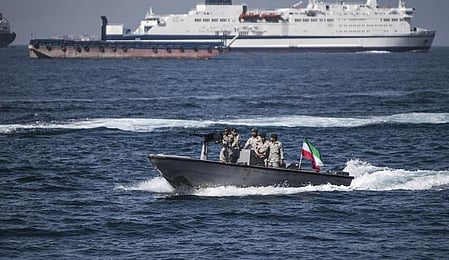
Vessel traffic through the Strait has resumed under the US-Iran ceasefire, as seen on the latest shipping maps. Iran has reportedly imposed a $2 million transit fee on select ships in the Strait of Hormuz.
Gulf News File photo
Iran has warned ships near the Hormuz Strait must obtain “permission” from its naval forces before transiting the narrow waterway.
It underscores Tehran’s grip over the strategic chokepoint.
“You must receive permission from Iranian Sepah navy for passing through the strait. If any vessel tries to transit without permission, it will be destroyed,” the Iranian navy said in a radio message, as per The Wall Street Journal.
The warning highlights lingering tensions.
On April 8, US President Donald Trump agreed to suspend attacks on Iran for two weeks, on the condition that the strait is reopened in a “complete, immediate, and safe” manner.
Maritime activity currently remains limited.
Most vessels have stayed stationary, with warplanes circling over the Arabian Gulf, according to reports and footage shared by ship crews.
Following are updates on the narrow waterway between Iran and Oman that carries roughly a fifth of the world’s oil supply.
Does the April 8 truce deal allow Iran to charge toll fees from ships crossing Hormuz?
No.
Under the ceasefire deal, Iran is not explicitly “allowed” to charge toll fees.
But the fragile truce (announced on April 8, 2026) has left the door open for it.
The ceasefire deal includes specific provisions for reopening the vital shipping lane.
Iran’s actions suggest it intends to assert control over access to the strait.
What the truce deal calls for
The deal requires Iran to guarantee “safe passage” through the Strait of Hormuz for two weeks via coordination with its Armed Forces, subject to “technical limitations” -- Iran’s Foreign Minister Abbas Araghchi stated this explicitly after the deal was announced.
Multiple reports confirm the agreement incorporates elements of Iran’s 10-point proposal, which includes a provision for Iran (and potentially Oman) to levy transit fees on ships — reportedly $1–2 million per vessel or the crypto equivalent of $1 per barrel of oil.
Iran has already begun formalising this move via a parliamentary bill and has been selectively charging “friendly” ships during the conflict.
Proceeds are framed as “war reparations” for reconstruction.
Oman has pushed back, stating it will not impose tolls. This has created ambiguity.
What did Trump say about the Hormuz toll fee?
Trump has signalled conditional tolerance for the Hormuz toll fee.
The US leader told ABC News during a phone call that a toll fee arrangement is a "beautiful thing" and that he was considering it as a "joint venture" with Iran.
Earlier, he floated the idea of the US charging tolls instead (“I’d rather do that than let them have them. We’re the winner”).
Trump also stated on Truth Social that "big money will be made" through this arrangement and that it could contribute to a "Golden Age of the Middle East".
Trump has prioritised “free traffic of oil” in broader talks but has not ruled out a revenue-sharing arrangement.
US officials, however, warned earlier that the toll fee could violate existing sanctions — unless an exception is granted.
What does UNCLOS say about charging tolls at international straits?
The Strait of Hormuz qualifies as an international strait used for global navigation.
Under international law, reflected in the United Nations Convention on the Law of the Sea (UNCLOS) Articles 37–44, which is binding even on non-parties like Iran and the US, ships enjoy a right of transit passage that “shall not be impeded”.
Coastal states may not levy charges “by reason only of their passage” (Article 26) — fees are permitted only for specific services rendered (e.g., pilotage) and must be “non-discriminatory”.
Iran’s blanket, selective toll is not service-based, making it a clear violation of UNCLOS.
Marine industry experts call it a “Tehran toll booth”. Iran argues it is exercising sovereignty and has not ratified UNCLOS.
Section 2 (Right of Transit Passage) Article 38 of UNCLOS: "In straits referred to in article 37 (Scope of Secion on Transit Passage), all ships and aircraft enjoy the right of transit passage, which shall not be impeded; except that, if the strait is formed by an island of a State bordering the strait and its mainland, transit passage shall not apply if there exists seaward of the island a route through the high seas or through an exclusive economic zone of similar convenience with respect to navigational and hydrographical characteristics"
What are the parallels with other straits and channels?
Natural international straits (Hormuz, Malacca, Gibraltar, Bab el-Mandeb) operate under transit passage rules — no mandatory tolls for mere passage.
Why artificial waterways differ
The Suez Canal, Panama Canal, and Kiel Canal charge fees because they are man-made infrastructure requiring maintenance.
What about the Turkish Straits fee?
Turkey collects limited administrative fees in the Turkish Straits (Bosphorus and Dardanelles) under the 1936 Montreux Convention, but these are not considered “full transit tolls”.
There is no post-1945 precedent for a coastal state imposing mandatory tolls on a natural strait.
Allowing it here could set a precedent for other maritime chokepoints or narrow international straits, maritime experts point out.
What did Iran say about the post-war Hormuz Strait?
Iran has repeatedly said the strait "will never return to its former state."
It views tolls as legitimate compensation for damage and a permanent “new protocol” for management, not a temporary ceasefire concession.
Foreign Minister Araghchi and Iranian lawmakers emphasise coordination with Iranian forces and “sovereignty”.
While agreeing to safe passage for two weeks, Tehran insists any final deal must include sanctions relief and recognises its de facto control.
What happens after the ceasefire?
The ceasefire buys time for direct talks in Islamabad, following an invitation from Pakistan's PM Shehbaz Sharif.
US and Iran confirmed they will send negotiators to Islamabad. The White House confirmed the talks will resume on Saturday (April 11).
The ceasefire has reopened Hormuz maritime traffic (as seen in latest vessel maps) but has not resolved the underlying legal or geopolitical dispute.
The Hormuz toll fee, now a de facto arrangement, remains a flashpoint. While it clashes directly with long-standing international maritime law, pragmatic politics may allow them.
If so, this would be a game-changer in the global energy calculus.
Sign up for the Daily Briefing
Get the latest news and updates straight to your inbox
Network Links
GN StoreAbout Gulf NewsTerms & ConditionsReach by GNSitemapContact usPrivacy PolicyGN FocusHave your sayWork with usAdvertise with usGulf News epaperPrinting Services
Download our app
© Al Nisr Publishing LLC 2026. All rights reserved.