All eyes on Hormuz Strait: Marine traffic starting to move as two-week ceasefire kicks in
Ship movements surging after ceasefire eases weeks of tension in key oil chokepoint
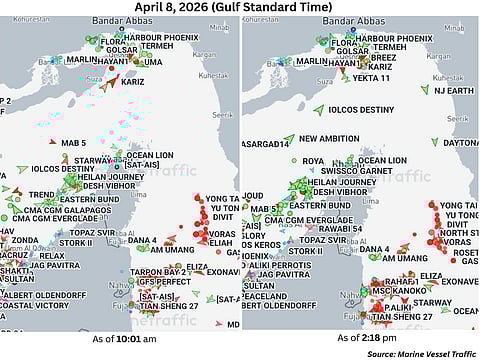
Major shipping companies and tanker operators have began moving vessels more freely once the risk of attack diminished following the two-week ceasefire declared by Iran-US ceasefire.
While the ceasefire remains fragile, marine traffic has started moving, though it remains far below pre-crisis levels.
Surge in marine traffic
The visible surge can be seen in just four hours since 10 am Gulf Standard Time (GST) signals cautious optimism that the critical waterway may gradually reopen.
As the world watches closely, it's not immediately clear whether the cargo and crude tanker ships are turning off their transponders as they go through the narrow waterway.
The images from Marine Vessel Traffic illustrate the immediate market response.
Before and After: Surge in Ship Traffic in the Strait of Hormuz as ceasefire takes hold (April 8, 2026)
Morning Snapshot (10:01 AM Gulf Standard Time):
On the morning of April 8, 2026, marine vessel traffic in the Persian Gulf and around the Strait of Hormuz remained relatively cautious.
The left map shows clusters of vessels near major Gulf ports like Bandar Abbas (Iran), Fujairah (UAE), and along the Omani and Iranian coasts.
Many ships appear stationary or moving slowly, with concentrations around loading terminals.
Red markers (often indicating tankers or vessels at anchor) dominate areas near Iranian waters, while green markers (various commercial vessels) hug safer routes.
This reflects weeks of severe disruption caused by the US-Israel–Iran conflict, during which Iran had largely restricted or selectively blocked the Strait — a chokepoint carrying nearly 20% of global oil trade.
Afternoon Update (2:18 PM Gulf Standard Time):
By mid-afternoon, the right map reveals a noticeable increase in activity. More vessels are underway, with additional green and red markers appearing in transit positions, particularly outbound from the Gulf.
Ships like Yekta 11, New Ambition, Iolcos Destiny, and others show clear movement.
The density of traffic has visibly grown in key channels, suggesting ships are seizing the opportunity to move after days of hesitation.
From blockade to cautious reopening
This before-and-after view captures a pivotal moment following intense diplomatic pressure.
President Donald Trump had issued a firm deadline of 8:00 PM Eastern Time on April 7 (early April 8 in the Gulf) for Iran to reopen the Strait or face devastating strikes on infrastructure.
Just about 90 minutes before the deadline, a two-week ceasefire was announced.
Iran agreed to guarantee safe passage for maritime traffic in exchange for the pause in hostilities.
Oil prices eased on the news, but full restoration of the 20+ million barrels per day that normally flow through Hormuz will take time, confidence, and sustained compliance with the ceasefire.
For now, these maps show a region breathing a tentative sigh of relief — from tension to tentative motion in one morning.


