A US Navy sailor aboard the guided-missile destroyer USS Milius (DDG-69) is reported to be on watch as the vessel transits regional waters amid operations.
Iran–US deal: Trump says ‘no more attacks’ as Hormuz reopening signalled
Pakistan says an official signing ceremony will take place in Switzerland on Friday
Last updated:
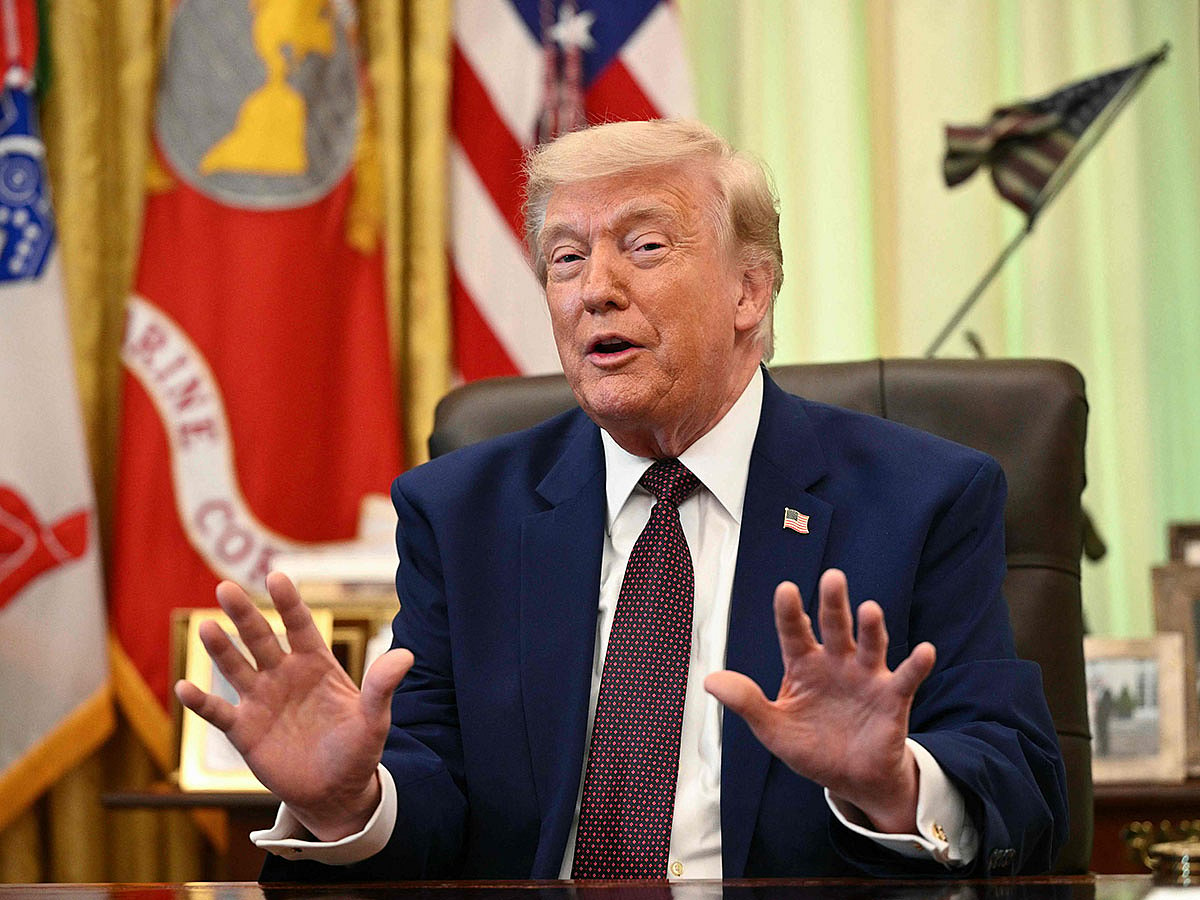
Trump hails looming Iran accord while Israeli strikes fuel fresh tensions
AFP
US President Donald Trump has said an agreement has been reached with Iran, claiming the US will end its naval blockade under the reported deal. Tehran has not confirmed the agreement. Pakistan, acting as a mediator, said the signing ceremony is expected in Switzerland on Friday, according to reports. Iran’s Deputy Foreign Minister Kazem Gharibabadi also said on state television that a deal has been finalised, with signing scheduled for Friday in Switzerland. The reports suggest a possible diplomatic breakthrough, though official confirmation from US and Iranian authorities is still awaited. Follow our live updates as events unfold:
US‑Israel war on Iran: Recent developments
Trump says Iran war deal imminent, Hormuz Strait to open immediately
US President Donald Trump said Saturday that a deal with Iran to end the war in the Middle East would be signed on Sunday, and that the strategic Strait of Hormuz would be "open to all" immediately after.
Iran had offered a different timeline earlier in the day, but nonetheless signalled an agreement was in the offing, as both the warring parties and their mediators expressed increasing optimism that weeks of halting negotiations were drawing to a close.
The new momentum came in spite of fresh skirmishes in the Strait of Hormuz, which Iran has blockaded since early in the war, throwing global markets into turmoil.
"The Deal is scheduled to get signed tomorrow, and immediately after it is signed, the Hormuz Strait is OPEN TO ALL," Trump said on his Truth Social platform.
Since an April 8 truce paused the worst of the fighting, Trump has repeatedly insisted a deal was near only for the wrangling to drag on.
Iranian foreign ministry spokesman Esmaeil Baqaei had said earlier on Saturday that the date of the signing was yet to be determined, but "it will not be tomorrow".
However, he added: "The possibility of this happening in the coming days cannot be ruled out."
The leader of key mediator Pakistan had also said a deal was closer "than ever before".
"With finalisation likely expected in the next 24 hours, Pakistan is preparing for the electronic signing of the peace deal immediately after, followed by technical level talks next week," said Prime Minister Shehbaz Sharif.
A Pakistani foreign ministry statement also said the signing was planned for Sunday.
The warring parties have nonetheless released conflicting information about the contents of the deal, as each seeks to show it emerged from the war with the upper hand.
Hormuz drones
Tehran has insisted it will maintain control over the Strait of Hormuz, a key maritime trade route for oil and gas shipments from the Gulf.
Since imposing its blockade, Iran has demanded vessels obtain permission from its armed forces before transiting the waterway, and has established a new body to oversee it and collect tolls.
The US has responded with its own blockade of Iranian ports.
Earlier Saturday, the US military's Central Command said Iran had "launched multiple one-way attack drones in an attempt to strike commercial ships transiting the Strait".
It added that "US forces have downed all of them in recent hours".
Iran's Foreign Minister Abbas Araghchi, in an interview with state television Friday, had said the deal on the table called for the lifting of the US naval blockade.
"The administration of Strait of Hormuz will no longer be the same as before," he added, calling the waterway one of Iran's "main instruments of deterrence".
The US has repeatedly said Iran remaining in control of the strait would be unacceptable, and Trump's post made no mention of tolls or other arrangements.
'Nuclear dust'
Another key sticking point in the talks has been the fate of Iran's nuclear programme, particularly its stockpile of highly enriched uranium - believed to have been buried by US strikes last year during a previous short-lived war.
Iran has long insisted its nuclear programme is peaceful and that it has a right to enrichment, but the United States, Israel and other Western governments suspect it of seeking a bomb.
Araghchi on Friday said the only way to deal with Iran's enriched uranium "is to dilute it inside Iran".
Trump, who has justified the war as necessary to prevent Iran from obtaining nuclear weapons, previously said the US would remove and destroy the uranium.
In Saturday's post, he said: "When all is calm, we will go in and get the Nuclear Dust... and downblend and destroy it, whether in Iran, or the United States".
"Hopefully, this process will all work out quickly, easily, and smoothly," he added. "If it doesn't, we have the ultimate alternative, hopefully never to be used again!"
Prime Minister Benjamin Netanyahu of Israel - which launched the war in tandem with the US in February - said Trump had promised him any agreement would include the removal of the enriched nuclear material.
In the streets of Tehran, there was scepticism the latest agreement would cross the finish line.
"I don't think there is any deal soon," said Saeed Sadeghi, 49. "I don't trust their word."
Fars news agency shared a video from Iran's northeastern city of Mashhad showing dozens protesting the deal outside a foreign ministry building Saturday.
It showed women in black chadors chanted "death to dishonourable Araghchi, the infiltrator", while waving red and black flags.
Dozens protest peace deal outside Iran foreign ministry
Dozens protested Saturday outside a foreign ministry office in Iran's northeastern city of Mashhad, chanting slogans against top diplomat Abbas Araghchi after a televised interview in which he discussed signing a peace deal with the US.
In a video shared by Fars news agency, women in black chadors chanted "death to dishonourable Araghchi, the infiltrator" in front of the building, while waving red and black flags.
The protest comes as the peace deal touted by US President Donald Trump and mediator Pakistan faces opposition from hardline Iranian figures.
They argue that it does not serve Iran's interests and would deprive Tehran of leverage over the Strait of Hormuz. They also accuse Iranian negotiators of having made too many concessions to secure the deal.
Other videos on social media that AFP could not independently verify showed people in front of the foreign ministry building in Tehran chanting "Araghchi, resign" and "Ghalibaf, resign", in reference to parliament speaker and chief negotiator Mohammad Bagher Ghalibaf.
Trump shares AI-generated naval war scene on Truth Social
US President Donald Trump shared an AI-generated, military-themed image of himself on his platform Truth Social, featuring a stylised portrayal with warships and fighter jets in the background.
The image caption read, "YOU'RE GETTING DISCOMBOBULATED."
The post comes amid heightened geopolitical developments in the Middle East, with Trump stating that a peace deal involving Iran is expected to be signed on Sunday. The US president posted the visual on Saturday (local time), which depicts him standing on the deck of a naval vessel in the role of "Commander in Chief," holding binoculars as he surveys a dramatic military scene at sea.
In the background, a fleet of US warships is shown sailing in formation across rough waters, while multiple fighter jets streak across the sky in a symmetrical arc, leaving behind white smoke trails that add to the cinematic effect. The American flags on the ships and the golden sunset backdrop further amplify the dramatic tone of the composition.
Audio warning: IRGC warns ships off Strait of Hormuz
The navy of Iran's Islamic Revolutionary Guard Corps (IRGC) warned ships operating near the Strait of Hormuz against transiting the strategic waterway, according to an audio recording of a public maritime radio channel.
The recording, provided to Xinhua by a crew member aboard a commercial vessel near the strait, showed that the IRGC navy addressed all vessels operating in the Arabian Gulf and the Gulf of Oman, saying the Strait of Hormuz had been "completely closed" and that any vessel movement within the strait would be dealt with "decisively."
"For the sake of your health and safety, absolutely refrain from any movement in the Strait of Hormuz until further notice," the recorded message said.
Qatari, Pakistani PMs discuss regional developments
Sheikh Mohammed bin Abdulrahman bin Jassim Al Thani, Prime Minister and Minister of Foreign Affairs of Qatar, discussed the latest developments in the region with the Prime Minister of Pakistan, Muhammad Shehbaz Sharif.
During a telephone call, the two sides reviewed cooperative relations between the two countries and ways to support and enhance them. They also discussed the latest regional developments alongside Pakistani mediation efforts aimed at de-escalation, which contribute to enhancing security and stability, according to Qatar News Agency.
Al Thani expressed Qatar's satisfaction with the progress made in the negotiations and Pakistan's mediation announcement that a final text for the peace agreement has been reached. He expressed hope that both the American and Iranian sides will sign the agreement soon.
Furthermore, he reiterated Qatar's full support for Pakistani mediation efforts aimed at ending the crisis through peaceful means, stressing the need for all parties to respond to these efforts to help create conducive conditions to a comprehensive agreement that achieves sustainable peace in the region.
Get updated faster and for FREE: Download the Gulf News app now - simply click here.
Arab Parliament slams media reports against UAE and Qatar
Mohammed bin Ahmed Al Yamahi, Speaker of the Arab Parliament, has condemned what he described as misleading media reports and allegations that lack accuracy and objectivity and target UAE and Qatar in a futile attempt to undermine their efforts, standing and influential role in supporting regional and international security and stability.
In a statement, Al Yamahi said such narratives do not serve the interests of the peoples of the region and contribute to spreading confusion and distorting facts at a time when current challenges require enhanced cooperation and solidarity among Arab countries to address crises and strengthen the foundations of development and peace.
He noted that the UAE and Qatar have played important roles in supporting initiatives and diplomatic efforts aimed at resolving conflicts and addressing crises, reflecting a clear commitment to the principles of cooperation, partnership and joint action to achieve development and prosperity for the peoples of the region.
Lebanese death toll from Israeli attacks rises to 3756
The Lebanese Ministry of Public Health announced on Saturday that the death toll from Israeli attacks on Lebanon since March 2nd has risen to 3,756.
According to the daily report issued by the ministry's Health Emergency Operations Centre, the number of wounded individuals during the same period has increased to 11,632.
Pakistan, Türkiye express hope over US-Iran breakthrough
Pakistan Deputy Prime Minister and Foreign Minister Muhammad Ishaq Dar held a telephone conversation with Turkish Foreign Minister Hakan Fidan, Pakistan’s Ministry of Foreign Affairs said on X.
The two leaders discussed the evolving regional situation and welcomed what they described as encouraging progress towards an understanding between the United States and Iran.
They expressed hope that recent developments would help pave the way for lasting peace and stability in the region.
Both sides agreed to remain in close contact and continue coordination as the situation develops further.
Two drones from Lebanon strike northern Israel
The Israeli military said two drones, suspected to have been launched by militant group Hezbollah from Lebanon, struck northern Israel on Sunday but caused no casualties.
"Two impacts of suspicious aerial targets in Israeli territory were identified near the Israel-Lebanon border. No injuries were reported," the military said.
In the wake of the strikes, two far-right Israeli ministers called for retaliatory strikes on Beirut's southern suburbs, a Hezbollah stronghold known as Dahiyeh.
"The shooting at northern communities is a test of the Dahiyeh Doctrine that the prime minister declared. I call on him to implement it decisively and firmly, and to bring down buildings in Dahiyeh," Finance Minister Bezalel Smotrich said on X.
"For every drone - a missile; for every violation - fire; for every UAV - Dahiyeh must tremble," wrote National Security Minister Itamar Ben Gvir on X.
Get updated faster and for FREE: Download the Gulf News app now - simply click here.
Qatari delegation in Tehran for Middle East peace talks
A Qatari delegation arrived in Tehran on Sunday, Iranian media and a diplomat said, as part of the mediation process to end the war between Iran and the United States.
Iran's ISNA news agency reported an adviser to Qatar's foreign minister had been dispatched to the Islamic republic.
Another Iranian news agency Tasnim said the purpose of the visit was to "go over the latest developments regarding the diplomatic process".
A diplomat with knowledge of the situation told AFP on Sunday that "Qatari negotiators flew to Tehran this morning".
Speaking on condition of anonymity to discuss the sensitive talks, the diplomat said the delegation travelled "to help facilitate the finalisation of the agreement".
Pakistan, which has led mediation to end the months-long Middle East war, and the US have indicated an agreement to end the fighting would be signed on Sunday.
But Tehran has cast doubt on that timing, and Iranian media has reported a final decision on the framework is yet to be made.
Iran's unity in 12-day war forced "enemy" to seek ceasefire: Pezeshkian
Iranian President Pezeshkian said that the national solidarity of the country's people during the 12-day conflict with Israel compelled Israel to seek a ceasefire, according to Iran's state news agency IRNA.
In a message marking the first anniversary of the conflict with Israel, Pezeshkian paid tribute to those killed during it and said that Israel had ‘miscalculated’ the impact of its ‘attacks’ on Iran.
The president said that Israel had "assumed" that the strikes targeting senior military commanders and strategic facilities would "weaken the Iranian nation and destabilise the Islamic Republic." However, he said, "the resistance shown by the Iranian people," alongwith the leadership of the late Supreme Leader, Ayatollah Seyed Ali Khamenei, and the preparedness of Iran's Armed Forces, prevented 'those goals" and "eventually compelled the adversary to accept a ceasefire."
Describing the 12-day conflict as a "symbol of national solidarity", Pezeshkian said Iranians from different political backgrounds and viewpoints had united in defence of the country.
He also commanded the citizens for their patience amid "economic difficulties over the past year", saying his administration had continued addressing public concerns despite operating "under severe pressures."
Iran media says Tehran 'not yet' taken final decision on US peace deal
Iran's Fars news agency said on Sunday that Tehran has not made a final decision on signing the agreement under discussion with the United States to end the Middle East war.
"The Islamic Republic of Iran has not yet taken or announced its final decision concerning the memorandum of understanding proposed during negotiations," reported Fars, which is close to Iranian conservative circles, citing "a well-informed source close to the Iranian negotiating team".
The prospective agreement has faced opposition from hardline Iranian figures, who argue that it does not serve Iran's interests and would deprive Tehran of leverage over the strategic Strait of Hormuz.
Three suspected Hezbollah drones hit northern Israel
The Israeli military said three drones, suspected to have been launched by militant group Hezbollah from Lebanon, struck northern Israel in separate incidents on Sunday, causing no casualties.
"Two impacts of suspicious aerial targets in Israeli territory were identified near the Israel-Lebanon border. No injuries were reported," the military said in an initial statement.
Later in a separate statement, the military said another "hostile aircraft" infiltrated the northern Israeli territory.
In the wake of the strikes, two far-right Israeli ministers called for retaliatory strikes on Beirut's southern suburbs, a Hezbollah stronghold known as Dahiyeh.
"The shooting at northern communities is a test of the Dahiyeh Doctrine that the prime minister declared. I call on him to implement it decisively and firmly, and to bring down buildings in Dahiyeh," Finance Minister Bezalel Smotrich said on X.
"For every drone - a missile; for every violation - fire; for every UAV - Dahiyeh must tremble," wrote National Security Minister Itamar Ben Gvir on X.
US agrees to hold off new sanctions on Iran
An Iranian official has revealed to Reuters details of a draft memorandum of understanding with the United States, under which Tehran would agree not to produce or acquire nuclear weapons and would reduce its stockpile of highly enriched uranium within the country, with implementation mechanisms to be negotiated over the next 60 days.
In return, Washington has agreed to release $25 billion in frozen Iranian assets through direct transfers and financial credit facilities, according to the official.
Israeli military strikes Beirut suburbs
The Israeli military announced it launched strikes on Beirut targeting Hezbollah infrastructure. Smoke could be seen rising over the Lebanese capital.
The office of Israeli Prime Minister Benjamin Netanyahu said the strikes were in response to Hezbollah attacks in northern Israel.
When Israel last struck the Beirut suburbs a week ago, Iran responded with strikes on Israel.
Lebanon complains to Security Council over alleged Israeli use of herbicide
Lebanon's foreign ministry said it had lodged a complaint with the United Nations over Israel's alleged spraying of herbicide glyphosate in Lebanese territory near the border earlier this year.
In a statement circulated on Sunday, the ministry said it had sent a letter to the UN Security Council and the UN secretary-general this week to complain about the incident, which occurred in February, a month before the latest Israel-Hezbollah war erupted on March 2.
The ministry said "laboratory tests and chemical analyses carried out on soil samples" in the south Lebanon border villages of Aita al-Shaab, Ras Naqura and Dhayra "confirmed the use of glyphosate at high levels of concentration".
It said the levels "greatly exceed" those usually found in agricultural areas after regular use by farmers.
The statement said the complaint was based on a report from Lebanon's government-linked National Council for Scientific Research (CNRS).
At the time, the UN peacekeeping mission in Lebanon said Israel had notified it of its plans to spray a "non-toxic chemical substance" near the border and had warned peacekeepers to take shelter.
Lebanon's President Joseph Aoun had denounced the spraying as a "flagrant violation of Lebanese sovereignty and a crime against the environment and health".
Get updated faster and for FREE: Download the Gulf News app now - simply click here.
Lebanon says 3 killed in Israeli strike on south Beirut
Lebanon's civil defence agency said an Israeli strike on Sunday on Beirut's southern suburbs killed at least three people, as Israel's military said it targeted Hezbollah.
The civil defence statement said that "the bodies of three martyrs were recovered from under the rubble and six wounded" were taken to hospital after the strike, which hit the Ghobeiry area of the Hezbollah stronghold.
Iran says US unable or unwilling to uphold 'commitments'
Iranian chief negotiator Mohammad Bagher Ghalibaf said on Sunday there was "no point" in continuing peace talks with the United States after its ally Israel attacked Beirut's southern suburbs.
"The Zionists' aggression against Dahieh once again showed that the United States either lacks the will to implement its commitments or lacks the ability to do so," Ghalibaf said in a post on X.
"If you do not have the will or the ability to fulfil your commitments, then there is no point in talking about continuing down this path," he added, against the backdrop of ongoing efforts to finalise a peace deal between the warring parties.
Iran military official says Beirut attack will not go 'unanswered': Media
A senior Iranian military official warned on Sunday that Israel's strike on Beirut's southern suburbs would not go "unanswered" by Tehran, according to local media.
"Without a doubt, these crimes will not go unanswered," Brigadier General Mohammad Jafar Asadi, deputy commander of Iran's highest military command, told Defa Press news agency following the attack.
Obama says Trump Iran deal will not improve on his pact
Barack Obama said it was unrealistic to expect that any deal between US President Donald Trump and Tehran would mark a "significant improvement" over his own nuclear pact 11 years ago.
In interview excerpts released ABC News talk show "This Week," the former president also suggested it was better to negotiate a deal that falls short of all of Washington's requirements in order to avoid an outright war.
"It is doubtful that any agreement that arises is going to be significantly different or a significant improvement from the deal that we had in the first place," Obama said, referring to 2015's landmark pact that Trump abandoned.
Obama said his own deal "had worked for a long stretch of time before... the United States pulled out of it."
Trump has stressed the deal, which he says would forever block Iran's ability to produce a nuclear weapon and would lead to the immediate opening of the blockaded Strait of Hormuz, could be signed on Sunday.
Tehran has not confirmed it will yet sign a deal, saying that for now there was "no point" in peace talks with the United States.
Obama said the troubled progress of a new US-Iran deal is a reminder that Washington can not "just bully our way or bomb our way to solutions" instead of engaging in comprehensive diplomacy.
"You'd think we would have learned that lesson by now," he said.
Iran-US talks remain inconclusive, source says
Iran was communicating its position to the United States through Qatari mediators in Tehran prior to Israeli strikes on Beirut’s southern suburbs on Sunday, according to the IRGC-affiliated Fars News Agency, which cited a source close to the negotiations.
The source said discussions between Iran and the US had not yet been finalised.
“Even if all of Iran’s views are incorporated into the US-Iran memorandum of understanding, no agreement will be signed at the time announced by Donald Trump,” the source was quoted as saying.
Israeli military says preparing for 'potential' incoming fire after Beirut strike
The Israeli military said it was bracing for a possible retaliatory attack "in the coming hours", after carrying out a strike on Beirut's southern suburbs earlier on Sunday.
"Following the IDF strike in Beirut ... the IDF is preparing for potential fire toward the territory of the state of Israel in the coming hours," the military said, without specifying from where the attack was expected.
Trump calls for 'no more attacks,' says 'very close' to Mideast deal
US President Donald Trump said the recent strike on Beirut “should not have happened,” warning it comes at a sensitive moment as he said the US is close to a peace deal with Iran.
Writing on Truth Social, Trump said Israel has the right to defend itself but described the attack it responded to as “very small and meaningless,” adding that no one was hurt.
He called for all sides to stand down, saying there should be no further attacks in Lebanon or against Israel, and warned the escalation could disrupt what he described as the beginning of a long and beautiful peace.
Iran's top security body backs 'path of dialogue': President
Decisions on the US–Israeli conflict with Iran and ongoing peace talks ultimately lie with the Supreme Leader and the Supreme National Security Council (SNSC), Iran’s president has said, amid reports of dissatisfaction from some domestic factions over the proposed deal.
President Masoud Pezeshkian, quoted by state-run IRNA, said that safeguarding national unity and cohesion remains the country’s top priority.
He stressed that all political factions are expected to adhere to decisions made by Supreme Leader Mojtaba Khamenei, underscoring the central role of leadership in guiding national policy.
US Navy confirms rescue of 14 Indian mariners in Arabian Sea
The United States Navy conducted a coordinated search and rescue operation in the Northern Arabian Sea on June 14, saving 14 Indian mariners after a distress signal was received.
A US Navy P-8 aircraft was first to respond, dropping a life raft survival kit to keep the stranded crew afloat until help arrived. A merchant vessel, M/V Jabal Ali 9, later recovered 11 mariners from the raft.
In a separate response, an MH-60S Sea Hawk helicopter from the aircraft carrier USS Abraham Lincoln rescued three additional crew members after their raft capsized in rough seas. All 14 mariners were reported safe and in good health.
The USS Michael Murphy also supported the wider emergency operation, carried out under the US 5th Fleet’s area of responsibility, which covers key strategic waterways across the Middle East and surrounding seas.
Putin discussed Iran, Ukraine war in call with Trump
Russian President Vladimir Putin called US counterpart Donald Trump on Sunday, Trump's 80th birthday, and discussed the wars in Ukraine and Iran and an upcoming visit of Washington's envoys to Russia, the Kremlin said.
"The conversation focused on the situation surrounding the memorandum of understanding being drafted between the United States and Iran. Donald Trump said an agreement is close," Kremlin aide Yuri Ushakov told reporters.
Ushakov also said that "it has been agreed that US presidential special representatives Steve Witkoff and Jared Kushner, who are currently closely involved in Iranian affairs, will return to Russia soon".
Iran's top security body backs 'path of dialogue': President
Iranian President Masoud Pezeshkian said the country's highest security authority supports the "path of dialogue", after hardliners criticised Tehran's negotiating team in talks with the United States.
"The Supreme National Security Council has concluded that the path of dialogue should be pursued," Pezeshkian said in a meeting with media executives, according to the presidency's website.
He added that the council was in charge of "decisions regarding war and negotiations".
Trump says Iran deal in 'a few hours,' blames Israel for delay: Axios
US President Donald Trump said Sunday that a peace deal with Iran was still on track to be signed within hours, despite an Israeli strike on Beirut that he said had delayed the plan.
"It shook it up. It delayed the signing by a few hours. It was supposed to be now. Now it is scheduled for a few hours from now," Trump said in a phone call to the Axios news outlet.
Trump fumed at Israeli Prime Minister Benjamin Netanyahu over the attack on Beirut, saying, "it is so bad - I couldn't believe it. An hour before we are supposed to sign the deal."
Using a string of expletives, Trump told Axios he raged at Netanyahu after Israel struck Beirut's southern suburbs on Sunday, killing three people, in response to what it said was Hezbollah fire at northern Israel.
"Why did Bibi (Netanyahu) have to do a *** attack?" Trump told Axios. "I was so pissed off. I let him know. He has no *** judgement. I let him know that."
Get updated faster and for FREE: Download the Gulf News app now - simply click here.
US forces redirect 142 commercial ships
US naval forces are operating within key strategic sea lanes across the Middle East, where patrols have been intensified amid heightened regional tensions, according to the report.
As of June 14, US Central Command (CENTCOM) forces have redirected 142 commercial vessels that complied with instructions, while nine vessels were disabled after failing to comply, underscoring the scale of ongoing maritime enforcement activity in the region.
CENTCOM continues operations across critical waterways, including the Arabian Gulf, Gulf of Oman and the Strait of Hormuz, which remain vital routes for global energy and maritime trade.
Iran's top security body warns response 'imminent' after Israel's Beirut strike
Iran's highest national security body warned on Sunday that a response was "imminent" following an Israeli strike targeting Tehran's ally Hezbollah in Beirut's southern suburbs.
"The response of the fighters of Islam is imminent," the Supreme National Security Council said in a statement on X. "Lebanon is our life and violation of the red lines of the Islamic Republic will not be tolerated."
Israel reports aerial targets falling across Israel and Lebanon
The Israeli military said a “launch crossing from Lebanon was identified falling in the Neot Mordechai area.”
It added that several other suspected aerial targets were reported to have fallen inside Israel, while additional impacts occurred in areas where Israeli forces are deployed in southern Lebanon.
Iran suspends flights in western regions after escalation
Iran's state broadcaster said on Sunday that flights at airports in the west of the country were cancelled, after Tehran warned it would respond to an Israeli attack on Beirut.
"Flights from airports in the western part of the country have been cancelled until further notice," state television reported following the warning from Iran's top security body.
UN chief condemns Israeli strikes at 'crucial moment'
UN Secretary-General Antonio Guterres on Sunday criticized Israel's strikes on Beirut that threatened US plans for Washington and Tehran to sign a framework peace deal later in the day.
"The strikes took place despite the ceasefire and at a time when the United States and the Islamic Republic of Iran are expected to reach an agreement that will pave the way to a peaceful resolution of this conflict," he said in a statement.
"I urge all parties to show maximum restraint at this crucial moment."
Netanyahu seeks urgent Trump meeting after G7: report
Israeli Prime Minister Benjamin Netanyahu is seeking an urgent meeting with US President Donald Trump following the G7 summit in Europe, amid rising tensions over Iran negotiations and the ceasefire with Hezbollah in Lebanon, CNN reported, citing an Israeli source.
The source said Netanyahu is trying to arrange the meeting after Trump returns to the United States from the summit next weekend or shortly afterwards.
Tensions escalated after Trump criticised Israel’s strike on Beirut in response to Hezbollah fire, saying the attack “should not have happened,” while describing Hezbollah’s earlier action as “very small and meaningless.”
According to the source, Israel aims to clarify its position in ongoing negotiations, with concerns centred on maintaining operational freedom against Hezbollah and the direction of US-Iran talks.
Israel is also reportedly wary that an emerging agreement could ease pressure on Tehran without addressing its nuclear programme, potentially strengthening Iran’s position in the region.
Get updated faster and for FREE: Download the Gulf News app now - simply click here.
Beirut strike shakes peace push: Iran media casts doubt on Trump’s Sunday deal as tensions surge
Iran's state media said no final decision has been made on a proposed agreement with the United States, contradicting President Donald Trump's assertion that a deal remained on track for signing on Sunday and highlighting the fragile state of diplomacy amid renewed violence in the Middle East.
The uncertainty emerged after Israeli airstrikes hit Beirut's southern suburbs, the Dahieh district, a stronghold of the Iran-backed Hezbollah. Lebanese authorities reported casualties as emergency crews and security personnel responded to the scene.
Israeli officials said the operation was carried out in response to rocket fire from Hezbollah toward northern Israel.
The attack on Sunday has added fresh strain to fragile efforts to secure a US–Iran deal aimed at ending the war, even as President Donald Trump insisted a truce remains within reach.
Potential US-Iran memorandum of understanding (MoU): From fragile ceasefire to broader agreement
The signing of a memorandum of understanding (MoU) between Washington and Tehran is expected to launch a new 60-day negotiating period aimed at transforming a fragile ceasefire into a broader agreement to end the conflict and address longstanding disputes over Iran's nuclear programme, sanctions relief and regional security arrangements.
Vance arrives at White House as Iran agreement signing looms
Ghalibaf issues strong support for Hezbollah and Lebanon
Iran’s Parliament Speaker Mohammad Bagher Ghalibaf has voiced strong political support late on Sunday for Hezbollah and Lebanon as tensions with Israel continue to escalate, reinforcing Tehran’s backing of its long-standing network of allied armed groups.
Ghalibaf, a prominent hardline figure with close ties to the Islamic Revolutionary Guard Corps, issued a defiant statement reaffirming Iran’s commitment to what it describes as the “Axis of Resistance” — a regional alliance that includes Hezbollah and other Iran-aligned factions opposing Israel and Western influence.
The remarks come amid rising cross-border clashes and intensified Israeli operations targeting Hezbollah positions in southern Lebanon and Beirut’s outskirts, raising fears of a broader regional escalation. Iran has consistently positioned Hezbollah as a key pillar of its regional deterrence strategy, and senior Iranian officials have repeatedly pledged continued political and strategic backing for the group.
Pakistan PM announces US-Iran peace agreement
Pakistan’s prime minister says the United States and Iran have agreed to an “immediate and permanent” halt to military operations across all fronts, including Lebanon, in a major claimed breakthrough aimed at de-escalating regional conflict.
The announcement, if confirmed by both Iran and the US, would mark a significant shift in efforts to contain fighting that has spread across multiple theatres in the Middle East, where tensions involving Israel, Hezbollah, and Iran-aligned groups have continued to escalate.
However, details of the agreement have not yet been independently verified, and neither Washington nor Tehran has issued a formal joint statement confirming the terms of the reported truce.
Get updated faster and for FREE: Download the Gulf News app now - simply click here.
Deal signed: Trump confirms deal with Iran
President Donald Trump has confirmed that the United States and Iran have reached an agreement, marking a potential breakthrough in efforts to end months of escalating conflict in the Middle East.
The announcement, if fully implemented, would represent a major turning point in a crisis that has drawn in Israel, Hezbollah, and other regional actors, with fighting spreading across Lebanon, Gaza, and key maritime routes.
Details of the deal have not yet been fully released, but it is expected to include a framework aimed at halting hostilities and opening a path toward broader negotiations on security arrangements, sanctions relief, and Iran’s nuclear programme.
The confirmation comes after weeks of contradictory signals between Washington and Tehran, with both sides previously signalling progress while disputing key terms of any final agreement. Regional tensions remain high, and it is not yet clear how allied groups on the ground will respond to the reported breakthrough.
Gharibabadi confirms Iran-US deal finalised, to be signed in Switzerland on Friday
Iran’s Deputy Foreign Minister Kazem Gharibabadi has said a deal with the United States has been finalised, with the official signing scheduled to take place in Switzerland on Friday, according to state media reports.
Speaking on state television during a phone interview, Gharibabadi said an “immediate and permanent end” to hostilities would be announced, including a halt to military operations across multiple fronts such as Lebanon.
He also claimed that the US naval blockade against Iran would be lifted the same night.
The reported statements have not yet been independently verified, and no formal confirmation has been issued by US authorities.
Vance to attend Iran signing in Geneva, Trump ‘possible’
US Vice President JD Vance said Sunday he planned to attend the signing of an Iran peace deal in Switzerland in a few days, but that President Donald Trump might go.
"I certainly plan to be there, but it's possible the president himself could be there," Vance told Fox News when asked if he'd be at the ceremony, which mediator Pakistan said would take place in Geneva on June 19.
Rubio congratulates Trump on Iran deal, questions linger over durability of agreement
US Secretary of State Marco Rubio has publicly congratulated President Donald Trump on what the White House is calling a milestone agreement with Iran, noting the announcement’s timing coincides with the president’s birthday.
Rubio’s remarks add to the administration’s celebratory tone following Trump’s claim that a breakthrough deal had been reached aimed at de-escalating months of regional conflict involving Iran, Israel, and allied armed groups across the Middle East.
Iran embassy in Turkiye hails ‘new era’ amid US-Iran deal claims
Iran’s embassy in Turkiye on Sunday welcomed what it described as a “new era” in the Middle East, offering an early diplomatic signal of Tehran’s response to reports of a tentative US–Iran agreement announced by President Donald Trump and Pakistani officials.
“Welcome to the Middle East of a new era,” the embassy posted on social media, framing the development as a potential turning point in regional tensions that have escalated sharply in recent months.
Qatar hails US–Iran breakthrough as ‘new diplomatic opening’ after MoU deal
Qatar on Monday welcomed a memorandum of understanding (MoU) between the US and Iran, describing the agreement as a positive step toward reducing regional tensions after months of escalating conflict across the Middle East.
Prime Minister and Foreign Minister Sheikh Mohammed bin Abdulrahman Al Thani said Qatar “welcomes the agreement reached between the US and Iran” and praised regional and international actors — including Pakistan — for helping create conditions for the understanding.
In a post on X, he expressed hope that upcoming negotiations would proceed “in a positive and constructive spirit,” saying they could help consolidate early progress and build momentum toward broader stability efforts.
“We affirm that the State of Qatar will always remain a steadfast supporter of these efforts and of all that promotes security and stability at the regional and international levels through dialogue and peaceful means,” he said.
UN chief hails US–Iran 'peace deal' as breakthrough
UN Secretary-General Antonio Guterres has welcomed what has been announced as a US–Iran peace deal, describing it as a “critical step” toward ending months of conflict and easing tensions across the Middle East.
Guterres congratulated both Washington and Tehran, saying the agreement reportedly provides for an “immediate and permanent ceasefire,” the reopening of the Strait of Hormuz, and a framework for further negotiations between the two sides.
“I warmly congratulate the US & Iran for having reached a peace deal that provides for an immediate & permanent ceasefire, the reopening of the Strait of Hormuz, as well as a framework for further negotiations,” he wrote.
“This represents a critical step towards the peaceful settlement of the conflict,” he added.
Erdogan backs US–Iran deal, warns against ‘provocations’ that could derail fragile peace
Turkish President Recep Tayyip Erdogan has welcomed the announced agreement between the United States and Iran, urging all parties to avoid actions that could undermine what he described as a rare opportunity for lasting peace in the region.
Erdogan, in an X post, said he hoped the development “will pave the way for the establishment of a lasting environment of peace and security in our region,” calling the reported breakthrough something “the entire world has long needed.”
He also warned against escalation in the critical period ahead of the agreement’s signing, urging restraint in rhetoric and actions that could inflame tensions or allow for “possible sabotage” of the diplomatic process.
The Turkish leader added that Ankara is prepared to continue supporting efforts aimed at stabilising the region, reflecting Turkey’s longstanding role as a regional mediator amid competing interests involving the United States, Iran, and neighbouring conflict zones.
Asia markets up on news of US-Iran deal
Asian markets rose on Monday (June 15) following the announcement of a US-Iran deal late on Sunday: Japan’s Nikkei 225 index jumped more than 4% on Monday, as global markets rallied following reports that the US and Iran have reached an agreement aimed at ending the conflict in the Middle East.
The sharp gains in Tokyo reflected broad investor optimism that a de-escalation between Washington and Tehran could ease geopolitical tensions, stabilise energy supplies, and reduce the risk of wider regional disruption that has weighed on global equities in recent weeks.
France, UK, Germany, Italy welcome US-Iran deal; signal readiness to lift sanctions
The leaders of France, the United Kingdom, Germany and Italy have welcomed the announcement of a memorandum of understanding between the US and Iran, hailing it as a major diplomatic breakthrough and expressing readiness to lift relevant sanctions if Iran takes clear, verifiable steps to address concerns over its nuclear programme.
In a joint statement, the four European leaders congratulated the US, the Iranian government and all parties involved in facilitating the agreement. They also acknowledged the role played by mediators in advancing the diplomatic process.
“We warmly welcome the announcement of the memorandum of understanding between the US and Iran,” the leaders said. “We congratulate the United States, the Iranian government and all those involved, including Pakistan, Qatar and all other mediators, on this diplomatic breakthrough.”
We are closing this coverage now. For the latest updates, click here.
Sign up for the Daily Briefing
Get the latest news and updates straight to your inbox
Network Links
GN StoreAbout Gulf NewsTerms & ConditionsReach by GNSitemapContact usPrivacy PolicyGN FocusHave your sayWork with usAdvertise with usGulf News epaperPrinting Services
Download our app
© Al Nisr Publishing LLC 2026. All rights reserved.