This photograph taken in the bay of La Ciotat, southern France on September 17, 2025 shows a surface drone from the French company Exail named "Inspector 125" launching a T18 towed sonar drone connected by a cable to the surface drone Inspector 125 by a cable next to a DriX H-8 drone to be able to map the seabed and detect underwater mines and carry out underwater and outdoor surveillance using the sensor.
Hormuz hit: US drops 5,000-pound bunker-busters on Iranian missile sites near strait – France, UK mine-hunting drones poised to help clear waterway
US CentCom confirms precision strike that shifts battle for the Strait of Hormuz
Last updated:
4 MIN READ
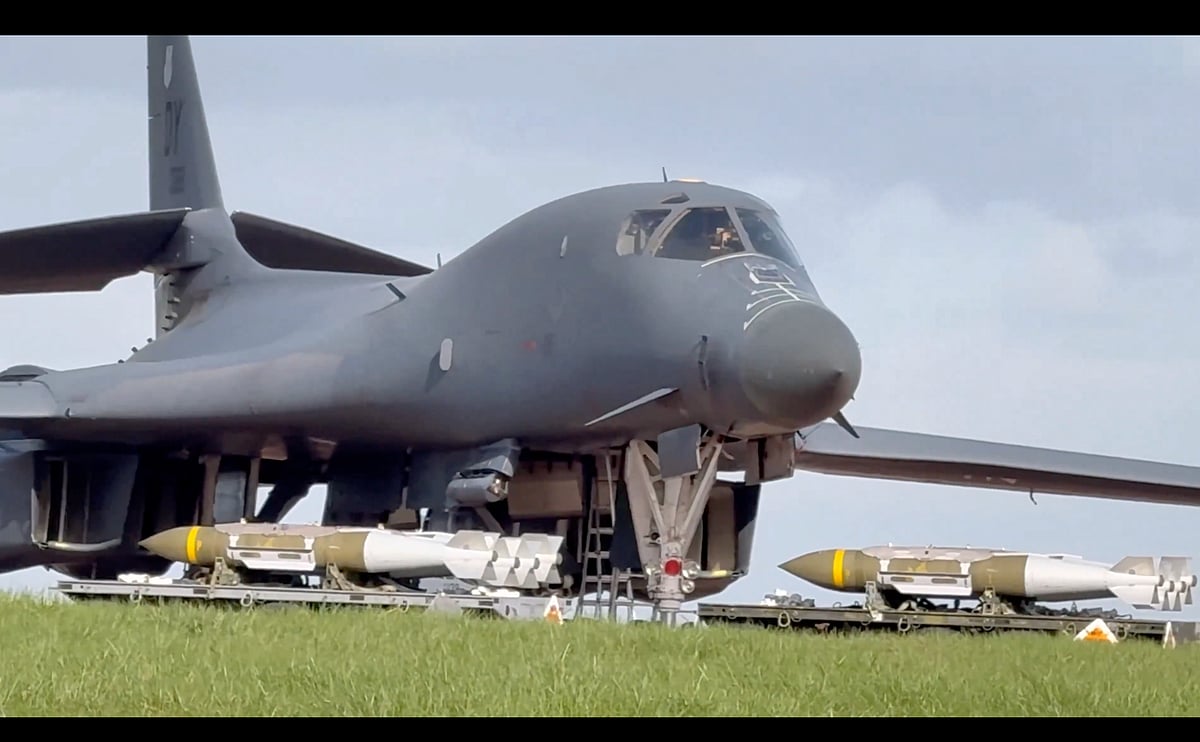
A US Air Force B1 bomber: The primary 5,000-lb (2,300 kg) class laser-guided "bunker buster" penetrator bomb used by the US is the GBU-28, which uses the BLU-113 warhead. A newer 5,000-lb guided bomb unit, the GBU-72 Advanced 5K Penetrator, has also been developed for enhanced, deep-target penetration, tested for use on F-15E and B-1B platforms.
X | @defense_civil25
The US Central Command has confirmed a "precision strike" that has dramatically shifted the battle for the Strait of Hormuz.
American forces have employed multiple 5,000-pound deep-penetrator munitions against hardened Iranian coastal missile sites near the strait.
The target: anti-ship missile sites sowing terror on international tankers, part of Iran’s desperate bid to choke off one-fifth of the world’s oil supply.
It comes just days after President Donald Trump publicly urged Nato, China, Japan, South Korea and every oil-importing nation to join in clearing Hormuz, a strategic waterway — warning that inaction would doom the alliance and leave global shipping at Iran’s mercy.
The deep penetrators targeted hardened coastal missile sites near the Strait. Iran's anti-ship cruise missile positions form the backbone of Iran's "area-denial network" controlling the Strait of Hormuz.
Numerous fully-loaded crude oil tankers are currently stranded in the Arabian Gulf, following the US-Israel war against Iran's IRGC that led to the virtual shutdown of the narrow waterway.
90 ships crossed Hormuz since March 1: Report
AP, citing maritime and trade data platforms, reported that about 90 ships, including oil tankers, have crossed Hormuz since the outset of the US-Israel war with Iran; the latter is still exporting millions of barrels of oil at a time when the waterway has been effectively closed.
As of 11pm, a total of 15 vessels transited the waterway during the previous three days, including 8 dry bulk vessels, 5 tankers, and 2 LPG carriers, as per Marine Traffic
Around 87% were outbound transits, with many vessels taking "unusual" routes through Iranian territorial waters.
A senior regime figure suggested earlier that the crucial strait "would not be the same", and is unsafe for ships.
It's not immediately clear what class of "bunker busters" were use in this latest hit. The primary 5,000-lb (2,300 kg) class laser-guided "bunker buster" penetrator bomb of the US military is the GBU-28, which uses the BLU-113 warhead.
A newer 5,000-lb guided bomb unit, the GBU-72 "Advanced 5K Penetrator", has also been developed for enhanced, deep-target penetration, tested for use on F-15E and B-1B platforms.
Given the shift in CentCom's focus, it's also not clear what effect it may have on global trade and oil prices.
UK's mine-hunting drones
UK Energy Secretary Ed Miliband earlier told reporters on Sunday that Britain is now “intensively” examining a targeted UK contribution: deploying autonomous mine-hunting drones and supporting vessels already in the region through the Royal Navy’s Mine and Threat Exploitation Group.
London sees this as the smart, low-risk way to help without triggering full-scale naval escalation.
The US-led (with Israeli support) campaign that began on February 28, 2026 after coordinated strikes killed Iran’s Supreme Leader Ali Khamenei and targeted nuclear and military sites.
Key recent CENTCOM actions include:
Destruction of over 100 Iranian naval vessels and 16 minelayers near the strait.
More than 6,000 combat flights establishing total US air superiority.
Precision strikes on Kharg Island (Iran’s main oil export hub) that wiped out naval mine storage and missile bunkers while sparing civilian oil infrastructure.
Repeated warnings to Iranian civilians to stay away from ports being used by the IRGC for attacks — because those facilities have lost protected status.
Ongoing hunts for Iranian command posts, air defences, missile launchers and drone facilities across the country.
This photograph shows a marine mine-hunter drone at the French multinational aerospace and defence corporation Thales site in Brest, western France, on October 1, 2025.
Neutralising anti-ship cruise missile batteries
The latest strike (17 March 2026) specifically neutralised coastal anti-ship cruise missile batteries that Iran had positioned to sink tankers.
CentCom described the sites as “hardened” bunkers — exactly the kind of targets the 5,000-pound deep-penetrators (bunker-buster variants) are designed to destroy.
Despite these successes, Iran is believed to have laced parts of the strait with naval mines — the remaining threat that full-size warships cannot easily clear without high risk.
That is where Britain’s specialised drone technology comes in.
All controlled from a portable shore- or ship-based station, these systems keep British sailors out of the "kill" zone while clearing mines at four times faster than legacy methods, according to Naval industry sources.
How UK mine-hunting & minesweeping drones work
The UK is not sending crewed minehunters into harm’s way. Instead, it relies on proven unmanned systems already forward-deployed in the Middle East:
RNMB Ariadne — a 12-metre autonomous surface vessel that tows the world-beating Towed Synthetic Aperture Multiview Sonar (TSAM). It scans the seabed from three angles in one pass, generating ultra-high-resolution 3D images. AI classifies every contact instantly.
Once mines are located, small remotely operated vehicles place explosive charges for safe, remote detonation.
The SWEEP minesweeping drone sails programmed patterns that perfectly mimic the magnetic, acoustic and pressure “signature” of a supertanker — deliberately triggering “influence” mines from a safe distance.
They are exactly the tools needed now that US strikes have taken out the missile batteries.
Domestic fallout, global priority
Ministers are simultaneously modelling the home-front impact. The partial blockade has already spiked petrol, diesel and wholesale energy prices, threatening Britain’s fragile recovery and household bills.
Whitehall sources say reopening the strait remains “a global priority” — and the combination of US firepower plus British drone clearance offers the fastest, least escalatory path forward.
No final decision has been announced on timing or scale of UK deployment, but officials stress everything is being coordinated “in concert with allies.”
With the missile threat now cratered and mines the last major obstacle, Britain’s autonomous systems could be the decisive factor in restoring the free flow of oil — and easing the pain at UK petrol pumps.
The situation is moving at breakneck speed.
Trump’s call for burden-sharing has been answered in part by American action on the missiles — now the world watches to see whether European allies, specifically France and the UK, will do the job on the mines.
Sign up for the Daily Briefing
Get the latest news and updates straight to your inbox
Network Links
GN StoreAbout Gulf NewsTerms & ConditionsReach by GNSitemapContact usPrivacy PolicyGN FocusHave your sayWork with usAdvertise with usGulf News epaperPrinting Services
Download our app
© Al Nisr Publishing LLC 2026. All rights reserved.