Hormuz mine war? Report warned US lacked enough mine-clearing power vs Iran
US naval preparedness against Iranian mine threats in focus
In naval warfare, few weapons are as effective — or as disruptive — as marine mines.
Of the 20 US Navy ships that have been severely damaged or sunk by adversary action since September 1945, 15 were "mine" victims.
The US has also used as both offensive and defensive weapons: when the US Navy employed mines in Haiphong in 1972, they were effective operationally and politically.
However, backing for US mine warfare (MIW) is "lacking" at worst and "fragmented" at best.
Result: a watered down "MCM", said retired Rear Admiral Paul Ryan, former commander of the US Navy’s Mine Warfare Command, who was cited in a decade-old report.
MCM stands for marine countermeasures (MCM) — naval operations focused on detecting, locating, neutralising, and clearing sea mines to ensure safe maritime navigation and protect naval assets
2015 report cites 'lack of support' for US mine warfare
The report, titled "Wanted: US Navy Mine Warfare Champion" written by Scott C. Truver, was published by the US Navy War College in 2015.
More importantly, the now-decade-old report highlighted a "lack of support" for mine warfare in the US Navy, potentially with implications for the current Iran conflict.
For example, it stated that the heavy-lift Sea Dragon MH-53E helicopter designed for MCM missions "continue to be sundowned.”
Instead, the MH-53Es were replaced by the medium-lift MH-60S helicopter.
Naval mine warfare has long been a central pillar of the maritime doctrine of the Islamic Revolutionary Guard Corps (IRGC) Navy, according to a 2017 assessment by the Office of Naval Intelligence
The tactic is now emerging as a major factor in the ongoing conflict with Iran
Reports indicate that Iranian forces began laying naval mines in the Strait of Hormuz recently
This raises concerns over the security of one of the world’s most vital energy shipping corridors.
The US CentCom announced recently that US forces had struck 16 Iranian vessels believed to be engaged in mine-laying operations
It forms part of efforts to prevent disruption of commercial traffic and oil shipments through the narrow waterway.
US President Donald Trump recently asked Nato allies and other countries, including China, who benefit from the Hormuz to "police" the strait.
Avenger surface mine vessels 'stricken'
Likewise, challenges to the littoral combat ship were seen "jeopardising" mine-countermeasures modernisation as the Avenger surface MCM vessels were "stricken" off the Navy list, the report added.
For decades, the 14 Avenger-class ships, built between 1987 and 1994, served as the primary mine countermeasures force for the US Navy.
In January 2026, four Avenger-class ships — USS Devastator (MCM 6), USS Dextrous (MCM 13), USS Gladiator (MCM 11), and USS Sentry (MCM 3) — were loaded onto the transport ship M/V Seaway Hawk in Bahrain to be transported to Philadelphia for disposal.
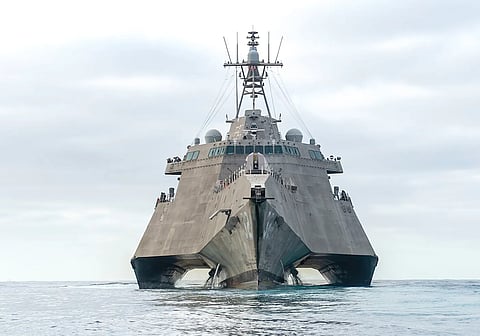
Now, the role of the Avenger class is being taken over by Independence-class Littoral Combat Ships (LCS) fitted with state-of-the-art mine countermeasure modules.
Irony, paradox
The report stated: "The great irony and paradox for the US Navy lie in the fact that mines do work and that mines/mining and MCM (mine countermeasures) will almost certainly be needed in a future crisis or conflict."
"More to the point of mines and mining in Navy strategies and operations is that in various fleet exercises during the past decade, senior flag officers have been increasingly concerned that they could not carry out operation plans because of a lack of modern mines and platforms."
During international MCM exercises in the Arabian Gulf in 2012 through 2014 stimulated by Iran’s “mine rattling” threats to close the Strait of Hormuz, numerous US and foreign navy surface and airborne MCM and EOD forces tested capabilities against threats.
This process helped identify both weaknesses and strengths.
Though issued more than a decade ago, it highlights a key point relevant amid the only US-Israel war against Iran.
'Mini-renaissance'
Since 2003, however, a “mini-renaissance” in MIW — primarily mine countermeasures — has emerged, bolstering optimism for mines and mining, the report highlighted.
"Unlike the history of the previous 50 years, there was no apparent mine embarrassment in the early 2000s that generated sufficient support to get MIW funding up to levels where it started to make a difference," Truver wrote.
"While that might be the case for MCM, the US Navy’s mining programs have also severely atrophied," the report stated then.
Things have changed ever since.
Independence-class LCS are reportedly in the Arabian Gulf conducting mine countermeasures operations, alongside with unmanned surface vehicles.
The USS Santa Barbara also made naval history by executing the first-ever at-sea launch of a LUCAS one-way attack drone from a littoral combat ship under Task Force 59.
While hunting mines, she's operating under armed overwatch from A-10C Warthogs loaded with JDAMs, laser-guided APKWS rockets, and enough firepower to shred any fast boat or drone swarm the Islamic Regime throws at them.
USS Canberra arrived in Bahrain in May 2025 as the first LCS with a full MCM mission package. USS Tulsa is right there alongside them.
Mine countermeasures
The current LCS fleet of the US Navy are fitted with autonomous mine-hunting sonars, the AN/AQS-20C, towed by unmanned surface vehicles so sailors stay outside the minefield.
Airborne laser mine detection systems are fitted on MH-60 helicopters, and are able to deploy unmanned influence sweep systems for acoustic and magnetic minesweeping.
Despite the escalating threat, the United States Navy says it is confident that its next-generation mine countermeasure capabilities can effectively counter Iran’s strategy.
It shows one thing: the growing use of naval mines highlights the strategic importance of Hormuz, a chokepoint and a critical flashpoint in the escalating regional war.


