What the new Asia-GCC social protection platform means for migrant workers
New initiative to help countries work together for better access to social protection
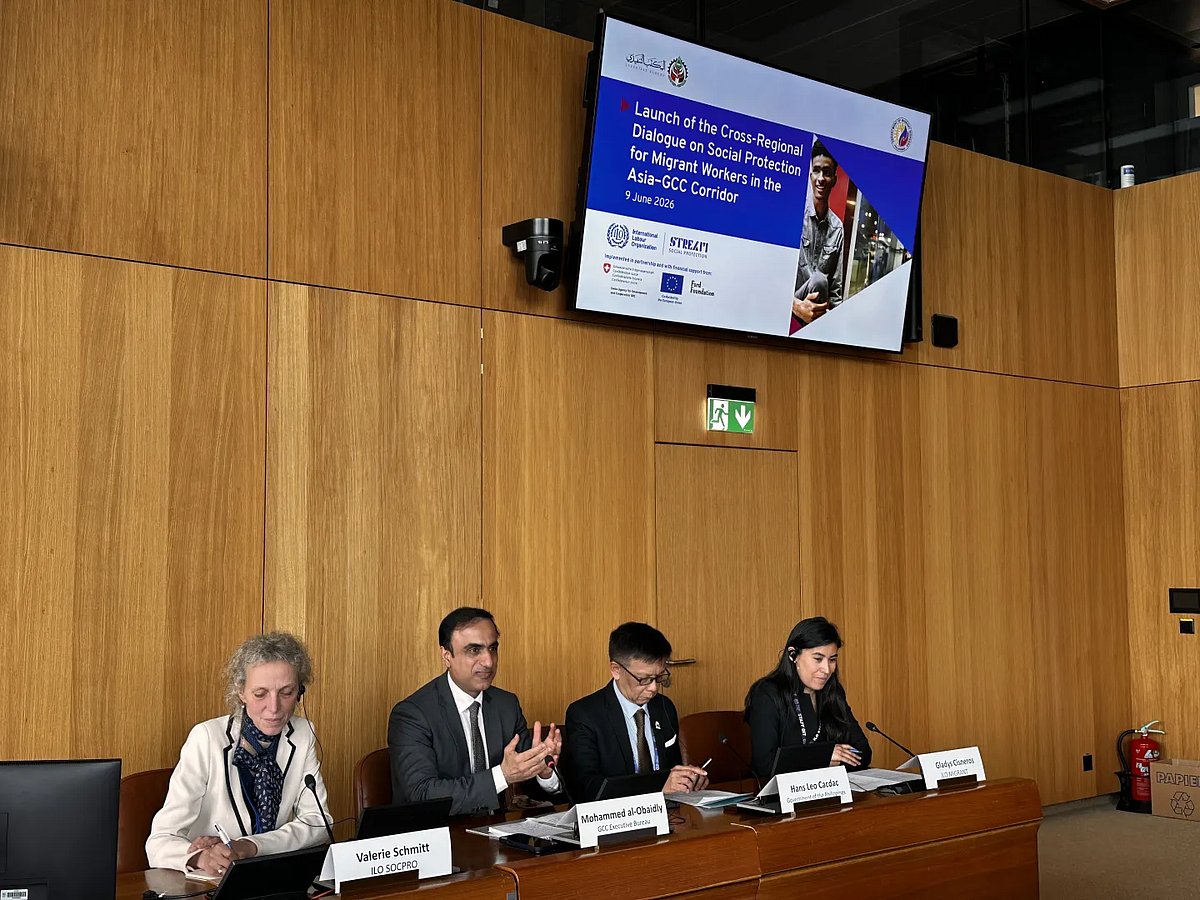
Dubai: For millions of migrant workers who leave home to build careers in the Gulf, one challenge often follows them across borders, social protection.
While many countries have introduced programmes ranging from insurance schemes to worker welfare initiatives, these systems do not always connect with one another. That can make it difficult for workers to maintain coverage or access benefits when they move between countries. A new platform has been launched this week to change that.
Unveiled on the sidelines of the 114th International Labour Conference, the cross-regional dialogue on social protection for migrant workers will bring together countries of origin and destination along the Asia-GCC corridor to find practical ways of improving protection for migrant workers and their families.
The initiative has been co-chaired by the Philippines and the GCC Executive Bureau for Ministries of Labour and Social Affairs, with support from the International Labour Organisation's (ILO) Stream programme.
Get updated faster and for FREE: Download the Gulf News app now - simply click here.
Why it matters
The Asia-GCC labour migration corridor is one of the world's busiest, with millions of workers contributing to economies across both regions.
In recent years, Gulf countries have introduced reforms aimed at strengthening labour market governance and improving protections for workers. At the same time, many Asian countries have expanded welfare mechanisms, insurance programmes, and support services for their citizens working abroad.
Yet despite this progress, social protection systems has remained largely organised within national borders. That means a worker may be covered in one country but face challenges when moving to another, especially when it comes to maintaining benefits or ensuring social security rights remain protected.
Built around cooperation
Unlike existing regional forums that discuss labour mobility more broadly, the new platform has been designed to focus specifically on social protection and how countries can work together in practice.
It will facilitate technical exchanges, peer learning, and institutional cooperation, while helping governments identify solutions that can improve migrant workers' effective access to protection.
Hans Cacdac, secretary of the Philippine Department of Migrant Workers, has noted that many protection gaps emerge because systems in origin and destination countries do not always work together.
"Strengthening social protection for migrant workers inherently requires inter-regional engagement, as protection gaps often arise at the intersection of origin and destination systems,” said Cacdac.
As the incoming chair of the Abu Dhabi Dialogue, Cacdac has stressed that the Philippines is committed to advancing the issue and hopes the new platform will help identify “concrete ways in which social protection systems can be better coordinated across borders to ensure coverage and portability of social security rights.”
Why the GCC's role is important
According to Valerie Schmitt, deputy director of the ILO social protection department, the platform's greatest strength is the fact that it is “jointly steered by countries of origin and destination.”
"The two co-chairs bring something unique: leadership from both sides of the migration corridor. This sends a powerful message that effective social protection can only be achieved through partnership, dialogue, and shared responsibility,” stated Schmitt.
For GCC countries, the platform has also offered an opportunity to showcase successful practices and learn from experiences elsewhere.
On the other hand, Mohammed bin Hassan Al Obaidli, director-general of the Executive Bureau of the Council of Ministers of Labour and Social Affairs in the GCC States, has bared that the initiative would serve as a framework for exchanging successful strategies and addressing common challenges.
"This platform functions as a framework for the exchange of successful strategies, the promotion of prominent initiatives from the GCC, and the resolution of obstacles to fulfill mutual goals in the field of social protection and labour migration,” explained Al Obaidli.
Connecting protection across borders
International partners supporting the initiative have mentioned that the challenge is no longer simply creating social protection systems, but ensuring they work across borders.
“Migrant workers connect our economies across borders. The challenge is to ensure that our systems of protection become equally connected,” said Patricia Barandun, head of section migration and forced displacement at the Swiss Agency for Development and Cooperation.
She has described the launch of a structured dialogue mechanism as an important step towards making protection “more effective, more coordinated, and more responsive to the realities of labour mobility in the 21st century.”
The European Union (EU), another partner in the initiative, has also highlighted the growing importance of cross-border social security coordination.
“Integrating social security systems across borders is a defining challenge for modern labour markets,” stated Michele Cervone, ambassador and deputy permanent representative of the EU to the United Nations.
“As countries work towards universal social protection, a major question is how can protection remain effective in a world where people are increasingly mobile?”
What’s next
With support from the ILO Stream programme, the platform will organise technical exchanges focused on implementation, coordination, and expanding access to protection over time.
Stakeholders have expressed hope that the initiative will evolve into a long-term mechanism for cooperation and eventually contribute to broader global discussions on social protection for migrant workers.
Gladys Cisneros, chief of the ILO's Labour Migration Branch, has pointed out that progress has already been made across the Asia-GCC migration corridor, but efforts often continue separately.
“Today's launch marks the beginning of what we hope will become a sustained platform for dialogue, cooperation, and practical action on cross-border social protection coordination,” shared Cisneros.
For migrant workers, the significance of the platform lies in its long-term goal to help ensure that protections do not stop at national borders, but move with workers wherever their jobs take them.
Network Links
GN StoreDownload our app
© Al Nisr Publishing LLC 2026. All rights reserved.