Filipina vlogger Alicia Lipata, aka “Mima Alicia”, 24, was shot dead by motorcycle-riding assailants outside her home in Barangay 171, Caloocan City (one of the 16 cities comprising Metro Manila) in the early hours of July 17, 2024.
Philippines: One gun, 10 shootings? How forensic experts can link a murder weapon to years of crimes
Forensic ballistics turns a single murder probe into a wider web of gun crimes
Last updated:
5 MIN READ
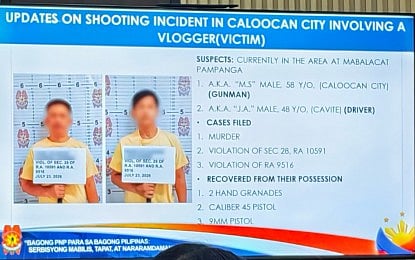
Suspects in the murder of Filipina vlogger Alicia "Mima Alicia" Lipata.
PNA
Manila: A handgun recovered from suspects in the killing of vlogger Alicia “Mima Alicia” Lipata has potentially opened a much larger criminal trail.
Now, the Philippine National Police (PNP) are saying that forensic tests conducted by ballistics experts connected the weapon to at least 10 other shootings dating back to 2016.
The Lipata case began with the fatal shooting of the vlogger outside her home in Caloocan City on July 17.
Her partner was also wounded.
Manila Northern Police District (NPD) director Brig. Gen. Benliner Capili, in a press briefing on Monday in Camp Crame, identified the gunman as a certain Manuelito Susano, the motorcycle rider as a certain John Alan de Guzman, and the third suspect as a certain Alvin Faustino.
From one murder to a possible gun trail
Faustino, the third suspect, surrendered on July 24.
Police allege that Faustino contacted the gunman, communicated information and transferred money related to the operation.
The PNP has said three other suspects remain at large: the alleged middleman “C.B.” and two alleged masterminds, “Boss A” and Jane Doe.
Clue for earlier 'hits'
The firearm evidence could give investigators something more than a lead to the people allegedly involved in Lipata's killing.
It could provide a physical bridge between cases.
If the same firearm was repeatedly used over several years, investigators can revisit old shooting cases, examine their evidence and potentially identify relationships that were invisible when each incident was investigated separately.
That is one of the most powerful uses of forensic ballistics: A gun recovered today can sometimes tell investigators where it has been before.
And in the Lipata case, police say that trail may stretch back a decade.
MOTIVE: Philippine police said the motive for Lipata's murder was an P8 million debt as well as grudges between her and the alleged masterminds of her murder. “The motive, it’s about the profession, and they also have a personal grudge, personal disagreement na nagsimula sa utang na ₱8 million ($131,200),” Philippine National Police (PNP) chief Gen. Jose Melencio Nartatez Jr. told local media on Friday. Nartatez said that Alicia owed ₱8 million to her business partners, who suspects previously arrested have identified as the “masterminds".
How investigators determine a gun's 'fingerprint'
But how can investigators determine that the same gun was used in crimes committed years apart and in different cities?
The answer lies in the microscopic marks that firearms can leave on bullets and cartridge cases every time they are fired.
The gun's 'fingerprint', however, isn't literally a fingerprint: When a firearm is fired, the bullet travels through the barrel before leaving the muzzle.
Inside a rifled handgun barrel are spiral lands and grooves that cause the bullet to spin. As the bullet travels through the barrel, those surfaces can leave microscopic impressions and "striations" on it.
STRIATIONS: A series of ridges, grooves, or linear scratches found on a surface. They commonly appear in biology, geology, and forensics
At the same time, the cartridge case is subjected to the action of the firearm.
The firing pin strikes the primer, while other parts of the gun — including the breech face and extractor/ejector mechanisms — can leave microscopic marks on the cartridge case.
Those marks are what firearms examiners study.
The firearm toolmarks are examined and they can be compared between evidence recovered from separate crime scenes and test-fired ammunition from a suspect firearm.
Step 1: Investigators collect the evidence
At a shooting scene, investigators may recover:
fired cartridge cases;
bullets or bullet fragments;
ammunition;
the suspected firearm;
and other physical evidence.
Cartridge cases can be particularly useful because they are often recovered in greater numbers and can carry several microscopic marks. Bullets can be damaged or deformed after striking a person, vehicle, wall or another object, making comparison more difficult.
In the Lipata investigation, police say a .45-calibre firearm was recovered after Susano and de Guzman were arrested.
Step 2: The recovered gun is test-fired
If investigators have a suspected firearm, a forensic laboratory can conduct controlled test fires.
The resulting bullets and cartridge cases provide reference samples from that particular firearm.
Examiners then compare those test specimens with ammunition evidence recovered from crime scenes.
The basic question is: Do the microscopic toolmarks show sufficient agreement to conclude that the questioned ammunition was fired by the same firearm?
Step 3: Examiners compare microscopic marks
This is where the science becomes more sophisticated than simply checking whether two bullets are both .45 calibre.
Calibre tells investigators what ammunition the gun can fire. It does not identify the individual gun.
Two different .45-calibre pistols can fire the same type of ammunition.
What investigators are looking for are microscopic characteristics produced by the particular firearm.
The barrel can leave striations on the bullet. The firing pin, breech face and other firearm components can leave corresponding marks on the cartridge case. Manufacturing imperfections and wear can contribute to these patterns.
Step 4: Investigators look backward
This is where the Lipata case becomes particularly significant.
Suppose cartridge cases recovered from a 2026 shooting are associated with a particular firearm.
Investigators can compare those markings with evidence preserved from older unsolved shootings.
If the markings correspond, investigators may discover that the same firearm appears to have been used in multiple crimes.
Experts describe this process as "case linkage": fired bullets and cartridge cases from different shooting incidents can be compared to determine whether they originated from the same firearm.
That is potentially what happened in the Lipata investigation.
Besides the PNP operating its own high-tech crime lab, the National Forensics Institute (NFI) at University of the Philippines Manila also support science-based crime investigations
Police say their ballistic examination connected the recovered .45-calibre firearm to at least 10 other shooting incidents in five Philippine cities and provinces, some dating to 2016.
If confirmed by laboratory findings and presented in court, that would mean the weapon allegedly recovered in the 2026 investigation could provide a physical connection between otherwise separate cases.
It is not simply “the bullet matched the gun”
This distinction matters. Television crime dramas often portray forensic ballistics as an instant, infallible fingerprint system.
Real forensic examination is more complicated.
Modern research has focused heavily on the reliability, reproducibility and statistical interpretation of firearm-toolmark comparisons.
Philippine police say forensic examination found sufficient agreement between toolmarks on ammunition evidence from multiple crime scenes and test-fired ammunition from the recovered firearm to associate the incidents with the same weapon.
The remarkable part of the case is not simply that police found a .45 handgun. It is that investigators say the ammunition evidence associated with that firearm may have created a forensic timeline of shootings stretching from 2016 to 2026.
Also In This Package
Philippine school shooting 'planned for weeks'
List: Senators, others named by ICC as co-perpetrators
Six students unharmed after shooting in Philippines
Boy, 8, stabbed to death; neighbour suspect released
Facial sketch released in ‘body-in-box’ killing case
How egg crates help solve 24-year-old cold-case murder
Network Links
GN StoreAbout Gulf NewsTerms & ConditionsReach by GNSitemapContact usPrivacy PolicyGN FocusHave your sayWork with usAdvertise with usGulf News epaperPrinting Services
Download our app
© Al Nisr Publishing LLC 2026. All rights reserved.