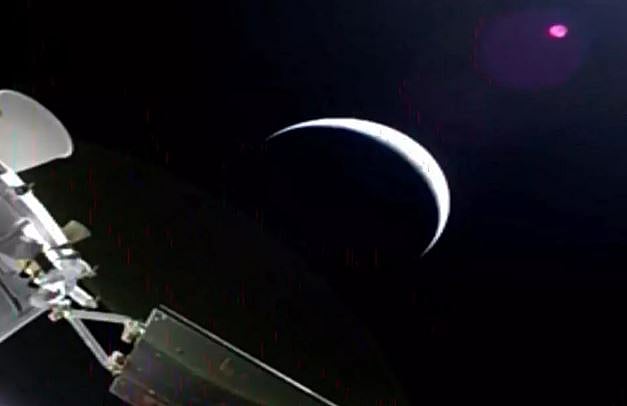
A total solar eclipse greeted the three Americans and one Canadian as the Moon temporarily blocked the Sun from their view. Mercury, Venus, Mars and Saturn shone in the black void, while the Apollo 12 and 14 landing sites served as poignant reminders of NASA’s first era of lunar exploration over 50 years ago.
The spectacle occurred shortly after the crew made their closest approach to the Moon, just over 4,000 miles away. Communications with Earth were lost for roughly 40 minutes as the spacecraft passed behind the lunar surface.
Get updated faster and for FREE: Download the Gulf News app now - simply click here.
Stunning views of the Sun’s corona
For nearly an hour, the crew observed the Sun’s outer atmosphere, the corona, while monitoring for unusual solar activity. NASA geologist Kelsey Young said their “unique vantage point” allowed them to describe solar features back to Earth.
All four astronauts used eclipse glasses to safely view the event. Venus appeared as a small white dot against the darkened Moon, alongside Mercury, Mars and Saturn in the distance.
Breaking records and celestial sightseeing
Artemis II also broke Apollo 13’s distance record, reaching 252,756 miles from Earth — more than 4,000 miles farther than Apollo 13.
It is blowing my mind what you can see with the naked eye from the Moon right now. It is just unbelievable.Jeremy Hansen
In a retro throwback to Apollo missions, Artemis II shattered Apollo 13’s distance record. NASA’s Orion capsule reached 252,756 miles (406,771 km) from Earth, 4,101 miles farther than Apollo 13, before performing a U-turn behind the Moon. “It is blowing my mind what you can see with the naked eye from the Moon right now. It is just unbelievable,” radioed Canadian astronaut Jeremy Hansen, challenging this generation to surpass the milestone.
Emotional moments
The astronauts carried Apollo-era memorabilia, including the Apollo 8 silk patch, and received a recorded message from Apollo 13 commander Jim Lovell.
Commander Reid Wiseman and his crew shared moments of awe and emotion, reflecting on humanity’s place in the universe while taking in the majestic lunar landscape.
Free-return trajectory sets course for home
Artemis II followed a free-return lunar trajectory, similar to Apollo 13, using Earth and Moon gravity to safely return the crew to Earth. The mission lays the groundwork for Artemis III, which will land astronauts near the Moon’s south pole in 2027.
Breaking distance records
The mission set a new distance record, surpassing Apollo 13, reaching 252,756 miles from Earth. The crew also captured breathtaking images of lunar craters, Apollo landing sites, and Earthrise.
Emotional moments and Apollo heritage
Commander Reid Wiseman and the crew carried Apollo-era memorabilia, including the Apollo 8 silk patch. The astronauts shared moments of awe and emotion while navigating the Moon’s surface and capturing historic sights.
Artemis II paves the way for lunar landing
This mission, NASA’s first crewed Moon trip since 1972, lays the groundwork for Artemis III, which will land astronauts near the Moon’s south pole in 2027. The crew’s lunar flyby combined science, exploration, and unforgettable views of the cosmos.
With inputs from AP, NASA
Network Links
GN StoreDownload our app
© Al Nisr Publishing LLC 2026. All rights reserved.