Why NASA approved iPhone 17 Pro Max for Artemis II Moon Mission: Inside the 4-phase testing process
To pass, the phones were modified for 'space mode'
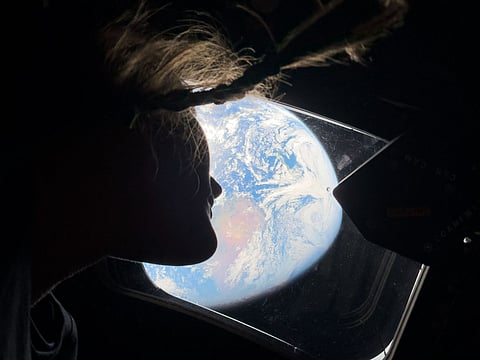
NASA’s Artemis II mission is a milestone moment on multiple fronts. For the first time in over 50 years, the agency has sent a crewed spacecraft into deep space, marking its return to human lunar exploration in the 21st century. But alongside that historic leap comes a surprisingly modern twist: astronauts are carrying smartphones.
Yes, each crew member aboard the Orion spacecraft has been equipped with an iPhone 17 Pro Max to document the journey.
A first for NASA and for smartphones
This is the first time NASA has officially approved an iPhone for use on a crewed deep-space mission. While astronauts have long relied on professional gear like DSLRs and GoPros, this marks a shift toward more accessible, everyday technology. The phones help in capturing moments: Earth glowing in the distance, the moon up close, and the human side of space travel.
NASA has already been sharing some of these images, including stunning views of Earth and the lunar surface, all taken on the iPhone 17 Pro Max, launched in September 2025.
Why approval wasn’t simple
Getting a smartphone into space isn’t as easy as slipping it into a pocket. NASA follows a strict, multi-phase safety process before clearing any hardware. According to reports cited by The New York Times, experts like Tobias Niederwieser from BioServe Space Technologies evaluate every device for potential risks in microgravity.
So what are the concerns: If the phone’s glass, like its Ceramic Shield display or sapphire lens. were to shatter, fragments wouldn’t fall. They would float freely inside the cabin, posing a danger to astronauts’ eyes, skin, or even their breathing.
To prevent this, NASA identifies hazards, creates mitigation plans, and tests them thoroughly before giving the green light.
The safety panel review
The hardware was first introduced to a panel that treated the iPhone not as a gadget, but as a flight component. They analysed every material used in the device, from the titanium frame to the internal adhesives.
Hazard identification
The biggest concern wasn't software, but shatter-physics. In microgravity:
Floating shards: If the screen or sapphire lens shatters, the fragments don't fall. They float, posing a risk to the crew's eyes and lungs.
Battery stability: Lithium-ion batteries behave differently under radiation and pressure changes.
Off-gassing: Materials in the phone had to be tested to ensure they wouldn't release toxic vapors into the Orion’s closed-loop air system.
The mitigation plan
To pass, the phones were modified for "Space Mode":
Permanent airplane mode: All cellular, Wi-Fi, and Bluetooth chips are strictly disabled to prevent interference with Orion’s navigation.
Physical security: The phones are stored in reinforced suit pockets during launch and secured with Velcro or specialised mounts inside the cabin to prevent them from becoming projectiles.
Feasibility validation
NASA demonstrated that the 'ceramic shield 2' glass on the iPhone 17 Pro Max met durability standards and that the mitigation plans (like the suit-pocket storage used by astronaut Jeremy Hansen) were effective.
Not your typical phone usage
Even though it’s a consumer device, the iPhone isn’t being used in the way you might expect. There’s no cellular connection, no internet, and no Bluetooth. Instead, it functions primarily as a high-quality camera. Some units are even secured with Velcro or tucked into suits, because in microgravity, even a phone can drift away.
Apple stayed out of it
Apple Inc. wasn’t directly involved in getting the device approved. NASA handled the entire certification process independently. Apple has, however, acknowledged that this is the first time an iPhone has been fully qualified for use both in Earth orbit and deep space.
A small shift with big implications
The inclusion of the iPhone 17 Pro Max may seem like a small detail, but it signals a shift: Consumer tech is beginning to earn a place in space missions.
For now, smartphones are there to document, not operate. But as technology evolves, they could play a larger role in how astronauts capture, share, and even experience life beyond Earth.


