Apple's new iPhone 17e is out. Should you buy it over the iPhone 17?
Apple’s new budget model cuts key features, but keeps the power
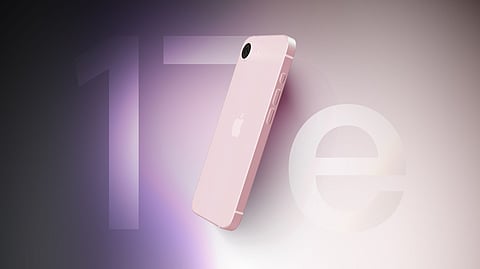
Dubai: Apple has just launched the iPhone 17e, and the big question everyone is asking is simple: is the cheaper model actually worth it, or should you stretch the budget for the full iPhone 17?
Here is everything you need to know, with all the technical jargon explained.
The price difference
This is the most straightforward part. In the UAE:
iPhone 17e: Starts at Dh2,599 (256GB)
iPhone 17: Starts at roughly Dh2,900 and goes higher depending on storage
That is a meaningful gap. Both phones come with 256GB as the base storage option, with a 512GB version available for Dh800 more on either model.
Pre-orders for the 17e open on March 4, with retail availability from March 11.
What they have in common
Before getting into the differences, it is worth noting where the two phones are actually identical:
Both run on Apple's A19 chip, the latest generation processor
Both use Ceramic Shield 2 on the display, Apple's toughest scratch-resistant glass to date
Both start with 256GB of storage as standard
Both support MagSafe, which is Apple's magnetic wireless charging system that also works with a range of accessories like wallets and cases
Design comparison
Design wise, almost identical. The two phones are nearly the same size and weight, with the 17e being just a fraction shorter and slightly lighter.
Both have aluminium frames and use Ceramic Shield 2 on the front, which is Apple's toughened glass designed to resist drops and scratches. Both are rated IP68, meaning they can handle being submerged in water up to six metres deep for up to 30 minutes.
Colour options are where they differ slightly:
iPhone 17e: Black, White, Soft Pink
iPhone 17: Black, White, Blue, Green, Lavender
The screen
This is one of the more noticeable differences in day-to-day use.
The 17e has a 6.1-inch screen and the 17 has a slightly larger 6.3-inch one. Both use Super Retina XDR displays, which is Apple's term for bright, sharp, colour-accurate screens. Both are sharp at 460 pixels per inch, which is excellent.
Where the 17e falls behind:
Its screen refreshes at 60Hz, meaning scrolling feels slightly less silky smooth compared to the 17's 120Hz display. Think of Hz like frames per second on a video: the higher the number, the smoother everything looks.
It is dimmer, particularly outdoors. The 17e tops out at 1,200 nits with HDR content, while the 17 can reach 3,000 nits in bright sunlight. Nits are simply a measure of screen brightness.
It does not have an always-on display, so the screen goes dark when not in use rather than showing the time and notifications at a glance.
The cameras
The 17e has one rear camera. The 17 has two.
Both share the same 48MP main camera with 2x optical zoom, which will be more than enough for most people's everyday photography.
What the 17e is missing:
A 48MP ultrawide camera, useful for landscapes and group shots where you need to fit more in the frame
Macro photography, which lets you take very close-up detailed shots
The ability to shoot spatial photos for the Apple Vision Pro headset
Some of the more advanced Dolby Vision video modes
The front camera on the 17e is also slightly less advanced, at 12MP compared to the 17's 18MP with more automatic tracking features.
Battery life
Both are solid, but the 17 lasts longer.
iPhone 17: Up to 27 hours of video streaming according to Apple, with real-world testing coming in around 24 hours
iPhone 17e: Up to 21 hours according to Apple, likely closer to 18 hours in practice
For most people, 18 hours of battery is perfectly fine for a full day. But if you are a heavy user, the 17 has the edge.
The chip and performance
Both phones run on Apple's A19 chip, which is the brain of the phone. In practical terms, they will feel almost identical for everyday tasks like scrolling, messaging, streaming and photography.
The only difference is a small one in the graphics processor, which handles visuals. The 17 has a five-core GPU and the 17e has four cores. Unless you are doing heavy gaming or video editing, you are unlikely to notice the difference.
Both phones also support Apple Intelligence, which is Apple's suite of AI features including writing tools, smarter Siri responses, and photo editing powered by artificial intelligence. This works the same on both models.
Connectivity
Here the 17 pulls further ahead, though most people will not feel the difference.
The iPhone 17 supports Wi-Fi 7, which is the latest and fastest version of Wi-Fi. The 17e supports Wi-Fi 6, which is still fast and perfectly capable. The 17 also supports a more advanced version of 5G called mmWave, which offers faster speeds in very specific locations like airports and stadiums. The 17e supports standard 5G, which covers the vast majority of situations.
The 17 also has more precise GPS using dual-frequency location tracking, compared to the 17e's single-frequency system.
So which one should you buy?
If you want the best camera flexibility, the smoothest screen, and the longest battery life, the iPhone 17 is the better phone. But it costs more.
If the price difference is a deciding factor, the iPhone 17e is genuinely excellent. It has the same chip, the same AI features, the same build quality, the same main camera, and more than enough battery for most people. The compromises are real but they are not dramatic.
For the majority of everyday users, the 17e will do everything they need it to and more.
What else Apple is launching this month
Alongside the 17e, Apple is also launching the new iPad Air M4 in the UAE on the same dates, with pre-orders from 4th March and retail availability from 11th March.
The M4 chip is Apple's most powerful tablet processor, offering significantly faster performance than previous iPad Air models for tasks like editing photos, multitasking, and running creative apps.
11-inch iPad Air M4: Dh2,499
13-inch iPad Air M4: Dh3,299
Both sizes support Wi-Fi 7 and optional 5G, and are compatible with the Apple Pencil Pro and Magic Keyboard for anyone who uses their iPad for work or creative projects.
Apple has also hinted that more product announcements are expected this week.
Areeba Hashmi is a trainee at Gulf News.
Stay updated: Get the latest faster by downloading the Gulf News app - it's completely free. Click here for Apple or here for Android. You can also find it on the Huawei AppGallery.