From $7 to a billionaire: How PNC Menon built Sobha’s global real estate empire
PNC Menon’s journey from $7 in Oman to billions, shaping real estate across continents
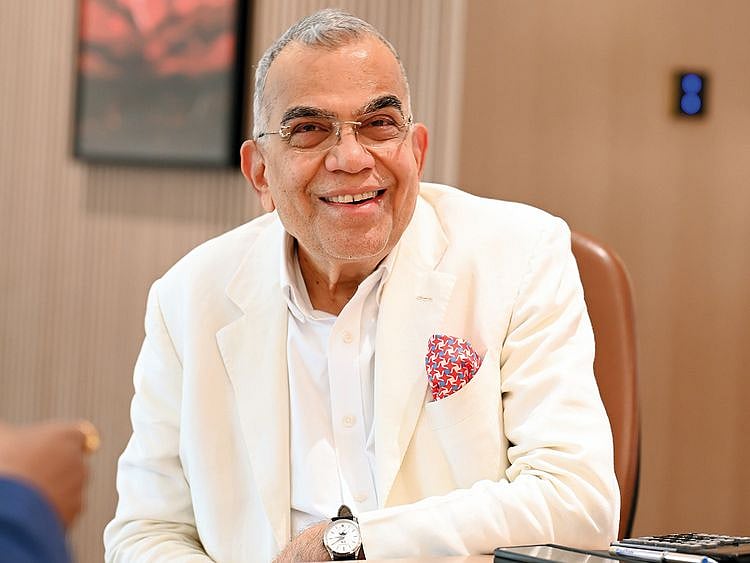
Dubai: Puthan Naduvakkatt Chenthamaraksha Menon, popularly known as PNC Menon, arrived in Oman in 1976 with just $7 in his pocket. From those modest beginnings, he founded an interior decoration firm that quickly gained prominence, securing contracts for royal palaces and ornate mosques across Oman, the UAE, Bahrain, and Qatar. Today, as Founder of Sobha Group, Menon oversees a multinational real estate and construction powerhouse that supports over 50,000 families worldwide.
I met Menon for the first time at the opening of 'The Gallery'. Journalists had gathered for a preview, eager to hear from him directly. My first impression was how effortlessly he lit up the room, leaning on humour rather than ceremony. His down-to-earth manner set the tone.
Despite his billionaire status, he carried a charm that felt unforced. He was approachable, present, and curious in return, which made everyone feel welcome.
“There have been multiple steps in my life. Somebody asked me 35 years ago how many steps there were in my dream. I said I've got 1,000 steps, and I am on the 10th step, and The Gallery by Sobha Furniture is my 20th step,” Menon said. “Fortunately, I have a son who's just now completed his 44 years after finishing his engineering. He has been a rank holder, so succession from the ownership this thing is already clear.”
Backward Integration
Menon’s commitment to 'Backward Integration', controlling everything from design and manufacturing to construction in-house, forms the bedrock of Sobha’s success. This approach, initially met with scepticism, earned validation through a Harvard Business School case study in 2019 by professors John Macomber and Alpana Thapar, which examined its replicability amid decisions on precast concrete plants and ready-mix operations for massive projects like Bangalore’s Sobha Bellahalli complex. “The Backward Integration model has been there since the very beginning. I think it's just got larger and larger as the scale has grown,” Menon said.
Sobha now employs nearly 55,000 people, embedding precision and quality into its projects across 27 cities and 14 states in India and the Middle East. Ravi Menon, who took over as chairman in 2024 after studying engineering at Purdue University, carries this forward. “The passion, that sense of precision, that the sense of quality, I think that is what has been there in his 56 years of his journey, and that continues today. Backward Integration provides us with that edge to be able to provide that level of precision, that level of detailing,” Menon's son Ravi explained.
Flagship developments like Sobha Hartland in Dubai exemplify this model, where self-performance of tasks sets Sobha apart in a fragmented industry. The strategy ensures timelines and standards that competitors struggle to match, fueling 2025 year-to-date sales of Dh22.7 billion across 60 projects, ranking Sobha third overall and second among private developers.
Philanthropy as core legacy
Menon balances empire-building with profound social impact, pledging 50% of his income to philanthropy centered on women’s empowerment, rural upliftment, healthcare, education, hunger relief, and sanitation. His initiatives span the UAE, India, and Oman, touching thousands. “So 50% suppose we make say $100, $50 is for philanthropy, and we have been doing very well," Menon said. Forbes ranks him as Oman’s richest citizen and number 87 among India’s wealthiest, with a net worth of $4.6 billion.
On Dubai’s market, he stays pragmatic amid land scarcity in this 4,000 square kilometer hub. “I’m not an astrologer. Five years is too long a period. Let me tell you that we are one of the best quality makers in this country. Nobody can beat us in quality,” Menon told Gulf News in an exclusive interview. Sobha holds four years of land stock for Dh8 billion annual potential across Dubai, Abu Dhabi, and Umm Al Quwain. Globally, entries into Australia and the US build on 2024’s Dh23 billion sales, targeting Dh30 billion in 2025 via 8-10 new UAE launches.
Blueprint for entrepreneurs
Reflecting on his path, Menon distilled timeless advice. “It has been a great journey for me, because I came to Gulf with $7. I love work. I come to my office every day, it gives us excitement, and we want to always challenge ourselves and try to do better.” To aspiring developers, he urged independence. “My advice to people is don’t take advice from others." Speaking from his experience, Menion said, we had a case study with Harvard. Initially they were not prepared to accept Backward Integration, now it is their study material, so my advice is don't take advice from others. ”
Speaking about the succession, Menon said “relevance of PNC Menon is gone,” but he will always be remembered as a trailblazer. His story, stretching from Kerala to billionaire status, carries the markings of someone who rewrote conventions rather than followed them. The narrative is less about his name holding relevance today and more about the systems he built – quality-first execution, family-aligned succession plans and purposeful growth cycles that found fertile ground in UAE, one of the most competitive business arenas globally.
The ethos he championed at Sobha Realty set a standard. His roots remain central to the arc a reminder that the blueprint was personal before it became global.
Sign up for the Daily Briefing
Get the latest news and updates straight to your inbox
Network Links
GN StoreDownload our app
© Al Nisr Publishing LLC 2026. All rights reserved.