Dubai Police’s secret weapon: Insects now help solve deaths with no clues
UAE’s 1st forensic entomology unit pinpoints time of death in cases beyond autopsy limits
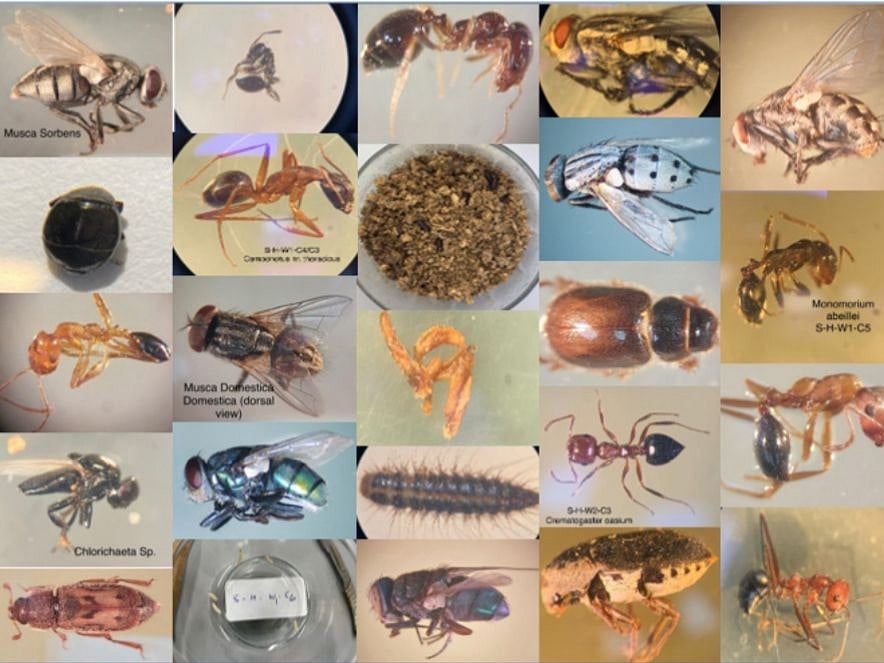
Dubai Police’s forensic entomology programme — the first of its kind in the Middle East — has evolved from a pilot project into a national reference system, with plans to share its expertise across the Gulf as regional interest in insect-based forensics grows.
In an exclusive interview with Gulf News, Lt Hussein Al Marzouqi, Assistant to Biologist Expert and Scientific and Field Supervisor of the Forensic Entomologists Team, said the programme has expanded significantly since its launch in 2022. “We initially documented 32 insect groups. Today, we have identified 34 species in Dubai that are directly linked to different stages of decomposition,” he said, explaining that this is especially critical in cases involving drying, mummification, or advanced decomposition, where conventional forensic methods can no longer provide precise answers.
The Dubai Police entomology database records insect species, larval morphology, growth timelines, environmental distribution and toxicology, providing investigators and courts with scientifically validated, repeatable evidence previously unavailable in the region. “For years, entomology existed, but without a regional database we could not rely on it. Now that gap has been closed,” Lt Al Marzouqi said, adding that the system has boosted confidence among investigators and prosecutors and reduced ambiguity in heavily decomposed cases.
The programme has drawn interest from neighbouring countries, with discussions under way with regional universities — particularly forensic medicine faculties — to help develop national databases using the same scientific framework. Similar talks are ongoing across the Middle East as capacity-building efforts, allowing each country to maintain its own reference system while sharing expertise. “The aim is not to export a ready-made database,” he said, “but to help each nation build its own based on its environment, guided by shared scientific standards.”
12 field sites, 48 monitoring points
Dubai’s rapid urban growth required extensive field research.
The team expanded monitoring locations from eight to 12 sites across the emirate, representing desert, agricultural, residential, industrial and coastal environments.
Each site contains four monitoring points — a total of 48 locations — equipped with solar-powered thermal cameras, GPS tracking and instruments measuring temperature, wind speed, and humidity.
“These are not laboratory simulations,” Lt. Al Marzouqi said. “All experiments are conducted in real environments.”
Areas such as Al Khawaneej, once largely agricultural, now contain multiple micro-environments due to construction and infrastructure expansion.
“A slight environmental change alters insect growth,” he explained. “That directly affects time-of-death calculations.”
40 decomposed bodies
Since the programme began, forensic entomology has been applied in nearly 40 investigations, ranging from natural deaths to suspected murders, suicides and drug-related fatalities. The team typically handles one to two cases a month, with a noticeable increase during hotter periods, when decomposition accelerates.
Man’s death inside restricted facility reveals security lapse
The death of a man inside a restricted industrial facility exposed a serious security lapse at a site handling valuable material. The incident occurred within a fenced compound guarded by a private security company, where public access is prohibited.
Authorities initially investigated the case as a possible crime, but forensic examinations confirmed the man had died nearly a week before his body was found. Regulations required twice-daily patrols, yet investigators, through insects, discovered no patrol had entered the area for seven days.
The deceased, a labourer living nearby, had no criminal intent and was under the influence of alcohol at the time. Investigators said the reinforced fence, standing more than three metres high, would have been extremely difficult to breach under normal circumstances.
Forensic evidence showed he died after falling inside the compound, suffering fatal head injuries and severe bleeding. Unable to move or call for help, and without a mobile phone, he remained undiscovered.
The case led to legal action between the site owner and the security contractor. Investigators identified a guard who failed to conduct patrols, prompting corrective measures and closure of the security gap.
Lt. Al Marzouqi said “We do not only uncover murder, drug or suicide cases. Sometimes we expose crimes linked to negligence, inaction or dishonesty — security gaps that could threaten the emirate or the country — and we work to close them.”
When insects cannot speak
Despite its value, forensic science has limits. Lt Al Marzouqi said some high-profile cases yielded “negative results” when insects could not access the body due to environmental barriers. In one case involving a foreign couple found in the mountains, the remains were tightly wrapped, buried under compact clay soil and deprived of oxygen, preventing entomology from determining time of death. “This does not mean the method failed, but that it was not applicable, and other forensic disciplines then take the lead,” he explained.
In contrast, another deserted-area case involving an Asian national showed insect development indicating death occurred 72 hours earlier, giving investigators a precise and critical timeframe.
Libya flood victim identification
UAE forensic specialists participated in a humanitarian mission to eastern Libya following the devastation caused by Storm Daniel. Upon arrival, approximately 20,000 individuals were reported missing, as severe flooding destroyed entire residential areas and overwhelmed local response capabilities.
The UAE teams remained in Libya for 40 days, supporting recovery and victim identification in coordination with local authorities. Expertise in DNA profiling and forensic entomology was deployed to establish standardized forensic procedures under emergency conditions.
During the mission, approximately 400 bodies were successfully identified, despite advanced decomposition resulting from prolonged exposure to seawater and debris. A temporary mortuary was established, and international identification protocols were implemented.
DNA reference samples were collected from families of the missing, with each case documented and linked to numbered burial locations. The mission ensured forensic accuracy, prevented misclassification of deaths, and upheld humanitarian principles by preserving the dignity of victims and providing closure to families.
AI, mobile apps, and the future of the field
The seven-member unit, comprising specialists, volunteers and administrative staff, is preparing to expand operations to additional emirates and coastal environments, where sea exposure introduces new decomposition variables.
Lt Al Marzouqi said one team member, originally a biotechnology graduate, has completed a master’s degree in forensic entomology in the UK. “One of my proudest achievements is establishing this project and, with strong leadership support, enabling staff to formally study this rare specialisation,” he said, noting the officer has graduated and will soon begin work — raising the number of Emirati forensic entomology specialists nationwide from one to two.
Artificial intelligence has been introduced to support investigations, allowing non-specialists to collect data and receive preliminary results, with expert review later. The project includes an AI-powered mobile app, developed with a Dubai-based company, to identify insect species at crime scenes using continuously updated data. The app is currently in the research phase.
The unit has also participated in specialised training programmes and brainstorming workshops and works closely with the Ministry of Environment’s non-climate environmental sector under the biological security framework. Lt Al Marzouqi said the aim is to develop a specialised scientific field to address multiple security gaps.
Network Links
GN StoreDownload our app
© Al Nisr Publishing LLC 2026. All rights reserved.