This photo taken on July 9, 2026 shows workers installing solar panels on a roof in Carmona, in the Philippine province of Cavite.
Solar boom: Pakistan and Philippines turn to rooftops as power costs soar
From grid anxiety to energy independence, rooftop solar reshapes power use
Last updated:
4 MIN READ
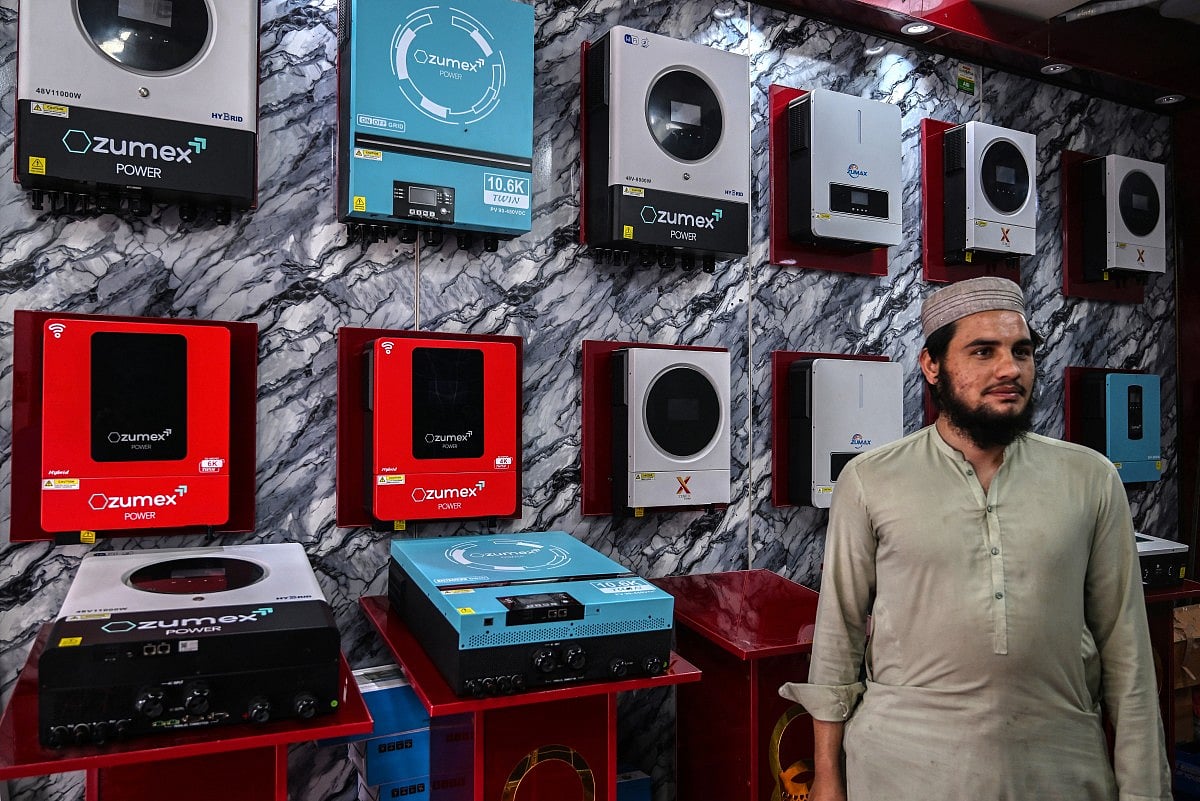
This photograph taken on April 4, 2026 shows a customer shopping for solar inverters at an electrical appliance store in Rawalpindi as Pakistan faces energy supply chain disruptions amid the Middle East war.
AFP-FAROOQ NAEEM
Manila: Millions of households and businesses in the Philippines and Pakistan are turning their rooftops into small power stations.
The reason: expensive mains electricity.
The key trigger: cheaper solar technology, thus helping accelerate a rapid shift away from grid dependence.
The two countries have emerged as major destinations for Chinese solar panels.
China accounts for about 80% of global solar-panel production.
The BBC reported that the Philippines and Pakistan ranked as the top two destinations for panels that are actually being installed domestically, excluding the Netherlands because it is largely a trans-shipment hub.
The boom has slightly different underlying drivers in each country.
Get it: Fast, verified news for FREE ... download the Gulf News app — simply click here
Economic choice
In the Philippines, climate journalist Jhesset Enano, speaking from Manila, said households began paying much greater attention to rooftop solar as the Middle East conflict raised concerns about fuel shortages and possible power disruptions.
For many Filipinos, the decision is increasingly economic rather than environmental.
“It is really more an economic choice for a lot of Filipinos.”
Enano said local solar installers who previously received around 100 inquiries a month were receiving 1,000 to 2,000 after the Strait of Hormuz crisis, highlighting how quickly interest surged.
Pakistan: A dramatic shift
Pakistan's shift has been even more dramatic. Zeeshan Ashfaq of Renewables First said the country's rooftop solar expansion accelerated after the Russia-Ukraine war pushed energy costs higher and disrupted LNG supplies.
Electricity prices rose by about 150% in three years, Ashfaq told the BBC.
The result is an unusual energy transformation: consumers are increasingly choosing solar not primarily because of climate concerns, but because they want cheaper, more reliable and more independent electricity.
A rooftop solar installation in the Philippines.
What the boom means
The BBC points to a significant change in how households view solar power.
Rooftop solar is increasingly being treated as an energy-security and household-finance tool, rather than simply a climate solution.
In the Philippines, the Middle East conflict and disruption around the Strait of Hormuz provided a psychological tipping point: people became more conscious that dependence on imported fossil fuels could expose them to international shocks.
Fossil fuel reliance
That is particularly relevant for the Philippines because its electricity system is heavily reliant on imported fossil fuels, while its geography creates additional transmission challenges across an archipelago (7,641 islands).
Enano said consumers ultimately bear the cost of losses in the centralised system.
This photograph taken on April 4, 2026 shows a worker arranging solar panels at an appliance store in Rawalpindi as Pakistan faces energy supply chain disruptions amid the Middle East war.
Pakistan's experience shows the other side of the equation: when grid electricity becomes both expensive and unreliable, households and businesses have a direct financial incentive to generate their own power.
Highlights
Philippines and Pakistan are leading a rooftop-solar surge, with millions turning roofs into electricity-generating assets.
China dominates solar manufacturing, producing about 80% of the world's panels.
The Philippines installed five times more rooftop solar in one year than during the previous 10 years combined, according to the figures cited by the BBC.
Pakistan added enough rooftop solar capacity in just two years to match its entire fossil-fuel power-plant fleet, according to energy think-tank Ember.
Philippine households spend about 12% of monthly income on electricity, according to a Reuters figure cited in the interview.
The Philippines' power prices were described as "the highest in Southeast Asia" in June, according to the country's Department of Energy, as cited by Enano.
Pakistan's electricity prices increased about 150% over three years, according to Ashfaq.
In the Philippines, concerns over fuel shortages and possible blackouts linked to the Middle East conflict helped push rooftop solar into the mainstream.
Philippine solar installers reported demand jumping from roughly 100 inquiries a month to 1,000–2,000 after the Strait of Hormuz crisis.
In Pakistan, solar is also reaching people beyond the conventional grid. One example cited was a fisher who used rooftop/personal solar to charge his phone and power lights after previously travelling 4–5 kilometres to access electricity.
Pakistan's President House has been fully powered by solar energy since 2021.
By the numbers
80% — Approximate share of global solar-panel production attributed to China.
No. 1 — Philippines' position among destinations for Chinese solar panels that remain in the country, according to the BBC discussion.
No. 2 — Pakistan's corresponding position.
5x — Increase in Philippine rooftop-solar installations in one year compared with the previous 10 years combined.
150% — Increase in Pakistan's electricity prices over three years, according to the interview.
12% — Share of monthly household income that Filipino households reportedly spend on electricity.
100 → 1,000–2,000 — Monthly solar inquiries reported by Philippine installers before and after the Strait of Hormuz crisis.
4–5 km — Distance one Pakistani fisher reportedly travelled to charge his mobile phone before having access to solar power.
Calculated moves
For an export-oriented economy such as Pakistan's, Ashfaq said high electricity costs have also made sectors such as textiles less competitive against countries including Vietnam, Bangladesh, Thailand and India.
The solar boom is being driven not only by the fight against climate change, but by a much more immediate calculation — how to keep the lights on without surrendering an ever-larger share of household or business income to electricity bills.
Also In This Package
Philippines rooftop solar — Barangay permit not needed
US builds solar capacity enough for 50 million homes
India’s power demand surges, as solar goes to waste
Middle East war sends Philippine solar demand soaring
Philippines bets on hydropower to boost grid for AI
Philippines bets billions on hydro, solar to power AI
Network Links
GN StoreAbout Gulf NewsTerms & ConditionsReach by GNSitemapContact usPrivacy PolicyGN FocusHave your sayWork with usAdvertise with usGulf News epaperPrinting Services
Download our app
© Al Nisr Publishing LLC 2026. All rights reserved.