100 days of US-Iran war: Iran fires missiles at Israel, first strike since April ceasefire
Trump urges Iran to return to talks, warns missile strikes on Israel could harm deal
Highlights
We are closing this coverage now. For latest updates, click here.
Oil climbs above $95 as traders watch supply risks, global demand outlook
Oil prices rose sharply in Asian trading Monday, with benchmark crude contracts nearing multi-month highs as investors weighed supply risks, OPEC+ production policy and expectations for stronger energy demand later this year.
As of 11:02 am (June 8, 2026) in Tokyo, US benchmark West Texas Intermediate crude traded at $93.30 a barrel, up $2.76, or 3.05%. Brent crude, the international benchmark, gained $2.78 to $95.99 a barrel, a rise of 2.99%.
Mojtaba Khamenei is 'very seriously injured': Trump
US President Donald Trump told NBC's Interviewer Kristen Welker during an explosive interview about his Iran war strategy, saying: "We're very close to having a deal (with Iran) — and if we don't have a deal, we'll do it one way or the other. Either way, we win."
On Mojtaba Khamenei: "I don't want to say whether or not I know where he is, but there's a good probability that I do... He's very seriously injured."
World facing increased nuclear risk, researchers warn
Researchers warned on Monday that nuclear-armed states were taking their arms out of storage and putting them on delivery systems, as the weapons of mass destruction are playing an increased role in global politics.
The Stockholm International Peace Research Institute (SIPRI) said the world's nuclear powers had an estimated total of 12,187 warheads, with about 9,745 of them in stockpiles for potential use.
Iran suspends flights at Tehran international airport: local media
Tehran's international airport suspended all incoming flights after Iranian missile strikes on Israel, local media said late on Sunday. "The civil aviation authority announced the suspension of all flights bound for the airport until further notice," said Iranian press agency Mehr -- the latest closure for Khomeini International Airport, one of two serving the capital, which had only re-opened in April after being shut for weeks over the Middle East war.
Get updated faster and for FREE: Download the Gulf News app now - simply click here.
Trump calls for calm, presses Netanyahu for 'restraint' after Iran missile attack
US President Donald Trump and Israeli Prime Minister Benjamin Netanyahu spoke by phone as tensions threatened to flare again following Iranian missile attacks on Israel, according to a US official cited by Axios. The reported call came at a critical moment for a fragile ceasefire that Washington has been trying to preserve after weeks of escalating confrontation involving Iran, Israel and US forces in the region.
Israel army says Iran 'committed grave mistake' by firing missiles
The Israeli military said Sunday that Iran had committed a "grave mistake" by launching a barrage of missiles at Israel.
"The Iranian terrorist regime has made a grave mistake by once again choosing the path of terror," military spokesman Brigadier General Effie Defrin.
Get updated faster and for FREE: Download the Gulf News app now - simply click here.
Israel vows to act across Lebanon, escalate against Hezbollah
The Israeli military vowed to press ahead with its military campaign in Lebanon and said it would step up operations against Hezbollah.
"The (Iranian) regime is attempting to establish a new equation through direct attacks on Israeli territory in response to IDF operations in Dahiyeh," military spokesman Brigadier General Effie Defrin said, in a televised statement.
"We struck in Dahiyeh in response to Hezbollah's relentless attacks on the communities of northern Israel. The IDF will continue to operate throughout Lebanon and will intensify its actions against the Hezbollah terrorist organisation."
Trump urges Israel not to retaliate
US President Donald Trump said he will call Israeli Prime Minister Benjamin Netanyahu to urge him not to retaliate against Iranian missile strikes on Israel, news outlet Axios reported.
"I am going to call Bibi right now and tell him not to retaliate," Trump was quoted as saying by Axios journalist Barak Ravid in a phone interview, using the Israeli leader's nickname.
"Each of them had their fun. Israel had its strike and Iran had its strike. We don't need another one," Trump said, according to excerpts of which Ravid posted on X.
Iran closes airspace over country's west
Iran closed the airspace over the west of the country after launching a salvo of missiles towards Israel in response to its latest strike on Lebanon.
"Due to safety and security assessments... the western part of the country's airspace was declared closed until further notice," said Majid Akhavan, the spokesman for the National Civil Aviation Organisation, in a statement carried by the news agency IRNA.
Get updated faster and for FREE: Download the Gulf News app now - simply click here.
Iran’s FM holds talks with UK, Turkey, Pakistan
Iranian Foreign Minister Abbas Araghchi has held calls with officials from the UK, Turkey, and Pakistan following Israel’s repeated violations of the Lebanon ceasefire.
Araghchi told Telegram that he spoke with UK Foreign Secretary Yvette Cooper and Turkish Foreign Minister Hakan Fidan to discuss the situation.
He also spoke with Pakistan’s army chief, Field Marshal Asim Munir, who has been instrumental in mediation efforts between the US and Iran.
Retaliation against Israel a 'warning', Iran's Guards say
Iran's powerful Revolutionary Guards said that Sunday night's missile attack on Israel was a "warning" after the Israeli strike on Beirut earlier in the day, threatening wider strikes in the event of new aggression.
"Tonight's operation was a warning. If such aggressions are repeated, the responses will be broader awill cover all US-Zionist targets in the region," the force said.
Iraq and Syria close airspace amid regional tensions
Iraq has temporarily closed its airspace and suspended air navigation, civil aviation officials confirmed.
At the same time, the Syrian Civil Aviation Authority announced a 12-hour closure of southern air corridors and a suspension of operations at Damascus International Airport.
Authorities in both countries cited safety and security concerns as the reason for the temporary measures.
Trump: Iran must 'get back to the table' amid missile attacks
President Donald Trump said that Iran’s recent missile attack on Israel complicates ongoing negotiations but expressed optimism that a deal is close.
Speaking to Fox News, Trump said, “You’ve shot your missiles, that’s enough. Get back to the table and make a deal.” He added that an agreement could be signed as early as Monday, Tuesday, or Wednesday this week.
Trump also criticised Israel’s airstrikes on Beirut, saying he was “not happy about it,” highlighting his concern over escalating regional tensions.
Get updated faster and for FREE: Download the Gulf News app now - simply click here.
Israel vows ‘powerful’ response after Iranian missile fire
Israel is preparing a “powerful” response to Iranian ballistic missile attacks, according to two Israeli sources cited by CNN.
The Israeli military said it has intercepted all Iranian ballistic missiles “thus far” following at least three separate barrages fired toward Israel. One source said at least 10 missiles were intercepted.
The Israel Defense Forces (IDF) said it is “currently identifying and intercepting threats” as the situation continues to develop amid heightened regional tensions.
Iran says it targeted Israeli air base with missiles
Iran’s Islamic Revolutionary Guard Corps (IRGC) has said it launched ballistic missiles at Israel’s Ramat David Air Base, located about 20km from Haifa in northern Israel.
The IRGC described the air base as the “source of aggressions” against southern Lebanon and Beirut’s southern suburbs.
Israel says intercepted all missiles fired by Iran so far
The Israeli military said it had so far intercepted all missiles fired by Iran on Sunday, while warning that the Islamic republic had launched a new salvo.
"The IDF intercepted all missiles from Iran thus far. The IDF has currently identified additional launches fired toward the State of Israel," the military said. "The Aerial Defence Array is currently identifying and intercepting threats."
US forces across Middle East remain vigilant, ready
US Central Command has confirmed that American forces deployed across the Middle East are maintaining heightened alert and are prepared to respond to any emerging threats.
The statement underscores ongoing vigilance amid rising regional tensions and recent missile activity targeting Israel.
Iran says Israel's Beirut strike 'crossed all red lines'
Iran's military central command said Sunday that Israel's latest strike on the southern Beirut suburbs had "crossed all red lines", demanding a halt to its campaign in Lebanon.
"The Israeli army must stop its attacks on southern Lebanon and the suburbs, and if it expands its attacks to that region or responds to Iran's action, it will face more devastating and regrettable blows," said General Ali Abdollahi, the head of the Khatam al-Anbiya command, without directly mentioning missile salvos that Israel said it was intercepting.
Israel says schools shut on Monday after Iran fires missiles
The Israeli military's Home Front Command said that schools across the country would be shut on Monday after Iran fired missiles at Israel.
"Following an assessment of the situation, the Home Front Command has decided to modify the instructions and place the entire country under a restricted activity level," the command said in a statement Sunday night. "No educational activities may be conducted."
Israel reports second salvo of Iranian missiles
The Israeli military warned of a second barrage of missiles fired from Iran, shortly after it reported the first such salvo since a fragile truce went into effect in April.
"An additional barrage of missiles was launched toward the State of Israel," it said. "The aerial defence array is currently identifying and intercepting threats."
Sirens sound across Israel after missile detection
Sirens were activated in multiple areas across Israel after the military detected missiles launched from Iran toward the country, the Israeli army said.
The Israel Defense Forces (IDF) reported that it remains on high alert for potential strikes in the coming hours. The warning comes hours after a deadly attack in Beirut’s southern suburbs, which the military linked to escalating regional tensions.
Israel army says territory being targeted by Iranian missiles
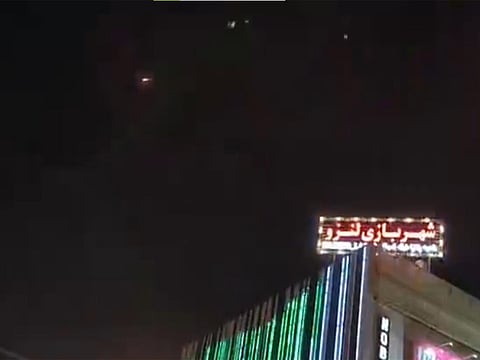
The Israeli army said it had detected incoming missile fire from Iran on Sunday, a first since a fragile truce went into effect in the Middle East war in April.
"A short while ago, sirens were sounded in several areas across the country, following the identification of missiles launched from Iran toward the State of Israel," the military said, in a statement.
The situation is ongoing, and authorities have urged residents to stay alert and follow official safety instructions.
Get updated faster and for FREE: Download the Gulf News app now - simply click here.
Israel army uncovers tunnel network under Beaufort castle
The Israeli military said it uncovered a sprawling tunnel network beneath the Beaufort castle in southern Lebanon, saying it was built to give Hezbollah a fortified strike hub just kilometres from Israeli territory.
Israeli soldiers recaptured the crusader-era castle recently, giving the military a strategic toehold it once occupied for nearly two decades.
"The tunnel network was constructed within a civilian area at a location that provides operational control over the Galilee Panhandle region, only six kilometres from Metula (in Israel), and served as a central Hezbollah terrorist organisation hub in the area," the military said.
It said the tunnel network was funded by Iran and engineered to shelter hundreds of fighters.
"In one tunnel, approximately one kilometre in length, troops located six underground shafts, a storage room used for weapons, an anti-tank missile launcher, anti-tank missiles, grenades, ammunition, combat equipment, advanced medical equipment, and several living quarters, including shower facilities, restrooms, an operating room, and kitchens," the military said.
Footage released by the military showed one narrow tunnel - similar to those found beneath Gaza - equipped with washrooms, trunks full of clothes, beds, a folded wheelchair and other household items.
Beaufort castle's elevated position and location near the border with Israel has turned it once again into a desirable position as Israel pursues its ground invasion in Lebanon.
Iran threatens US interests, Israel after Beirut strike
Iran's chief negotiator warned on Sunday that an Israeli strike on south Beirut and the ongoing US blockade of Iranian ports would trigger retaliation.
In a social media post, parliamentary speaker Mohammad Bagher Ghalibaf accused Washington of giving Israel the "green light" for strikes that hit two targets in the Lebanese capital.
This and the blockade, he said, "turns the bases and assets of America and the (Israeli) regime in the region into legitimate targets. Our armed forces, as always, are free to act".
Trump says he 'didn’t guarantee no war'
US President Donald Trump has pushed back against claims that he broke campaign promises to keep the United States out of new military conflicts.
In a pre-taped interview on NBC’s Meet the Press, aired Sunday, Trump said he never guaranteed there would be no war, adding that his focus was on strengthening the US military.
Well, first of all, I didn’t guarantee no war. Why would I have built the strongest military in the world?Donald Trump
Trump defended ongoing US military operations, including actions involving Venezuela and Iran, saying they are not comparable to long-running conflicts such as Iraq and Vietnam.
“We’re there for a few months. And the threat is largely over. Soon it will be over,” he said.
Trump also reiterated his stance on Iran’s nuclear programme, warning that it must not be allowed to develop nuclear weapons, saying the US cannot permit that under any circumstances.
Get updated faster and for FREE: Download the Gulf News app now - simply click here.
Kuwait files second ICAO protest over airport violations
Kuwait’s Civil Aviation Authority has submitted a second formal complaint to the International Civil Aviation Organization (ICAO), accusing Iran of repeated airspace violations and attacks on Kuwait International Airport facilities.
The authority said the incidents represent a serious breach of international aviation treaties and pose risks to passengers, airline operations, and airport infrastructure.
It said the latest strike on Terminal 1 last week caused fatalities, injuries, and major damage, forcing a temporary suspension of flights and disrupting airport operations.
Kuwait noted the attack came just 48 hours after Terminal 1 reopened following earlier repairs from a previous incident in February.
The authority urged ICAO to take urgent action to prevent further violations and hold those responsible accountable under international law, while reaffirming Kuwait’s right to protect its sovereignty and aviation safety.
Trump urges more 'surgical' strikes against Hezbollah: NBC
US President Donald Trump called for more "surgical" strikes against Hezbollah in Lebanon in an interview broadcast Sunday.
"I'd like to see Lebanon have a better life. I'd like to see a more surgical attack on Hezbollah. I think it should be more surgical," Trump said, according to a transcript of the interview with NBC's "Meet the Press," recorded Friday.
Trump says no plan to withdraw troops from Iran conflict
US President Donald Trump has said he is not planning to withdraw around 50,000 troops involved in the Iran war until there is a “completion” of the operation.
Speaking in an interview with NBC’s Meet the Press, Trump said he does not consider the troops to be in danger, adding that the US has “the best defence anyone has ever seen” and “the best offence anyone has ever seen.”
“I would say it would be foolhardy to do that because maybe we may use them,” he said, referring to the possibility of keeping forces deployed.
During the interview, Trump also compared casualties in the current operation with past US wars, including Vietnam, noting that 13 US personnel had been killed so far. He described the figure as “too many” but significantly lower than historic conflicts.
Trump added that he believes the US is “doing a great job” in the ongoing operation.
Trump calls Iran’s leader 'more rational' than predecessor
US President Donald Trump said Iranian Supreme Leader Mojtaba Khamenei is “more rational” than his predecessor, in an interview with NBC’s Meet the Press.
Trump also claimed Khamenei is “pretty badly injured,” adding: “Younger, I think, more rational. Injured — he’s pretty badly injured. So, there’s a certain bravery there.”
Khamenei, who reportedly succeeded his father Ayatollah Ali Khamenei, has not been seen in public since sustaining injuries in an Israeli attack that killed his father on the first day of the war.
Trump declined to comment on what he knew about Khamenei’s current location.
Trump says Iran assets won’t be unfrozen immediately
The US president said in an interview with NBC News’ Meet the Press that any agreement to end the war would not immediately unfreeze Iran’s assets.
He added that any such move would come later, stating: “Yeah, if they behave, if they do a good job, we start talking.”
Tehran has been seeking the release of its frozen overseas assets, estimated by Iranian reports and experts at more than $100bn, as part of a potential deal with Washington.
OPEC+ increases production quotas for July
OPEC+ ministers decided Sunday to increase oil quotas by a total 188,000 barrels per day for July, in a move analysts said would be unlikely to have an impact on prices sent higher by the Mideast war.
The hiked production output was agreed in a video meeting of oil ministers from key OPEC+ countries Saudi Arabia, Russia, Iraq, Kuwait, Kazakhstan, Algeria, and Oman, a statement from the organisation said.
The increase was similar to ones decided in previous months.
Plane carrying Iran football team lands in Mexico
A plane carrying Iran's World Cup football squad landed early Sunday in the Mexican border city of Tijuana, AFP journalists witnessed, after the United States kicked off a bitter diplomatic row over visas.
An AFP photographer saw the plane, which departed Turkey with a stop in Spain, land around 5:00 am (1200 GMT) local time in Tijuana, where the Iranian team will be based during the tournament co-hosted by Mexico, the United States and Canada.
Uncertainty over US entry permits for Iran World Cup squad
Uncertainty remains over US entry permits for Iranian players just days before the World Cup begins, with various Iranian bodies denouncing "unfair" treatment.
Iran is set to play all three of their group-stage matches in the United States, facing New Zealand and Belgium in Los Angeles before taking on Egypt in Seattle.
They have obtained visas but, according to the Iranian ambassador to Mexico, speaking at a press conference on Saturday in Tijuana, the squad will have to enter and leave the US on "the same day" as their matches.
A spokesperson for the Iranian football federation had previously said, however, that the players would arrive in the US one day before their first match, and two days before the subsequent games.
On Sunday Iran's football chief Mehdi Taj - among some 15 staffers denied US visas, according to Iranian media - criticised the United States' "unfair" treatment of the team, in a video shared by state news agency IRNA.
"Where in the world is a national team only allowed to enter the host country one day before its matches?" he said, describing the arrangement as "a form of malice, favouritism, unpreparedness and inequality".
The United States and FIFA have not commented on the matter.
Pakistan’s Naqvi meets Iran’s Araghchi in Tehran
Pakistan’s Interior Minister Mohsin Naqvi has met Iranian Foreign Minister Abbas Araghchi in Tehran, delivering a message from Islamabad intended for Iran’s leadership.
According to Araghchi’s Telegram channel, the written message from Pakistani Prime Minister Shehbaz Sharif, addressed to Supreme Leader Ayatollah Mojtaba Khamenei, was formally handed over during the visit.
The two sides also reviewed Pakistan–Iran bilateral relations and discussed ongoing diplomatic efforts aimed at ending the US–Israel conflict with Iran, which Pakistan is helping to mediate.
One killed, four wounded in shooting attacks in Israel
One person was killed and four others wounded in multiple suspected shooting attacks in Israel on Sunday, rescuers and the army said.
Israel's emergency service Magen David Adom said "a man of about 30 was found with no signs of life and penetrating wounds" near the community of Tzur Natan, a few kilometres away from the West Bank.
At the same site, a man was "evacuated in serious condition".
MDA said it provided medical treatment to two men in another shooting, aged about 50 and 30 respectively, at a gas station near the town of Kokhav Yair.
It also said it treated a man aged about 30 in Tzur Yitzhak whose hand was wounded.
The Israeli army said that "following reports of multiple shooting incidents, IDF soldiers... were dispatched to the areas of Sal'it and Tzur Yitzhak a short while ago".
Police menawhile said: "Following the earlier report regarding a shooting at the entrance to Kokhav Ya'ir, police forces conducting searches located the vehicle suspected of involvement in the attack and neutralized the terrorist believed to be responsible."
Israeli media reports said an attacker was still on the run and that security forces were searching for him.
UAE urges nuclear safety action after Barakah drone strike
The UAE has urged the international community to strengthen protections for civilian nuclear infrastructure after a terrorist drone attack targeting the Barakah Nuclear Energy Plant, warning that assaults on peaceful nuclear facilities pose a serious threat to regional and global security.
Speaking during an extraordinary meeting of the Board of Governors of the International Atomic Energy Agency (IAEA), Abdullah Balalaa, Assistant Minister of Foreign Affairs for Energy and Sustainability Affairs, said the attack involved drones launched from Iraqi territory and targeted the Barakah facility, striking an electrical generator outside the plant's inner perimeter.
No injuries were reported and there was no impact on radiation safety levels, according to Emirati authorities.
The emergency session was convened following a request submitted by Egypt, Jordan, Morocco and Saudi Arabia.
Get updated faster and for FREE: Download the Gulf News app now - simply click here.
Israel army says intercepted two projectiles fired from Lebanon
Israel's military said Sunday that it had intercepted two projectiles launched from Lebanon into Israeli territory, despite a new ceasefire agreement announced this week aimed at ending hostilities between Israel and Hezbollah.
"Following the sirens that sounded a short while ago in the areas of Yiftah and Ramot Naftali, two projectiles that crossed from Lebanon into Israeli territory were intercepted," the military reported.
Israel and Lebanon agreed to a new US-brokered ceasefire on Wednesday. However, Hezbollah has rejected the agreement.
Is Israel spying on US? Threat level 'critical'
The Pentagon has reportedly raised the counterintelligence threat posed by Israel to its highest internal designation, amid growing friction between Washington and Jerusalem over the wars in Iran and Lebanon.
According to NBC News, citing current and former US officials, the Pentagon’s Defence Intelligence Agency recently elevated Israel’s threat rating from “high” to “critical” following concerns that Israeli intelligence agencies were seeking information about sensitive US deliberations on the regional conflicts.
The assessment, described by officials as a seven-page document, reportedly details a series of incidents that heightened concerns inside the US defence establishment. Officials told NBC that Israeli intelligence activities were viewed as going beyond the level of espionage typically expected between allied nations.
Read more here.
US weighs redirecting Iranian assets for Gulf reconstruction
The United States is considering redirecting Iranian assets to help Gulf allies fund reconstruction and repair damage attributed to Iran, according to a Reuters report citing a source familiar with the matter.
US Treasury Secretary Scott Bessent has directed a team to assess the costs of damage already inflicted on Gulf allies, the source said. The proposal would also explore the possible use of Iranian assets to cover future destruction.
The development comes amid rising regional tensions, with Iran reportedly launching additional drone operations following a wave of strikes against Kuwait and Bahrain.
World Cup fever muted in Iran under shadow of war, hardship
In a Tehran neighbourhood dotted with shops selling football jerseys and sporting goods, 10-year-old Helma was already feeling World Cup fever.
"I'm supporting Iran because it's always the champion!" she said, sporting a bracelet in the green, white and red of the national flag. "This year, it will be number one out of all the countries!"
Holding a shopping bag containing a national team jersey, her mother explained that Helma was set to appear in a video clip supporting Iran's side, adding: "We came to buy Team Melli outfits for the shoot."
But after weeks of war with Israel and the United States - one of the co-hosts of this year's tournament - not to mention persistent economic hardship and stuttering efforts to bring the conflict to a final close, not every Iranian shares the grade-schooler's excitement.
Read more here.
Israeli airstrikes leave 3,593 dead, 10,990 injured in Lebanon
The Lebanese Ministry of Health has announced that the death toll from Israeli attacks on Lebanon since March 2 until Saturday has risen to 3,593 killed and 10,990 injured.
In its daily statistical report, cited by the Lebanese National News Agency, the ministry stated that Israeli airstrikes in the past 24 hours resulted in the deaths of 35 people and the injury of 120 others.
As OPEC+ meets, Iran war hobbles power to shape oil market
OPEC+ ministers meet Sunday to weigh higher production quotas in a bid to cap oil prices that have surged since the Iran war effectively choked off Gulf crude shipments.
But even if the cartel members vow to ramp up output by thousands of barrels per day, analysts say geopolitical realities mean they probably won't move the needle on prices.
With the crucial Strait of Hormuz shut since US and Israeli attacks on Iran in late February, oil prices have nearly doubled, igniting inflation pressures worldwide.
Ministers from the 21 member states of OPEC+, the main oil producing nations and their allies, are holding their quarterly meeting online.
The group is likely to beef up its production quotas by "188,000 barrels a day", said Jorge Leon, analyst at Rystad Energy, similar to recent increases.
But in reality, only seven members - Saudi Arabia, Russia, Iraq, Kuwait, Kazakhstan, Algeria and Oman - have the capacity to do so.
100 days of war: What Trump achieved — and what's next
One hundred days after the United States and Israel launched military strikes on Iran, the Middle East remains caught between war and peace.
The conflict has killed senior Iranian leaders, disrupted one of the world’s most important energy routes and drawn the region into its most dangerous confrontation in years.
Yet despite a ceasefire, the Strait of Hormuz remains largely blocked, tensions persist in Lebanon and a lasting agreement between Washington and Tehran remains out of reach.
As the war reached the 100-day mark on Sunday, the key question was no longer how it started on February 28, but whether President Donald Trump had achieved what he set out to do.
Read more here.
US says it destroyed two Iran drones targeting Hormuz shipping
The US military said late Saturday it shot down two Iranian attack drones threatening Strait of Hormuz shipping traffic, the latest clash between the warring forces as tensions escalate anew in the Middle East.
"Earlier today, US forces in the Middle East shot down two Iranian one-way attack drones that threatened international maritime traffic in the Strait of Hormuz," US Central Command said on its X account.
"American forces remain postured and ready to continue defending against Iranian aggression."
A new exchange of fire with Iran in the Gulf tests the fragile ceasefire
Iran fired ballistic missiles and drones toward Bahrain and Kuwait that were intercepted early Saturday, Bahrain's government said, and called on Tehran to halt attacks on Gulf neighbors that test a fragile ceasefire in the Middle East conflict.
Iran said that it targeted American military assets in both countries, after the U.S. attacked surveillance facilities on Qeshm Island and near Sirik that Iran said were used to protect borders and "ensure the security of navigation in international waters." Tehran called the attack a ceasefire violation.
Israeli airstrikes kill 9 after ceasefire deal
Israeli airstrikes on southern Lebanon on Saturday killed nine people including three members of the Lebanese military, the Lebanese army and state media said, days after the two sides reached a new ceasefire deal.
Lebanon's President Joseph Aoun called the strike against its military a "flagrant violation" of the country's sovereignty and international law during an "ongoing escalation that threatens stability and security in the south."
US‑Israel war on Iran: Recent developments
Day 99: Iran targets Bahrain and Kuwait after new US strikes
Day 98: Trump hails ‘great success’ with Iran, offers no new details
Day 97: UN peacekeeper killed in south Lebanon shelling
Day 96: US: Iran's Kuwait attack was 'deliberate & calculated'
Day 95: Rubio says Iran's Khamenei alive and 'increasingly engaging'
Day 94: Kuwait intercepts missiles, drones; Iran halts US talks
Day 93: Trump asked for tougher terms in proposed Iran war deal
Day 92: Hormuz disruption raises summer fuel shortage fears
Day 91: Trump wraps Iran talks without announcement
Day 90: US, Iran reach deal pending Trump's final approval
Day 89: Trump says 'not satisfied' yet on Iran deal
Day 88: Iran condemns US attacks as violation of ceasefire
Day 87: 'Proceeding nicely': US-Iran talks intensify, oil drops
Day 86: US-Iran talks: Trump says 'I don’t make bad deals'
Day 85: Trump: Iran deal ‘largely negotiated’, Hormuz to open