Northern lights illuminate the night sky over Vienna during a geomagnetic storm.
'Solar maximum': Why the Sun can disrupt satellites, GPS, power grids
Why coronal mass ejections and late-cycle flares pose surprise threats to modern tech
Last updated:
7 MIN READ
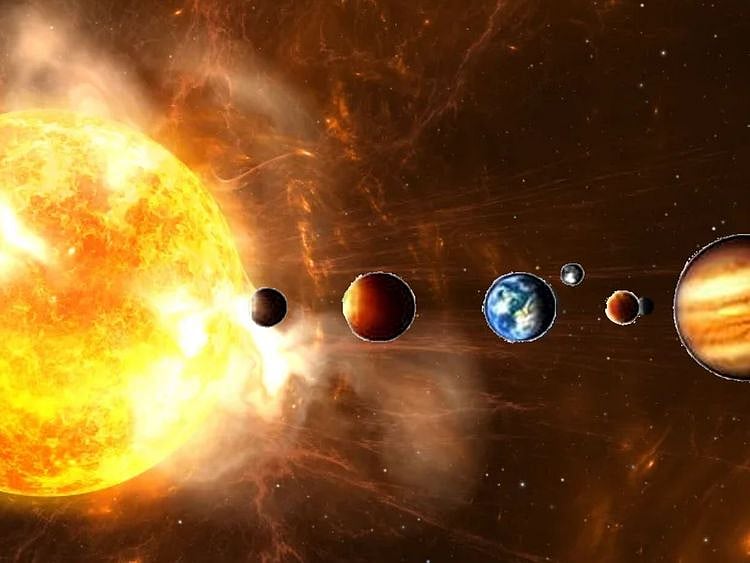
Illustrative image. When the CMEs (coronal mass ejection) slam into Earth's magnetosphere, they can create powerful geomagnetic storms that affect spacecraft (electronic gadgets in orbit) or on earth.
Gulf News
It feels like Earth has been experiencing more extreme heat lately.
And it may be tempting to blame the Sun.
But while the Sun is currently in one of its most active periods in more than a decade, scientists say its greatest immediate impact is not making the planet significantly hotter — it is increasing the risk of powerful space weather capable of disrupting satellites, GPS, radio communications and, in rare cases, electrical infrastructure.
NASA and the US National Oceanic and Atmospheric Administration (NOAA) say the Sun entered the solar maximum phase of Solar Cycle 25 in late 2024 — marking the most active period of its roughly 11-year magnetic cycle.
Get updated faster and for FREE: Download the Gulf News app now - simply click here.
Contrary to popular belief, "solar maximum" is not a single day or month when solar activity suddenly peaks.
Scientists describe it as a broad plateau that typically lasts one to three years, during which the Sun produces elevated numbers of sunspots, powerful X-class solar flares and coronal mass ejections (CMEs).
SOLAR CYCLE: The Sun's magnetic activity runs in an approximately 11-year cycle.
Those eruptions can send billions of tons of magnetised plasma hurtling toward Earth at speeds exceeding one million miles (1.6 million kilometers) per hour.
If a CME is directed toward Earth, it can trigger a geomagnetic "storm" after traveling through space for about 15 hours to three days.
G5 geomagnetic storm: May 10–12, 2024
The most powerful example in recent years occurred on May 10–12, 2024, when multiple CMEs struck Earth in rapid succession, producing the Gannon Storm, the first G5 (Extreme) geomagnetic storm—the highest level on NOAA's five-point scale—since the Halloween Solar Storms of 2003.
Solar Maximum: The period of peak activity when the Sun's magnetic field is at its strongest and undergoes a flip. Key features include high numbers of "sunspots", intense solar flares, and coronal mass ejections (CMEs). Its impact on Earth include more frequent and vibrant aurora displays (Northern and Southern Lights) that can be visible at lower latitudes.
Scientists consider the event a landmark because several Earth-directed CMEs merged during their journey through space, creating a far more powerful disturbance than any of the eruptions would have produced individually.
The storm generated spectacular auroras across unusually low latitudes while causing disruptions to satellite operations, GPS navigation, high-frequency radio communications and increasing atmospheric drag on spacecraft in low-Earth orbit.
G4 geomagnetic storm: June 1–2, 2025
More recently, another Earth-directed CME triggered a G4 (Severe) geomagnetic storm on June 1–2, 2025, underscoring that dangerous space weather continues even as Solar Cycle 25 begins its gradual decline.
SOLAR MINIMUM: The opposite of Solar Maximum, this phase marks the "quietest" point of the solar cycle, signaling the end of one cycle and the beginning of another. Key features include the Sun appearing relatively spotless and smooth. Solar flares and CMEs are rare.
Why scientists still expect major solar storms
Although current observations suggest Solar Cycle 25 likely reached its highest activity earlier and more intensely than scientists originally forecast, researchers caution that the Sun remains highly active.
Unlike seasonal weather, the exact date of solar maximum cannot be determined in real time. Scientists rely on a 13-month smoothed average of sunspot numbers, meaning the official peak can only be identified after solar activity has clearly begun to decline.
As of June 2026, researchers believe the Sun is transitioning into the declining phase of Solar Cycle 25, but that does not mean the threat has passed.
KNOCK-ON EFFECTS OF SOLAR STORMS: Powerful solar storms can interfere with satellite operations, GPS systems, and radio communications.
History shows that some of the largest geomagnetic storms occur after the official peak. The devastating Halloween Solar Storms of 2003, for example, erupted during the declining phase of Solar Cycle 23 rather than at its maximum.
For that reason, scientists continue to monitor the Sun closely for:
Powerful X-class solar flares
Large Earth-directed coronal mass ejections
Strong geomagnetic storms
Satellite and spacecraft disruptions
GPS positioning errors
High-frequency radio blackouts
Increased radiation exposure for astronauts and some high-altitude flights
Localized impacts on power transmission systems during the strongest events
Does this make Earth warmer?
Scientists stress that these solar storms are different from climate change.
While the Sun does become slightly brighter during solar maximum, its total energy output changes by only about 0.1% over the 11-year cycle.
That variation is enough to influence Earth's upper atmosphere and drive space weather, but it is far too small to explain the rapid rise in global temperatures observed since the Industrial Revolution.
According to NASA, the warming effect from changes in solar activity since 1750 is tiny compared with the impact of human-produced "greenhouse" gases.
Timeline: How a CME becomes a geomagnetic storm
Day 0 — The Sun erupts
It begins with an active sunspot region.
On May 8, 2024, giant sunspot AR3664 (NOAA AR13664) unleashed multiple powerful X-class solar flares, the strongest category of solar eruption.
Almost simultaneously, several Earth-directed coronal mass ejections (CMEs) were launched into space. Unlike a solar flare—which is a burst of light arriving at Earth in about 8 minutes—a CME is a massive cloud of plasma and magnetic fields that takes 15 hours to three days to reach Earth.
Day 1–2 — Multiple CMEs merge in space
Normally, a single CME travels independently.
During the May 2024 event, however, at least four Earth-directed CMEs erupted within a short period.
The faster CMEs caught up with slower ones ahead of them.
Scientists call this CME cannibalism or a CME pile-up.
Instead of arriving separately, they merged into one enormous, highly compressed magnetic structure, making the eventual impact on Earth much stronger than any individual CME would have produced.
Day 2 — Earth's magnetic shield is hit
Around May 10, the combined CME slammed into Earth's magnetosphere.
The solar wind pressure compressed Earth's magnetic field from its normal dayside distance of roughly 10 Earth radii down to about 5 Earth radii, bringing it unusually close to satellites in geostationary orbit.
NOAA upgraded the event to G5 (Extreme)—its highest storm category and the first such designation since 2003.
Minutes after impact — Geomagnetic storm begins
Once the CME's magnetic field connected with Earth's magnetic field, enormous electrical currents began flowing through near-Earth space.
These produced:
intense auroras
powerful radiation belts
disturbances in Earth's ionosphere
rapidly changing magnetic fields
These changes disrupted many technologies that rely on stable magnetic or radio conditions.
Hours later — Satellites begin feeling the effects
One of the first impacts occurred in low Earth orbit.
The geomagnetic storm heated Earth's upper atmosphere (the thermosphere), causing it to expand.
Although the atmosphere at satellite altitudes is extremely thin, the expansion dramatically increased atmospheric drag.
Low-orbit satellites slowed down more quickly than expected and required additional orbit corrections. Operators of large satellite constellations, including communications satellites, had to monitor orbital changes closely to reduce collision risks.
Satellites also experienced:
increased radiation exposure
temporary sensor anomalies
degraded communications
navigation errors
At the same time — GPS becomes less accurate
The CME disturbed Earth's ionosphere—the electrically charged layer of the atmosphere through which GPS signals travel.
GPS receivers depend on precise timing.
When radio waves pass through a turbulent ionosphere, they are delayed and bent unpredictably.
The result included:
positioning errors
degraded precision agriculture
surveying inaccuracies
navigation problems for aircraft and ships
These effects lasted for hours in some regions.
Communications disruptions
High-frequency (HF) radio users also experienced degraded communications.
HF signals bounce off the ionosphere.
When the ionosphere becomes disturbed:
long-distance aviation communications become unreliable
maritime radio links degrade
emergency radio networks may experience interruptions
Military communications can also be affected during severe storms.
Power grid impacts
Rapidly changing magnetic fields induced electric currents in long conductors on Earth's surface.
These geomagnetically induced currents (GICs) can flow through:
power transmission lines
transformers
pipelines
The May 2024 storm prompted utilities worldwide to implement mitigation measures. Although widespread blackouts were avoided, G5-class storms have the potential to damage transformers and stress electrical grids.
Beautiful side effect: Auroras reach the tropics
One of the most visible consequences was spectacular auroras.
The storm expanded Earth's auroral oval so dramatically that the Northern and Southern Lights became visible far from the poles, including across much of the United States and parts of Europe.
It became the most widely photographed aurora event in decades.
What about the June 2025 storm?
On June 1–2, 2025, another Earth-directed CME triggered a G4 (Severe) geomagnetic storm.
The event again caused concerns for:
satellite operations
GPS positioning
radio communications
geomagnetic measurements
While it did not reach the intensity of the May 2024 G5 storm, it was severe but generally not expected to cause widespread power transmission failures, as per the U.S. Geological Survey.
Why scientists closely watch "CME pile-ups"
Researchers now believe the worst geomagnetic storms often result not from a single enormous CME, but from multiple CMEs launched in rapid succession.
When successive CMEs merge in interplanetary space, they compress magnetic fields, retain higher speeds, and deliver much more energy to Earth's magnetosphere than isolated eruptions.
This "perfect storm" scenario is what made the May 2024 Gannon Storm the strongest geomagnetic storm in more than 20 years and a benchmark event for modern space-weather forecasting.
What's next?
Solar Cycle 25 is expected to continue "weakening" gradually over the next several years before reaching solar minimum around 2029 or 2030.
During that period, the number of sunspots, solar flares and CMEs should steadily decline.
Even so, isolated major solar storms remain possible until the cycle fully subsides.
For scientists and satellite operators alike, the message is clear: while the Sun has likely moved beyond the highest point of Solar Cycle 25, Earth is still passing through an active period in which occasional severe space weather can occur with little warning.
Sign up for the Daily Briefing
Get the latest news and updates straight to your inbox
Network Links
GN StoreAbout Gulf NewsTerms & ConditionsReach by GNSitemapContact usPrivacy PolicyGN FocusHave your sayWork with usAdvertise with usGulf News epaperPrinting Services
Download our app
© Al Nisr Publishing LLC 2026. All rights reserved.