Hormuz deal takes shape — but it’s not Trump’s deal
Joint Iran-Oman being finalised, but deal is no guarantee for security Hormuz, says Tehran
Iran and Oman are reportedly closing in on a framework to restore shipping through the Strait of Hormuz, but the emerging arrangement could leave Tehran with a degree of control over the world’s most important oil chokepoint — precisely the outcome Washington has sought to prevent.
The diplomatic picture shifted significantly Wednesday (Aug. 5, 2026) as Iran said it and Oman had reached an understanding on the geographic coordinates of a shipping route through the Strait of Hormuz.
Iran said a joint announcement was being finalised, although it warned that an agreement with Oman alone would not guarantee security in the waterway.
On Wednesday state news agency IRNA reported that a Hormuz joint statement between Iran and Oman is in the “final stages”, to lay down specific arrangements for commercial shipping, the agency reported citing Iran Foreign Ministry spokesman Esmaeil Baqaei.
Get it: Fast, verified news for FREE ... download the Gulf News app — simply click here
Baqaei said Tehran and Muscat have been negotiating for two months to establish a safe commercial shipping route, with Iranian authorities reviewing the proposal's technical, legal, security and environmental aspects.
Baqaei reiterated Tehran's position that the Strait's closure followed US and Israeli military action against Iran, and argued that “broader” security conditions remain linked to the regional situation and what Iran describes as “US actions” affecting the waterway.
'Progress', 'very good discussions'
In a significant change in tone, President Donald Trump said the US and Iran were having “very good discussions” and suggested a resolution could be “close”.
“It could happen. Tomorrow or the next day,” Trump said on Tuesday. “A lot of progress has been made. And they called me and they said, ‘Please let’s talk.’”
US Secretary of State Marco Rubio also said progress had been made, while stressing that no final agreement had yet been reached.
But beneath the optimistic rhetoric lies the central dispute: Who controls the ships?
And that is why the deal taking shape is not necessarily the deal Trump wants.
The emerging compromise: reopen Hormuz, but give Iran a role.
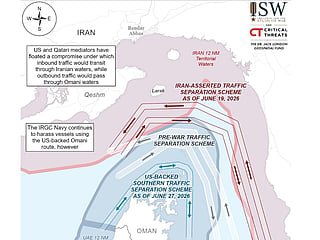
According to people familiar with the negotiations cited by Western media, the emerging Iran-Oman arrangement would potentially give Tehran control over ships entering the Arabian Gulf through the strait.
The proposed system would separate traffic into routes: vessels entering the Gulf would use a channel under Iranian control, while ships leaving the Gulf would largely use a route closer to Oman.
Iran seeks payments: Authority unclear
The exact extent of Iranian authority — particularly over inspections and permissions — remains unresolved.
Iran has also sought payments associated with passage.
Reuters reported that Tehran proposed fees equivalent to 5%–7% of cargo value, while Oman has pushed for a lower figure and Washington has argued for no fees.
That is a major sticking point.
For Iran, a reopening that recognises some form of Iranian management would turn its wartime leverage over Hormuz into a negotiated political and economic concession.
For Washington, that risks legitimising precisely the leverage the US went to war to eliminate.
What Trump wants instead
The Trump administration's stated position has been much more straightforward:
Hormuz should reopen to free and unrestricted navigation, with no Iranian tolls or special control over international shipping.
A White House statement in June said Trump's agreement with Iran was intended to reopen the strait to “free navigation.”
The administration has also explicitly rejected tolls. In a May fact sheet, the White House said Trump and Chinese President Xi Jinping agreed that the Strait of Hormuz should reopen and that no country or organization should be allowed to charge tolls.
That is fundamentally different from a system in which ships must use routes managed or supervised by Iran.
So the disagreement isn't simply about whether Hormuz opens.
It is about the conditions under which it opens.
Why Iranian control matters so much
The Strait of Hormuz is not an ordinary shipping lane.
It is the narrow maritime gateway connecting the Arabian Gulf with the Gulf of Oman and the Arabian Sea.
Huge volumes of crude oil, petroleum products and LNG normally pass through it. That makes control over navigation enormously valuable.
If Iran gains a recognised role in determining which vessels enter the Gulf, checking cargoes or collecting fees, Tehran could emerge from the war having converted its ability to disrupt shipping into an accepted form of influence over the waterway.
That would be a major strategic gain.
It could also establish a precedent in which commercial shipping depends on an agreement with Iran rather than simply exercising internationally recognised navigation rights.
Iran's position is also different from Washington's
Iran has been pushing for a system that recognises its geographic position and security concerns.
An earlier report showed discussions described the broad concept as Iran controlling inbound shipping and having visibility over outbound traffic, with the ability to intervene if necessary.
Iran has also argued that any arrangement must address the security of the waterway and its own concerns about future US military attacks.
In other words, Tehran is not simply negotiating: “Open the strait.”
Iran is negotiating: “Open the strait under a system that recognises our security role.”
That distinction is at the heart of the talks.
Oman is trying to bridge the two positions
Oman has emerged as the key intermediary because it has longstanding relationships with both Tehran and Washington.
Muscat’s proposed framework reportedly envisions regional management of Hormuz and “voluntary” rather than mandatory transit fees, an attempt to provide Iran with a security role without giving it unrestricted authority over international shipping.
Qatar and Pakistan are also involved in the broader diplomatic effort. Qatar said this week that mediators were exchanging draft proposals and coordinating efforts to restart US-Iran negotiations.
Doha said a ceasefire and reopening of Hormuz were essential to creating conditions for negotiations.
The biggest irony for Trump
Trump can point to a reopening of Hormuz as a diplomatic “victory”. But if the price is Iranian control over part of the shipping system, Tehran can claim a "victory" of its own.
The emerging arrangement may prove politically awkward for Washington: The Trump administration entered the conflict arguing that Iran should not be allowed to use Hormuz as a strategic weapon.
A deal that gives Iran a recognised role in controlling traffic could be portrayed by Tehran as “proof” that its ability to close or disrupt the waterway forced the US and regional powers to negotiate on its terms.
The question is therefore not whether Hormuz reopens. It is who gets to decide what happens after it reopens.
The deal is not done yet
There is an important caveat: the reported framework remains fluid.
Iran and Oman said they had agreed on route coordinates, but Iran itself acknowledged that this did not guarantee the waterway's security.
Washington has also disputed some Iranian descriptions of the proposed arrangement.
A US official, quoted by Western media, said any temporary routes would not require ships to obtain Iranian permission and would involve no tolls — directly contradicting parts of the Iranian account.
That means the apparent breakthrough could still unravel over the precise meaning of key terms, such as “control,” “inspection,” “security” and “fees.”
And those words matter enormously.
What to watch next
The real test will not be another optimistic statement from Washington or Tehran.
It will be whether:
Commercial tankers begin transiting Hormuz regularly;
Iran relinquishes unilateral authority to stop or inspect ships;
No mandatory Iranian transit fees are imposed;
War-risk insurance costs begin falling;
Gulf oil and LNG exports normalise; and
The arrangement is incorporated into a broader U.S.-Iran ceasefire or peace framework.
A genuine reopening should be measured by actual shipping flows, insurance rates and the removal of blockades rather than diplomatic declarations alone.
Trump wants Hormuz reopened without Iran gaining a veto over global shipping.
Iran wants the strait reopened in a way that preserves — and potentially legitimises — its role as the gatekeeper of traffic into the Gulf.
Oman is trying to construct a compromise between those incompatible positions.
Hard questions unanswered
That is why an agreement may be getting “closer” while the hardest question remains unanswered.
Hormuz can reopen without Trump getting everything he wants.
And if Iran emerges with recognised authority over even part of the traffic through the maritime chokepoint, Tehran could end the war with something it did not have before: a negotiated seat at the table controlling one of the world's most strategically important waterways.
Also In This Package