Strait of Hormuz: Why are there two 'routes'?
Competing security escorts leave shippers torn between protection and provocation
Iran and Oman are reportedly nearing a bilateral agreement, also known as "shipping framework", to manage maritime traffic in the Strait of Hormuz under a temporary or intermediate framework.
Iranian statements from the Foreign Ministry emphasise that these are strictly bilateral coastal-state talks, meaning that Iran does not shape its priorities around US/Trump timelines or demands.
In the absence of a deal, maximalist positions predominate: Washington wants the waterway reopened to "unrestricted" international commerce, Tehran is seeking guarantees that it will retain a role in monitoring maritime traffic and protecting what it considers its security and sovereignty interests.
Get it: Fast, verified news for FREE ... download the Gulf News app — simply click here
Amid on-going Iran-Oman talks and Qatar mediation between Iran and the US reportedly producing a draft deal currently being circulated, key elements reported from Iranian and regional officials include:
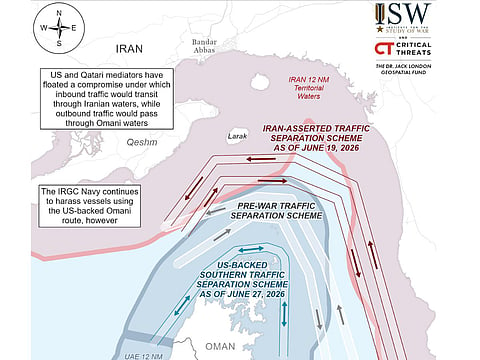
Inbound vessels (into the Arabian Gulf) would use a channel controlled by Iran, close to its coast.
Outbound vessels would use a channel near Oman, but (per the Iranian account in the linked post and similar reporting) only after notifying Iranian officials, giving Iran visibility and the option to intervene.
An “intermediate” or “middle” corridor that would shut down the prior northern (Iran-asserted) and southern (Omani/US-associated) routes once operational.
Possible “service fees” (not formal tolls) for environmental impact, security, and staffing, with revenues shared equally between Iran and Oman — though US officials have disputed the accuracy of Iranian descriptions of approvals, permissions, or fees in any temporary arrangement.
Iran rejects US claim about Hormuz reopening
Iran also rejected claims that the strait will simply “open tomorrow” under a US-backed deal.
More importantly, Iran has linked full reopening to lifting the US naval blockade of Iranian ports and broader points from the earlier MoU.
Oman has been more reserved publicly and has not fully confirmed the Iranian framing.
Muscat has historically coordinated with the IMO and others on temporary southern corridors.


Geography: Traffic Separation Schemes
The Strait of Hormuz is only about 33 kilometers (21 miles) wide at its narrowest point.
Within that space are internationally-recognised Traffic Separation Schemes (TSS) — essentially maritime "lanes" designed to keep ships moving safely.
Since the latest conflict escalated, however, competing security arrangements have emerged.
The United States has encouraged many commercial ships to use a southern corridor closer to Omani waters, where American and allied naval forces can provide escorts and surveillance.
Iran argues that shipping should instead use corridors it oversees and rejects what it sees as a US-imposed navigation system.
Why is this becoming a geopolitical showdown?
The disagreement goes beyond shipping.
It is really about who has the authority to control one of the world's most important maritime chokepoints.
The U.S. position is based on the principle of freedom of navigation, arguing that the Strait of Hormuz is an international waterway that no single country can control.
Iran, meanwhile, argues that because much of the strait passes through or alongside Iranian territorial waters, it has an essential security role in regulating traffic, particularly during wartime.
Recent negotiations mediated by Oman have reportedly explored temporary arrangements in which Iran would oversee inbound traffic while Oman managed outbound movements, illustrating how contested the issue has become.
What does this mean for global trade?
For shipping companies, the conflicting messages create a difficult choice.
If operators follow US-protected routes, they may be viewed by Iran as ignoring its warnings.
If they comply with Iran's preferred routing, they risk undermining the international principle of free navigation and potentially conflicting with U.S. guidance.
The uncertainty has already driven up insurance premiums, complicated voyage planning and kept energy markets on edge because any disruption in Hormuz can affect oil and LNG exports from Gulf producers.
Contest over transit rules
The latest exchange is not merely a disagreement over shipping lanes—it is a contest over who sets the rules in the Strait of Hormuz.
The United States says the southern corridor remains open and protected, citing the successful transit of more than 1,000 commercial vessels over the past three months.
Iran rejects that claim, insisting that ships should follow routes it designates and warning that vessels using alternative passages could be targeted.
Until a broader diplomatic agreement is reached, the Strait of Hormuz is likely to remain one of the world's most closely watched — and potentially volatile — maritime flashpoints.
Why Hormuz matters: Technical details
The Strait of Hormuz is one of the world's most important energy chokepoints, linking the Arabian Gulf with the Gulf of Oman and the Arabian Sea.
A prolonged disruption threatens global oil and gas supplies and can push up energy and shipping costs far beyond the region.
That makes the emerging proposal potentially significant: It could allow shipping to resume without requiring either side to fully surrender its position.
But technical details and questions over who monitors vessels, who can "intervene", what constitutes a violation and whether Iran receives any form of payment remain key obstacles.
For now, the talks appear to be focused less on whether the Strait will reopen than on the rules under which international shipping could resume — and how much authority Iran would retain over traffic passing through the waterway.