Droughts, floods, extreme heat: Is the world heading for a ‘super’ El Nino?
UN forecasts 80% chance of El Nino emerging between June and August as Pacific waters warm
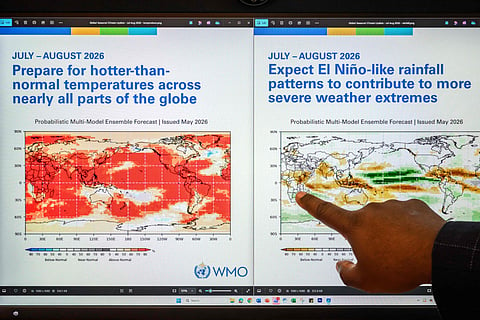
Dubai: The world could be heading towards a rare “super” El Nino, a climate phenomenon capable of triggering droughts, floods, crop failures and extreme heat across continents.
The United Nations said on Tuesday there is now an 80 per cent chance that El Nino will develop between June and August, raising concerns about a fresh wave of weather disruptions around the globe.
A giant pool of unusually warm water building beneath the Pacific Ocean has scientists on alert, raising fears that one of the strongest El Nino events ever recorded could soon take shape.
According to a BBC report, some forecasts suggest the event could develop into a so-called “super” El Nino, powerful enough to reshape weather patterns across much of the world.
The World Meteorological Organization (WMO) said forecasts from its global network indicate a pronounced shift toward El Nino conditions, with the probability rising to more than 90 per cent by November. Most forecast models suggest the event is likely to be at least moderate in strength and could become strong.
“El Nino conditions are developing and are set to influence global temperature and rainfall patterns,” the WMO said in its latest climate update.
Why scientists are concerned
80% chance of El Nino developing between June and August
More than 90% chance by November, according to the WMO
Subsurface Pacific waters are more than 6°C above average in some areas
Some forecasts suggest a possible “super” El Nino
Previous strong El Nino events have been linked to droughts, floods and food-price spikes
The phenomenon is developing against a backdrop of record global temperatures driven by climate change
El Nino is a naturally occurring climate pattern that develops when surface waters in the central and eastern Pacific Ocean become unusually warm. The phenomenon typically occurs every two to seven years and lasts between nine and 12 months, altering rainfall, wind and temperature patterns far beyond the Pacific.
What has caught scientists’ attention this year is not just the likelihood of El Nino’s return but the amount of heat already building beneath the ocean surface.
The BBC reported that data from satellites, ocean buoys and floating sensors show a vast reservoir of unusually warm water moving eastward beneath the Pacific. In some locations, temperatures more than 6 degrees Celsius above average have been recorded hundreds of metres below the surface.
Classic precursor
Scientists view such subsurface warming as a classic precursor to a significant El Nino event because the heat often rises to the surface, warming the atmosphere and influencing weather systems worldwide.
Michelle L’Heureux of the US National Oceanic and Atmospheric Administration’s Climate Prediction Center told the BBC that the warmth of these waters rivals some of the strongest El Nino events previously observed.
Professor Adam Scaife of the UK Met Office was quoted by the broadcaster as saying scientists are highly confident that a major event is developing and that it could even challenge historical records.
Why this El Nino matters
Even if the event falls short of “super” status, scientists say it will arrive in a world already experiencing unprecedented warmth due to human-driven climate change.
The WMO stresses that climate change does not necessarily increase the frequency of El Nino events, but it can amplify their impacts. Warmer oceans and a warmer atmosphere provide more energy and moisture, increasing the potential for extreme weather.
That means heatwaves can become hotter, droughts more severe and heavy rainfall more intense.
UN Secretary-General António Guterres described El Nino as an urgent climate warning.
“El Nino is arriving on our doorstep,” he said in a video message released by the United Nations.
“El Nino conditions will pour fuel on the fire of a warming world.”
Potential global impacts
While every El Nino behaves differently, forecasters already see elevated risks in several regions.
The WMO said forecasts point to below-normal rainfall during the crucial June-to-September rainy season in parts of the Greater Horn of Africa. South Asia could see below-average monsoon rainfall, while Central America may experience warmer and drier conditions.
Other regions could face the opposite problem. Increased rainfall and flooding risks are often associated with El Nino in parts of the Americas.
The phenomenon can also influence tropical cyclone activity, encouraging hurricane development in parts of the Pacific while suppressing activity in the Atlantic.
Past El Nino events have been linked to crop losses, food-price spikes, water shortages and disruptions to global trade.
Wilfran Moufouma Okia, head of climate prediction at the WMO, told AFP that the 2023-24 El Nino contributed to reduced rainfall in Panama, affecting operations at the Panama Canal and creating ripple effects for the global economy.
For now, scientists caution that several months remain before the event reaches its peak, typically around the end of the year. Wind patterns over the Pacific remain a critical wildcard, making it difficult to determine whether this El Nino will ultimately become a record-breaker.
But one message is already clear: even a moderate El Nino could have significant consequences in a world already grappling with rising temperatures and increasingly extreme weather.


