Oil hovers near $80 as US-Iran deal hopes offset lingering Hormuz supply risks
Muted trading follow sharp sell-off earlier in the week on potential US-Iran agreement
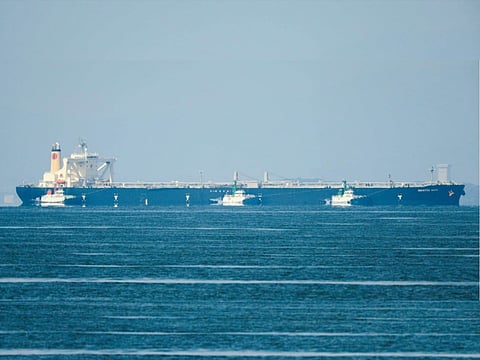
Oil prices were little changed early Thursday as markets weighed growing hopes for a U.S.-Iran diplomatic breakthrough against continued uncertainty over the reopening of the Strait of Hormuz, the world's most important oil shipping chokepoint.
At about 9:54 am Thursday, Aug. 6, Tokyo time, the market snapshot showed Brent crude at $79.38 a barrel, down 7 cents, or 0.09%, while West Texas Intermediate (WTI) was at $75.01, down 21 cents, or 0.28%.
The muted trading followed a sharp sell-off earlier in the week after Qatar said draft proposals for a potential US-Iran agreement were being circulated.
Brent plunged 5.3% on Tuesday to settle at $79.36, while WTI fell 5.7% to $75.77 — both three-week lows.
Get it: Fast, verified news for FREE ... download the Gulf News app — simply click here
The latest price action suggests traders are pricing in a greater probability of a diplomatic solution, but not yet assuming that the crisis is over.
Qatar said Wednesday that efforts to bring Washington and Tehran back to negotiations were progressing, with draft agreement language circulating among mediators.
The potential deal, reported on Wednesday, is closely tied to arrangements for restoring commercial navigation through the Strait of Hormuz.
The stakes are enormous. Hormuz normally carries a major share of the world's seaborne oil and LNG trade, meaning any credible agreement that restores shipping could rapidly increase available supplies and reduce the geopolitical premium embedded in crude prices.
Hormuz remains the market's biggest wildcard
The potential reopening of the waterway has already become the dominant driver of oil prices.
On Tuesday, optimism over a possible agreement pushed crude sharply lower.
OilPrice.com reported that Brent subsequently stabilised around $80 as traders assessed the prospect of a diplomatic resolution.
But an agreement has not yet been finalised.
AP reported Thursday that Washington and Tehran appear closer to an arrangement over Hormuz, but significant disagreements remain.
A proposed mechanism could involve Iranian control over inbound shipping and Omani involvement in outbound traffic — terms that Washington has opposed.
That leaves oil traders caught between two competing scenarios: Deal succeeds vs talks collapse.
Why the market isn't celebrating yet
The sharp fall in crude prices this week is partly a geopolitical risk premium unwind, rather than evidence that physical oil supplies have fully normalised.
The war caused tanker traffic through Hormuz to fall dramatically and pushed Brent above $100 a barrel during the initial supply shock.
That means the market could remain highly sensitive to every headline from Washington, Tehran, Doha and Muscat.
For consumers, particularly in Asia, a sustained reopening of Hormuz could eventually translate into lower import costs and reduced pressure on domestic pump prices. But the effect would not necessarily be immediate because refiners, traders and shipping companies would first need to see sustained and reliable flows through the waterway.
The bigger picture
Oil has effectively moved from a war premium to a peace premium.
Brent is now hovering around $79, compared with the triple-digit levels reached during the most severe phase of the crisis. Reuters said Tuesday's settlement was the lowest for Brent since July 13.
But the market remains vulnerable to a violent reversal.
If the US-Iran draft deal translates into a ceasefire and a credible mechanism for reopening Hormuz, Brent could face further downward pressure. If negotiations break down or shipping remains restricted, the geopolitical premium could return just as quickly.
For now, $80 a barrel has become the market's psychological battleground — with diplomacy increasingly more important to oil traders than the latest inventory report.


