Sun unleashes most powerful solar radiation storm in over 20 years
A massive solar blast hit Earth. Here's how it's affecting us, from GPS to satellites
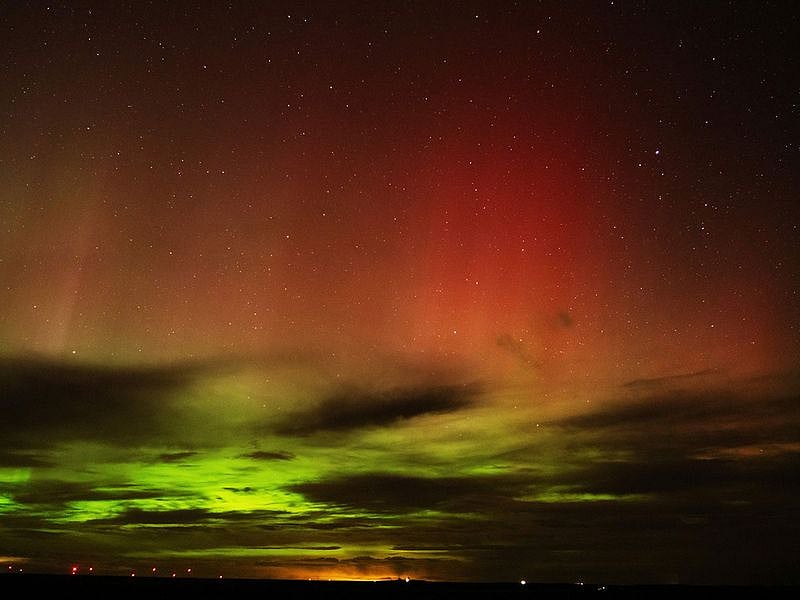
The sun just threw a massive tantrum our way, and we're all about to feel it. A severe solar radiation storm, the strongest we've seen since Halloween 2003, slammed into Earth's atmosphere on Monday, bringing with it both spectacular light shows and some serious technological headaches. There's a lot more happening behind those shimmering curtains of green and purple light than meets the eye.
What's actually happening up there?
The sun basically coughed up a massive chunk of itself on Sunday in what scientists call a coronal mass ejection, or CME for short. This wasn't just any solar burp, it was triggered by an X-class solar flare, the most powerful type there is, and it came barreling toward Earth at breakneck speed.
The result? A severe geomagnetic storm that arrived Monday afternoon at 2:20 pm ET, plus a level four solar radiation storm on a scale that only goes up to five. To put that in perspective, we haven't seen radiation levels this high since October 2003, when similar storms knocked out power in Sweden and fried transformers in South Africa.
"We've been making all these phone calls to ensure that we keep all the critical technological infrastructure operators informed about what's happening," explained NOAA's (National Oceanic and Atmospheric Administration) Space Weather Prediction Centre. That's right, they've been speed-dialing everyone from NASA to FEMA to make sure nobody gets caught off guard.
The communication breakdown
Here's where things get technical, but stay with me because this affects more than you might think. High-frequency radio communications in polar regions? Basically blocked during the storm's peak. Airlines flying polar routes had to scramble, and satellite operators were definitely earning their paychecks Monday night.
The reality is we've built our modern world on a delicate web of satellite communications and GPS systems, and when the sun gets angry, that web starts to shake. Remember that extreme geomagnetic storm back in May 2024? GPS-guided tractors found their precision agriculture systems going haywire. Thankfully, satellite and power grid operators managed to keep things mostly under control, but it was a close call.
Risks beyond Earth
For astronauts aboard the International Space Station, solar radiation storms aren't just an inconvenience, they're a genuine health hazard. NASA's been keeping close tabs on the crew, ready to have them hunker down in better-shielded sections of the station if radiation levels spike too high. It's the same protocol they followed during last May's extreme storm, basically turning parts of the station into a cosmic storm shelter.
And it's not just the ISS crew who needs to worry. Passengers on polar flight routes face increased radiation exposure during these events too, though airlines have procedures to minimise the risks.
Nature's greatest light show
The aurora forecast hit a level eight on the Kp scale, which runs from zero to nine. Meaning? People across the northern half of the United States had front-row seats to one incredible celestial display.
The northern lights weren't just visible in the usual suspects like Alaska or Montana. Forecasters predicted auroras could dance as far south as Alabama and northern California. Even Missouri and much of the Midwest got a shot at seeing them, though clouds over Michigan and Montana threatened to spoil the view for some unlucky skywatchers.
Why now?
The sun runs on an 11-year cycle, oscillating between periods of relative calm and intense activity. Right now, we're in what's called the solar maximum phase, basically, the sun's teenage years when it's at its most dramatic and unpredictable.
"During solar maximum, the number of sunspots, and therefore, the amount of solar activity, increases," said Jamie Favors, director of NASA's Space Weather Program. "This increase in activity provides an exciting opportunity to learn about our closest star, but also causes real effects at Earth and throughout our solar system."
The storm peaked Monday night into early Tuesday morning, with conditions expected to settle down by Tuesday afternoon. But the sunspot region responsible for this eruption is still active, and any flares it produces over the next week could easily send more Earth-directed fireworks our way.
The science of the spectacle
So what creates those mesmerising auroras anyway? When charged particles from the sun's coronal mass ejection crash into Earth's magnetic field, they collide with gases in our atmosphere. Different gases produce different colours, oxygen gives us those classic greens and reds, while nitrogen adds purples and blues to the mix.
The intensity varies throughout the night in what scientists call substorms, roughly 20-minute bursts where the auroras kick into overdrive and become visible much farther south than usual.
What this means going forward
The 2003 Halloween storms serve as a stark reminder that space weather isn't just pretty lights and scientific curiosity, it has real-world consequences. Power grids, satellites, GPS systems, aviation, even farmers trying to plant crops in perfectly straight lines all depend on our technological infrastructure staying intact.
The good news? We're better prepared now than we were two decades ago. Organisations like NOAA's Space Weather Prediction Center monitor the sun constantly, giving us advance warning when these cosmic storms are heading our way. That heads-up allows power companies, satellite operators, and airlines to take protective measures before things get dicey.
Going forward, events like these storm are likely to become more common. It's a reminder that for all our technological advancement, we're still at the mercy of our nearest star's mood swings.
Network Links
GN StoreDownload our app
© Al Nisr Publishing LLC 2026. All rights reserved.