US-Iran war: Hormuz oil flows rebound to two-thirds as Trump warns of more strikes on Tehran
US-Iran clashes intensify around Hormuz, but global oil shipments edge back
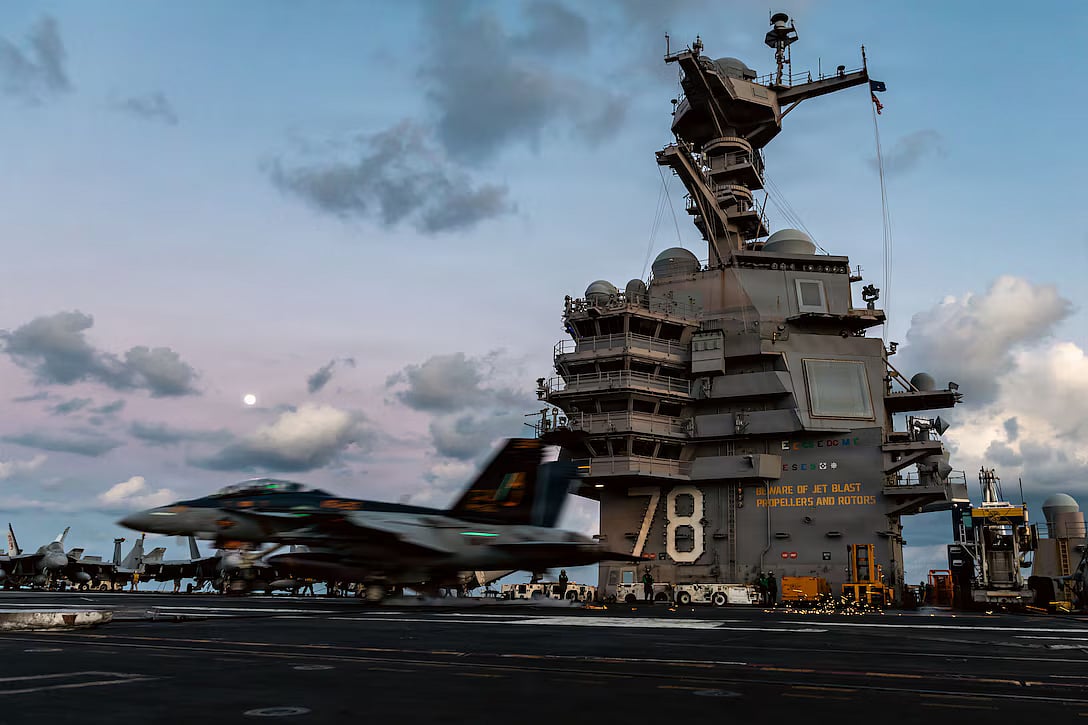
Direct hostilities between Washington and Tehran resumed this week after a month-long lull, with US forces striking two Iranian rocket launchers on Larak Island near the Strait of Hormuz and Iran answering with ballistic missiles aimed at American positions in Jordan. President Donald Trump has vowed to hit Iran "hard" while describing the renewed US strikes as "very limited," dismissing questions about nuclear escalation and calling Iran a "failed nation" already defeated militarily. The flare-up comes six months into a war that has left the two sides at an impasse, with the strait closed by Iran and Iranian ports under a US naval counter-blockade, even as oil flows through Hormuz claw back toward two-thirds of pre-war levels. In Washington, the crisis lands amid fresh turmoil at the Pentagon, where Army Secretary Dan Driscoll has resigned after months of friction with Defence Secretary Pete Hegseth. Follow all the latest developments here:
UN Secretary-General Antonio Guterres has called for renewed negotiations as military activity continues across the Middle East, saying the return of strikes between the United States and Iran makes “maximum containment” essential. He said earlier diplomacy had appeared close to a breakthrough and urged both sides to restart talks.
Guterres also called for "freedom of navigation" to be fully restored in the Strait of Hormuz and Bab al-Mandab — two key maritime routes whose disruption can affect global energy and trade flows.
US Treasury Secretary Scott Bessent said Iran was attempting to rebuild a network of radar installations along the Strait of Hormuz before the US military struck and destroyed the emerging system, in a move to deny Tehran a grip of the strategic waterway.
Bessent described Iran's effort in unusually dismissive terms, referring to what he called a “patchwork tinker toy erector set radar” that Iranian forces were trying to reconstruct along the shores of the Strait.
“Iran does not have control of the Strait. And they are in a death spiral,” Bessent said.
He said Iran had been rebuilding “some patchwork of tinker toy erector set radar” along the Strait before US forces targeted the installations.
The comments came after the US military launched a new wave of strikes against Iranian targets on Tuesday, including air-defence systems, radar sites, maritime assets, mine-laying capabilities and communications facilities, as per the US Central Command.
Radar is critical to Iran's ability to monitor shipping and military activity through the Strait, detect aircraft and ships, and support anti-ship and air-defense operations.
Two attacks on commercial tankers were reported in the past 48 hours around the Strait of Hormuz, as Iranian forces continued what a regional maritime security centre described as persistent "surveillance, harassment and attempted disruption" of shipping.
The Bahrain-based Joint Maritime Information Center (JMIC) said its latest assessment recorded two incidents corresponding to UK Maritime Trade Operations (UKMTO) warnings 122-26 and 124-26.
The first incident, UKMTO 122-26, involved the oil tanker Burgan, which reported a security incident while transiting the waterway. The vessel subsequently anchored at a position about 1 nautical mile northwest of Jazirat Um Al Ghanam.
The second incident, UKMTO 124-26, involved a tanker that reported being struck by three unknown projectiles while completing an outbound transit of the Strait, about 17 nautical miles east of Khasab, Oman. UKMTO said there were no reported casualties or environmental impact and that authorities were investigating.
JMIC said the incidents came alongside continued activity attributed to Iran's IRGC, including unmanned aerial vehicle overflights, targeted surveillance of merchant ships and occasional VHF radio hailing.
The pattern, the centre said, indicates an Iranian effort to maintain a visible military presence along the critical shipping lane and keep pressure on vessels attempting to navigate the Strait.
The latest incidents involve both inbound and outbound commercial traffic, underscoring the continuing risk to ships approaching or leaving the world's most important oil chokepoint.
The US launched a new wave of strikes against Iranian military targets, escalating a confrontation that had entered a period of relative calm and raising fresh fears that fighting could again spread across the Gulf.
The latest strikes followed Iranian attacks and attempted attacks on commercial shipping, US forces and strategic targets around the region. Washington has framed the operation as a response to threats against shipping and US personnel, particularly Iran's apparent efforts to deploy naval mines in the Strait of Hormuz.
President Donald Trump warned Tehran that any further retaliation would bring a much stronger US response, signaling that Washington is prepared to escalate rather than return immediately to the earlier ceasefire arrangement.
Kuwait said its air-defence systems are responding to hostile missile and drone threats, following what the Army described as "Iranian aggression".
The General Staff of the Kuwaiti Armed Forces confirmed that any explosions heard in the country are likely the sound of air-defence systems intercepting incoming targets.
Authorities urged residents to remain calm and follow safety and security instructions issued by the relevant authorities.
An Iranian official said on Tuesday that two people were killed and several others were wounded by a US attack while attending a wedding in the south.
"A residential home was attacked while people were holding a wedding ceremony," Ahmad Nafisi, deputy governor of Hormozgan province, told state television, adding that "two people were reported martyred and a number of others wounded".
Get updated faster and for FREE: Download the Gulf News app now - simply click here.
The US State Department has urged Americans in the Middle East to exercise heightened vigilance as regional tensions escalate, warning of possible flight cancellations, airspace closures and other travel disruptions.
In a security update, the department said the regional security environment remains “complex”, with the potential for unforeseen escalation.
Americans travelling to or from the Middle East were advised to closely monitor airport and airline operations.
The State Department also warned that Iran and groups supportive of Tehran could target US interests overseas or locations associated with the United States and Americans, including businesses and other institutions.
US citizens were advised to follow the latest country-specific security alerts and guidance from their nearest US embassy or consulate.
Iranian state television reported on Tuesday that several people who were attending a wedding ceremony were wounded by a US attack in the country's south.
"A number of residents were wounded in the attack while attending a wedding ceremony," state television reported, adding that the US attack hit a "residential area" in Bandar Kuhestak in Sirik county.
Explosions were heard across several areas of southern Iran as US forces launched a new wave of strikes against Iranian targets, Iranian media reported.
Iranian state television said US forces struck Jiroft airport in the southeastern province of Kerman, without immediately reporting casualties or the extent of damage.
An explosion was also heard in Asaluyeh, a major gas and petrochemical hub on Iran’s Gulf coast, according to the semi-official Fars news agency.
Other explosions were reported around Bandar Abbas and Qeshm Island near the Strait of Hormuz, where Iranian media said several sites had been struck.
Get updated faster and for FREE: Download the Gulf News app now - simply click here.
Iran’s armed forces said on Tuesday they had launched retaliatory attacks against US bases and interests across the region after Washington carried out fresh strikes on Iranian targets, the semi-official Tasnim news agency reported.
Tasnim cited an Iranian military source as saying US interests and bases in the region were being targeted, and that Tehran’s response would be significantly greater than the American attacks.
The United States struck an airport in the southern Iranian province of Kerman on Tuesday, state television reported, as Washington announced a fresh wave of attacks.
"Minutes ago, the enemy US attack targeted Jiroft airport," state television said, after reporting several strikes along the coast of the Strait of Hormuz and on Iranian islands in the Gulf.
Fresh explosions were heard on Tuesday in southern Iran along the strategic Strait of Hormuz as well as on an island in the Gulf, state television reported, as the United States carried out strikes in the area.
"Explosions were heard again in Bandar Abbas city and Qeshm island," state TV said, adding that blasts were also heard on Lavan island, home to one of Iran's oil export terminals in the Gulf.
Iran's Revolutionary Guards vowed on Tuesday to make the United States "regret" fresh attacks around the Strait of Hormuz, even as US President Donald Trump warned Tehran against striking back.
"Severe punishment awaits the aggressors; the United States will regret its new attacks," said Guards spokesman Hossein Mohebi in a post on X, after explosions were heard in multiple areas along and east of Hormuz.
President Donald Trump warned Iran on Tuesday not to retaliate against the latest US strikes, saying Tehran faced "much harder and higher" attacks if it hits back.
Trump said Tuesday's US attacks near the Strait of Hormuz were in response to Iran laying mines and shooting missiles at an American base in Jordan.
"If the failed Nation of Iran retaliates for this very justified attack, they will be hit again at a much harder and higher level, but it will not be the biggest attack of them all, that is waiting in the wings and, when it is over, there will be very little left of the Islamic Republic of Iran!" Trump said on his Truth Social network.
Iranian state media said on Tuesday that four projectiles hit parts of the southeastern Sistan-Baluchistan province, east of the Strait of Hormuz.
"Four projectiles had hit areas within the counties of Chabahar and Konarak," said the official IRNA news agency, citing provincial official Ali Khalilabadi, without specifying whether there was any damage.
The UN nuclear agency said in a confidential report seen by AFP on Tuesday that the lack of access to key nuclear sites in Iran "needs to be addressed with the utmost urgency".
"The agency's lack of information about this nuclear material and access to facilities to verify it is a matter of proliferation concern," the International Atomic Energy Agency (IAEA) said in the report.
A top Iranian official called on citizens to curb their petrol consumption on Tuesday, as the country faces difficulty importing enough fuel to meet demand due to a US naval blockade.
"Of course, part of the responsibility for this high consumption does not lie with our people; it lies with our industry," parliament speaker and top negotiator Mohammad Bagher Ghalibaf said in a televised address.
"But in any case, what is clear is that we need to save gasoline in our consumption."
US forces launched strikes Tuesday against Iran's Revolutionary Guards in response to attempted attacks on commercial shipping and American forces, the US military said.
The strikes -- which began at 12:00 pm (1600 GMT) -- came after "recent attempted attacks by (the Guards) against commercial shipping in the Strait of Hormuz and against American service members deployed to the region," US Central Command said on X.
Iranian President Masoud Pezeshkian thanked Russian President Vladimir Putin on Tuesday for Moscow's stance during the Middle East war, in their first meeting since the conflict broke out.
Moscow has massively deepened military and economic ties with Iran since launching its own full-scale invasion of Ukraine.
"We appreciate and thank you for your positions at every stage, both during the period when the fighting and acts of aggression were taking place and under normal circumstances, when the United States was imposing sanctions on us, both at the United Nations and in international forums," Pezeshkian told Putin at a meeting on the sidelines of the Shanghai Cooperation Organisation summit in Kyrgyzstan.
"This shows that our relationship is a strategic relationship; it is not an ordinary relationship," he added.
An earlier statement by the Iranian presidency had said that two presidents "reviewed bilateral relations" and "discussed ways to strengthen and expand cooperation in various fields".
Iran's President Masoud Pezeshkian held talks on Tuesday with Russian President Vladimir Putin on the sidelines of the Shanghai Cooperation Organisation summit in Kyrgyzstan, the Iranian presidency said.
"During the meeting, the latest state of bilateral relations between Iran and Russia was reviewed and the two sides discussed ways to strengthen and expand cooperation in various fields," said the presidency in a statement accompanied by images of Putin and Pezeshkian shaking hands.
Mediator Qatar on Tuesday urged the United States and Iran to return to negotiations after they renewed tit-for-tat attacks.
"We have said from day one that leaving the issue unresolved and trying to normalise the closure of the Strait would lead to escalation," Qatari foreign ministry spokesman Majed Al Ansari told a regular press briefing.
"This is precisely what we have witnessed over the past two days," he said.
"We urge the parties to exercise wisdom and return to the negotiating path, and we continue to intensify our efforts with our mediation partners to ensure a return to that path."
"In Qatar, in the region, in the world today, we cannot afford to accept the status quo," Al Ansari said.
"Discussions with our mediation partners - whether in Pakistan or Oman - are ongoing," he added.
Get updated faster and for FREE: Download the Gulf News app now - simply click here.
Iran's President Masoud Pezeshkian on Tuesday vowed to match any US move to return to a June deal aimed at ending their war, as he prepares to meet Russian counterpart Vladimir Putin at a regional summit.
The two allies were due to hold talks on the sidelines of the Shanghai Cooperation Organisation (SCO) summit in Kyrgyzstan, a bloc promoted by Russia and China as an alternative to Western power.
"I state explicitly that if the United States returns to its commitments under the aforementioned memorandum of understanding, the Islamic Republic of Iran will immediately take reciprocal action," Pezeshkian said, according to the Iran presidency's website.
The memorandum aimed at ending hostilities between Tehran and Washington that began in late February with US and Israeli attacks on Iran that killed former supreme leader Ayatollah Ali Khamenei.
The deal, meant to set the stage for final peace talks, later collapsed, with both sides accusing each other of violating its terms.
Pezeshkian's remarks came as the Strait of Hormuz remained a key point of contention between Iran and the United States, which resumed exchanging fire on Monday after more than a month of relative calm.
Three "unknown projectiles" struck a tanker in the Strait of Hormuz overnight, a British maritime agency said Tuesday following a fresh flare-up in the US-Iran war.
Tehran has imposed an effective blockade of the strait since the United States and Israel launched their war in late February.
It says it wants to charge fees for passage and has attacked ships it accuses of attempting to circumvent its preferred route through the waterway.
Iran's President Masoud Pezeshkian said Tuesday that Tehran would "immediately" reciprocate if the United States returned to a June deal aimed at ending their war.
"I state explicitly that if the United States returns to its commitments under the aforementioned memorandum of understanding, the Islamic Republic of Iran will immediately take reciprocal action," Pezeshkian said at a Shanghai Cooperation Organisation summit in Kyrgyzstan, according to the website of the Iranian presidency.
The memorandum of understanding was aimed at ending months of hostilities between Tehran and Washington that began in late February with US and Israeli attacks on Iran that killed former supreme leader Ayatollah Ali Khamenei.
Gold prices faced short-term pressure during early Asian trading on Tuesday, easing toward $4,443 per ounce at the timing of publication as escalating Middle East tensions pushed crude oil higher and fueled fears of persistent inflation.
Spot gold slipped to $4,440.34 per ounce after holding near $4,454.68 earlier in the session.
A surge in energy prices following recent geopolitical military exchanges has reinforced expectations that the Federal Reserve may maintain a hawkish monetary policy path, adding near-term headwinds to non-yielding bullion.
Oil prices extended gains Tuesday amid fears of a fresh bout of military exchanges between the United States and Iran following a flare-up at the weekend and Donald Trump's warning that he will hit the country "hard".
The latest bout of strikes between the foes has further stoked worries about inflation that has put pressure on central banks to hike interest rates, which has in turn jolted equity markets.
Iran’s most potent wartime lever may be weakening. Bloomberg reported, citing Goldman Sachs, that oil flows through the Strait of Hormuz have recovered to roughly two-thirds of their pre-war level. That is a significant reversal from the collapse in traffic earlier in the conflict, when Tehran’s threats, attacks and minelaying activity turned the waterway into the centre of the global energy shock.
Reuters reported on Aug. 31 that shipments through Hormuz have recovered to around 15 million to 16 million barrels per day, though they remain below pre-war volumes. The recovery has come despite continuing military risk and renewed exchanges of fire between Washington and Tehran.
Get updated faster and for FREE: Download the Gulf News app now - simply click here.
US Army Secretary Dan Driscoll has submitted his resignation to President Donald Trump, ending an 18-month tenure after months of reported friction with Defence Secretary Pete Hegseth.
The White House confirmed the departure Monday but gave no reason, and it was initially unclear whether Trump had accepted the resignation. Driscoll, an Iraq war veteran and longtime friend of Vice President JD Vance, had served as the Army’s civilian chief since February 2025.
The departure comes as the Pentagon confronts a fresh US-Iran military flare-up, adding to leadership churn during a sensitive period for the force.
Multiple reports said tensions centered on control of Army policy, the modernisation agenda and Hegseth’s removal of senior officers. Hegseth reportedly pushed to remove advisers and reshape promotion decisions, moves Driscoll at times resisted.
His exit follows other high-profile Pentagon departures under Hegseth, intensifying scrutiny of civilian oversight and institutional stability within the US military. A successor has not been announced.
The Kingdom of Bahrain has strongly condemned and denounced Iran's hostile attack on the UAE using a drone on Monday, describing it as a flagrant violation of the UAE's sovereignty and a dangerous escalation threatening regional security and stability.
Bahrain said the attack contravenes international law, the Charter of the United Nations, UN Security Council Resolution 2817 (2026), and the principles of good-neighbourliness.
In a statement, Bahrain's Ministry of Foreign Affairs affirmed the Kingdom's full solidarity with the UAE and its complete support for all measures taken by the country to safeguard its security, sovereignty and territorial integrity, and to protect its citizens and residents.
President Donald Trump said the resumed US strikes against Iran were “very limited,” while leaving open the possibility of further military action after a renewed exchange of fire between Washington and Tehran.
Trump called Iran a “failed nation” and said its military capabilities had been severely weakened. But he signalled that the US could strike again if it judged Iran to be threatening regional security or shipping in the Strait of Hormuz.
“That doesn’t mean we won’t smack them,” Trump said. “We’ll see what happens.”
Speaking amid tensions from Iranian missile strikes on US air assets in Jordan, US President Donald Trump snapped at the question about nuking Iran and emphasised that conventional forces have already crushed Iran militarily.
He repeated: "They're totally defeated militarily — so I defeat them and now I should use a nuclear weapon on top of them? What a stupid question." As Iran's Revolutionary Guard Corps prepares intensified strikes and officials warn of major responses, Trump vowed a strong conventional reply while noting minimal US munitions use so far.
President Donald Trump has vowed a forceful US response after Iran launched ballistic missiles at American military positions in Jordan, reigniting direct hostilities with Tehran following a month-long lull and raising fresh fears of a wider regional escalation.
The Iranian attack came hours after US forces struck two Iranian rocket launchers on Larak Island, near the Strait of Hormuz, on Sunday. The US Central Command said the launchers were being prepared by Iran's Islamic Revolutionary Guard Corps to fire rockets carrying sea mines into the strategic waterway.
US President Donald Trump threatened on Monday to hit Iran "hard" after the two foes traded fire for the first time in weeks, as his Treasury secretary vowed to keep up a pressure campaign aimed at hobbling Tehran's economy.
After six months of war, the foes remain at an impasse, with Iran keeping the strategic Strait of Hormuz closed and the US persisting with a naval counter-blockade of Iranian ports.
Sign up for the Daily Briefing
Get the latest news and updates straight to your inbox
Network Links
GN StoreDownload our app
© Al Nisr Publishing LLC 2026. All rights reserved.