Egypt uncovers two rare ancient tombs and burials in Minya
New findings reshape understanding of early Egyptian funerary architecture
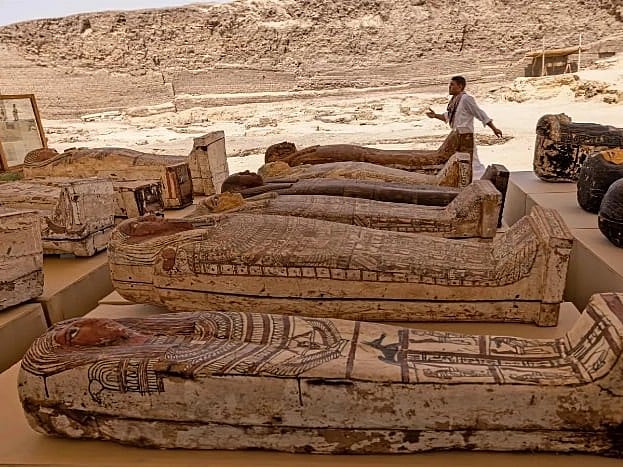
Egypt has uncovered two rare tombs dating back to the Early Dynastic Period in Minya province, a discovery that archaeologists say could provide new insights into the evolution of ancient Egyptian funerary architecture and burial practices.
The Ministry of Tourism and Antiquities said a mission from the Supreme Council of Antiquities made the discovery in the Jabal Al Tayr area, where excavations also revealed a collection of burials and funerary artefacts spanning periods from the Predynastic era to the Late Period.
Get updated faster and for FREE: Download the Gulf News app now - simply click here.
The discovery sheds new light on the evolution of funerary architecture in ancient Egypt and underscores the long-term significance of Jabal Al Tayr as a burial ground spanning multiple historical era.
Sherif Fathy, Minister of Tourism and Antiquities, described the find as a significant addition to Egypt's archaeological record, saying it could broaden understanding of how burial structures and rituals developed over thousands of years.
According to the Supreme Council of Antiquities, the two tombs feature an unusual architectural design, with one regarded as a unique and previously undocumented model, while the second closely mirrors it and remains exceptionally well preserved.
Preliminary studies suggest similarities between the tombs and that of King Den at Abydos, one of Egypt's earliest pharaohs, reinforcing the historical significance of the Jabal Al Tayr area as a major necropolis across successive eras.
Researchers said the first tomb was constructed using a design in which thick walls at the base gradually narrowed towards the top, a technique that may represent an early stage in the architectural development that eventually led to the construction of step pyramids and later true pyramids.
While parts of the first tomb were damaged by ancient quarrying activities, archaeologists identified important evidence of construction methods, including stone-cutting marks and large wooden supports used to reinforce the structure. The second tomb escaped such damage, preserving most of its original features.
Excavations also uncovered individual and collective burials, human remains, traces of decayed wooden coffins, black-topped pottery vessels dating to the Naqada II and III periods, and remnants of woven plant mats used in burial practices.
The ministry said the measures are intended to standardise occupational health procedures, ensure compliance with labour regulations and strengthen the protection of workers' health and safety through a unified occupational fitness and disease-screening framework.
Network Links
GN StoreDownload our app
© Al Nisr Publishing LLC 2026. All rights reserved.