18th-century city and Byzantine necropolis uncovered in Egypt
The residential structures date to the era of Sheikh Al Arab Hammam
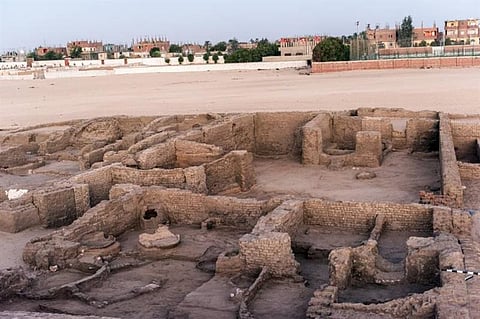
Dubai: The remains of an 18th-century mudbrick residential city, and a Coptic necropolis dating to the Byzantine period, have been uncovered by a joint Egyptian–French archaeological mission, Egypt’s Ministry of Tourism and Antiquities said. The discovery was made at the Sheikh Al Arab Hammam site in Qena Governorate, Upper Egypt.
The discovery, made in Al Arki village in Upper Egypt, offers new insight into settlement patterns and daily life in a region where historical sources are limited. The residential structures date to the era of Sheikh Al Arab Hammam, a prominent 18th-century regional figure.
Sherif Fathy, Minister of Tourism and Antiquities, said the project aims to preserve the site and prepare it for inclusion on Egypt’s tourist map, noting its location between the major archaeological centres of Dendera and Abydos.
Hisham El Leithy, Secretary-General of the Supreme Council of Antiquities, said the findings were particularly significant due to the scarcity of documentation about the area.
Excavations uncovered six houses with associated service buildings and part of an industrial zone, according to Diaa Zahran, head of the Islamic, Coptic and Jewish Antiquities Sector. Some houses were capped with mudbrick domes, while others had roofs made of palm trunks. Traces of white lime plaster were found in several rooms, pointing to varied architectural techniques.
Artefacts recovered include bronze coins, pottery fragments, children’s toys, jewellery and textile remains, suggesting a diverse and active community.
Beneath the residential layers, archaeologists found part of a Coptic necropolis from the Byzantine era. Mission head Ahmed El Shoky said geophysical surveys helped identify the burial area after a limestone coffin lid was discovered reused as paving near one of the city’s entrances.
The necropolis includes simple ground burials and others enclosed within mudbrick structures. Finds include linen wrappings and tunics woven in Coptic style, decorated with geometric, floral and animal motifs, as well as crosses and inscriptions. A copper stamp used to decorate baked goods was also uncovered.
Experts said the discovery provides valuable evidence on funerary customs, industrial activity and population distribution in Upper Egypt from the Byzantine to the Islamic periods.
Pierre Tallet, director of the French Institute of Oriental Archaeology, said bio-archaeological studies would examine the remains of around 23 individuals to determine their diet, health, age and sex, particularly given indications of mummification practices.