An aerial shot of the alignment and stations as of July 2026 of the North-South Commuter Railway (NSCR) project. The 147-km railway will connect Clark, Pampanga, Metro Manila and Calamba, Laguna. Full rollout is slated in 2033, with initial operations in December 2027.
Philippines races toward 2027 launch of North-South Commuter Railway (NSCR)
New trainsets bring 147-km rail closer to rollout, linking Manila to industrial hubs
Last updated:
4 MIN READ
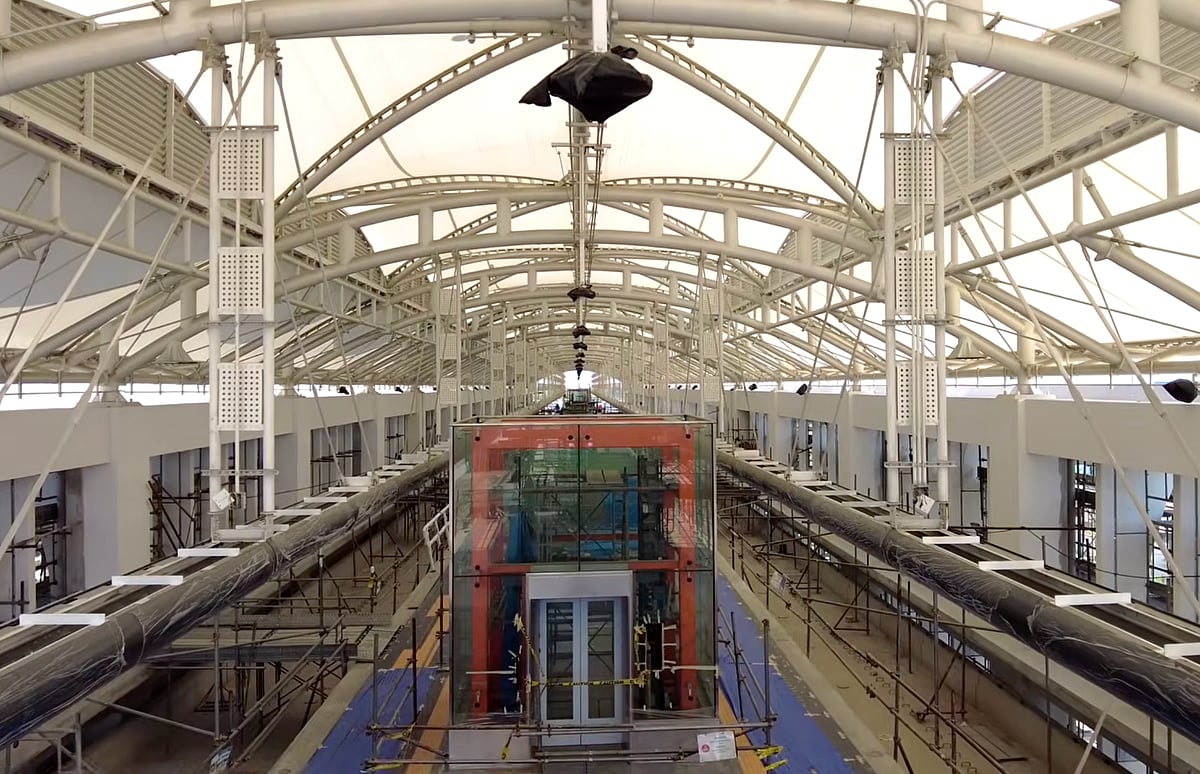
An elevator that brings passengers to the train platform being installed at a station of the North-South Commuter Railway, a 147-km electrified train that will connect New Clark City in Pampanga, Metro Manila (16 cities and one municipality) and Calamba, in Laguna, Philippines.
Sumitomo Mitsui Construction Co., Ltd.
MANILA: The Philippines has taken another step toward launching one of its biggest railway projects, with the delivery of the third North-South Commuter Railway (NSCR) trainset and the arrival of a fourth train in the country.
The project is on track for partial operations from Valenzuela to Malolos by the fourth quarter of 2027, with the Clark underground station reaching 73.29% completion as of September 2026, according to the Department of Transportation.
It is one of the most ambitious infrastructure mega-projects in the history of the Philippines. With a total estimated cost of ₱873.62 billion (about $15.42 billion), the NSCR is seen as the backbone of an entirely new transportation system expected to transform life in Manila, central and southern Luzon.
The staggering budget covers the construction of a fully elevated, double-track, electrified system, complex right-of-way acquisitions, and advanced Japanese-built trainsets.
The NSCR is literally the spine connecting three major economic regions: Central Luzon (Region III), the National Capital Region (Metro Manila), and Calabarzon (Region IV-A).
2027
Year of partial opening of the North-South Commuter Railway in the Philippines, connecting factories and residential district in Laguna (south of Manila) to the New Clark City in Pampanga, about 100km north of Manila.
Seamless integration
It is not an isolated rail line: the NSCR will act as the primary structural link connecting with existing transit routes like the LRT-1, LRT-2, and MRT-3, as well as the upcoming $9-billion Metro Manila Subway.
The NSCR line will span approximately 147 kilometers with 35+ stations, seamlessly stretching from New Clark City and Clark International Airport in the north down to Calamba, Laguna in the south.
The arrival of the fourth train does more than add another train to the fleet — it signals that the NSCR is moving from construction toward the crucial testing and commissioning phase ahead of its planned 2027 partial launch.
Each trainset can move up to 2,288 passengers
The 147-km line is expected to ease the life of commuters travelling across the "Greater Capital Region" (Metro Manila) and neighbouring provinces.
Train deliveries
The fourth eight-car Electric Multiple Unit "trainset" arrived at the Port of Manila in August 2026.
800,000
Daily passenger capacity of NSCR once fully rolled out
The third trainset was delivered to the Department of Transportation at the Malanday Depot, while the fourth has arrived in the Philippines and is undergoing customs clearance and unloading.
The fourth set is scheduled for delivery in October 2026.
A station on the under-construction electric NSCR line: When fully operational, currently targeted for 2033, the NSCR is expected to carry up to 800,000 passengers daily.
The deliveries mark continued progress in preparing rolling stock for the 147-km NSCR, which will link Clark in Pampanga with Metro Manila and Calamba in Laguna.
73.29%
Completion of Clark underground station of the North-South Commuter Railway (NSCR), as of September 2026
The government expects seven trainsets to be in the Philippines by September 2027 to support testing, commissioning and preparations for partial operations targeted for December 2027.
An under-construction train station on the North-South Railway project between Laguna and Pampanga in the Philippine. The project is expected to contribute to reduced road congestion and greenhouse-gas emissions while supporting more sustainable urban development.
A total of 13 eight-car trainsets are being manufactured and supplied by the Japan Transport Engineering Company (J-TREC)-Sumitomo joint venture.
Each trainset can accommodate up to 2,288 passengers, providing additional capacity for commuters travelling across the Greater Capital Region and neighbouring provinces.
The railway is also expected to substantially reduce travel times: A journey between Clark and Makati, for example, is projected to take less than an hour, offering commuters an alternative to congested roads.
Beyond commuting, the NSCR is designed to strengthen connections between major economic centres, support investment and improve access to employment, education, healthcare and other services.
A drone shot of the under-construction North-South Commuter Railway, a key component of the Luzon Economic Corridor (LEC), which seeks to improve infrastructure connectivity and economic integration across Central and Southern Luzon, connecting Metro Manila (16 cities and 1 town) to neighbouring provinces.
The latest train deliveries come as the Philippines and Japan mark 70 years of diplomatic relations, highlighting the role of bilateral infrastructure cooperation in the country's long-term transport development.
The 147-km North-South Commuter Railway project in connecting Manila to central and southern Luzon also highlights continued infrastructure cooperation between the Philippines and Japan as the two countries mark 70 years of diplomatic relations.
What you need to know
Fourth trainset arrives: The fourth NSCR trainset is now in the Philippines and undergoing customs clearance and unloading.
Third trainset delivered: The third trainset has been handed over to the Department of Transportation at Malanday Depot.
Seven by September 2027: Seven trainsets are expected to be in the Philippines for testing, commissioning and operational-readiness activities.
13 trains in total: J-TREC-Sumitomo is manufacturing 13 eight-car trainsets for the project.
2,288 passengers each: Every trainset can carry up to 2,288 passengers.
Partial operations in December 2027: The government is targeting the start of partial NSCR operations by December 2027.
147-km railway: The electrified line will connect Clark, Pampanga, Metro Manila and Calamba, Laguna.
800,000 daily passengers: Full operations, targeted for 2033, are expected to serve about 800,000 passengers a day.
Clark-Makati in under an hour: The project is designed to dramatically cut travel times, with Clark-Makati journeys projected to take less than an hour.
Luzon Economic Corridor: NSCR is a major component of the Luzon Economic Corridor, improving access to jobs, education, healthcare and investment opportunities.
Location map of Lima Estate, as it intersects the Luzon Economic Corridor (LEC), which represents the Philippines’ largest economic "engine", accounting for approximately 50% of GDP. The LEC offers a compelling platform for economic growth, supported by targeted fiscal and non-fiscal incentives, a skilled, English-proficient workforce, and opportunities to integrate into regional and global supply chains.
Network Links
GN StoreAbout Gulf NewsTerms & ConditionsReach by GNSitemapContact usPrivacy PolicyGN FocusHave your sayWork with usAdvertise with usGulf News epaperPrinting Services
Download our app
© Al Nisr Publishing LLC 2026. All rights reserved.