$9-billion Manila Subway breakthrough: Bicutan 'megahub' land handed over — hardest part is making it all connect
Bicutan mega hub clears key hurdle as Metro Manila bets big on going underground
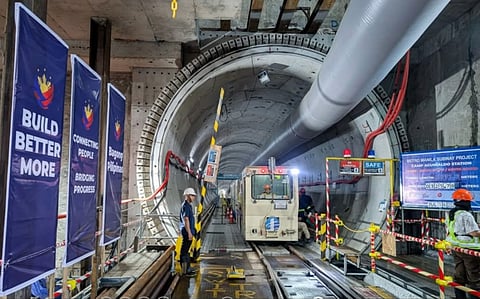
For generations, Metro Manila has been defined by traffic.
The Philippine capital, home to more than 15 million people and the centre of an urban region of nearly 30 million, is one of Asia's most congested metropolises.
Commuters routinely spend hours each day traveling between home and work, while economic losses from traffic have long been measured in billions of dollars annually.
The government's answer is buried beneath the city.
The 33-km Metro Manila Subway, the Philippines' first underground rapid transit railway, is steadily advancing after years of delays.
Get updated faster and for FREE: Download the Gulf News app now - simply click here
Latest breakthrough: Bicutan becomes a mega hub
One of the project's biggest developments came this week.
On Tuesday, property developer Filinvest Land Inc. turned over a 6,000-square-metre parcel in Bicutan to the Department of Transportation (DOTr), removing a key right-of-way (ROW) obstacle for what is expected to become one of Metro Manila's busiest railway interchanges.
The station is designed to connect the Metro Manila Subway with the North-South Commuter Railway (NSCR), allowing passengers from Bulacan and Central Luzon to transfer directly onto the subway toward Bonifacio Global City, Ortigas, Quezon City and other major destinations.
Filinvest also plans to build an elevated pedestrian link connecting the future station to its adjacent commercial property, illustrating how developers are beginning to redesign projects around future rail access.
The hub will utilise a track-sharing design, allowing subway trains to run on the NSCR line to create a continuous transit network from Clark in the north to Calamba in the south, the company said in a statement.
"We believe that a progressive economy relies heavily on robust infrastructure," FLI President and Chief Executive Tristan Las Marias said in a media statement.
He added that the developer will also build an elevated pedestrian link connecting the station to its adjacent 6.5-hectare commercial property.
The broader 5.8-km railway segment, which includes the Bicutan station, is slated for partial completion in 2031.
DIRECT JOBS: Officials estimate the massive infrastructure project will generate 350,000 direct and indirect jobs across construction and transit operations ahead of full system-wide deployment in 2033.
A city finally building underground
Unlike Manila's elevated LRT and MRT lines, the subway will run almost entirely below ground, linking 17 stations from Valenzuela in the north to Bicutan in the south, with a spur serving Ninoy Aquino International Airport.
The line will connect major business districts, government centers and residential communities, creating the country's first true high-capacity underground rail corridor.
When fully operational, officials project the subway will carry roughly 370,000 passengers daily, while integrating with existing rail lines to create a far larger multimodal network.
The Philippines' Department of Transportation (DoTr) recently announced the winner of the $270 -million NAIA Terminal 3 subway station contract. The station, which will serve Manila's Ninoy Aquino International Airport, forms part of the $9-billion Manila Subway currently under construction.
Why the project kept slipping
The subway has rarely moved according to schedule.
Groundbreaking took place in 2019, but construction was slowed by the COVID-19 pandemic, supply-chain disruptions and, perhaps most critically, the acquisition of thousands of privately-owned properties needed for stations, tunnels and depots.
Right-of-way (ROW) issues repeatedly forced revisions to construction timelines.
Transportation officials now say land acquisition accelerated significantly through 2025, allowing tunnel boring and station works to proceed more rapidly than in previous years.
This is thanks in no small part to the new right-of-way law, known as Republic Act 12289, also known as the Accelerated and Reformed Right-of-Way (ARROW) Act, signed in September, which amends the 2016 ROW Act RA 10752 to streamline infrastructure development.
A private operator before the trains arrive
Even before construction is finished, the government is preparing for how the railway will be run.
The Department of Transportation plans to tender a ₱179-billion operations and maintenance concession to private operators, one of the largest rail operating contracts ever offered in the Philippines.
Officials expect the concession to attract experienced international railway operators capable of maintaining complex subway systems and advanced signaling technology.
The strategy reflects a broader shift in Philippine infrastructure policy—government finances construction while private firms compete to operate major transport assets.
More than just another railway
Transportation planners increasingly view the subway not as a standalone project but as the center of a much larger network.
Future connections will include:
North-South Commuter Railway
MRT-3
MRT-7
LRT-1
LRT-2
NAIA rail spur
Future "intermodal" transport terminals
The goal is to allow commuters to travel across Metro Manila with fewer transfers while reducing dependence on private vehicles.
Urban economists say these connections could reshape property values, encourage higher-density development around stations and stimulate billions of pesos in private investment over the coming decades.
The bigger test
Engineering may no longer be the project's biggest challenge.
The real test is whether the subway can become the backbone of an integrated metropolitan transport system rather than another isolated rail line.
For decades, Metro Manila expanded faster than its transportation network. Roads filled long before mass transit caught up. Each new railway eased congestion in one corridor only to expose bottlenecks somewhere else.
The subway represents an attempt to reverse that pattern.
If completed on schedule and successfully integrated with the rest of the capital's rail system, it could become the single most transformative infrastructure project in modern Philippine history — changing not only how Filipinos travel, but also where they live, work and invest.
For a city that has spent decades trapped in traffic, the promise of moving underground is about far more than trains. It is about reclaiming time.


