When will Pakistan’s first astronaut fly into space?
Two Pakistani pilots are training in China for the historic mission
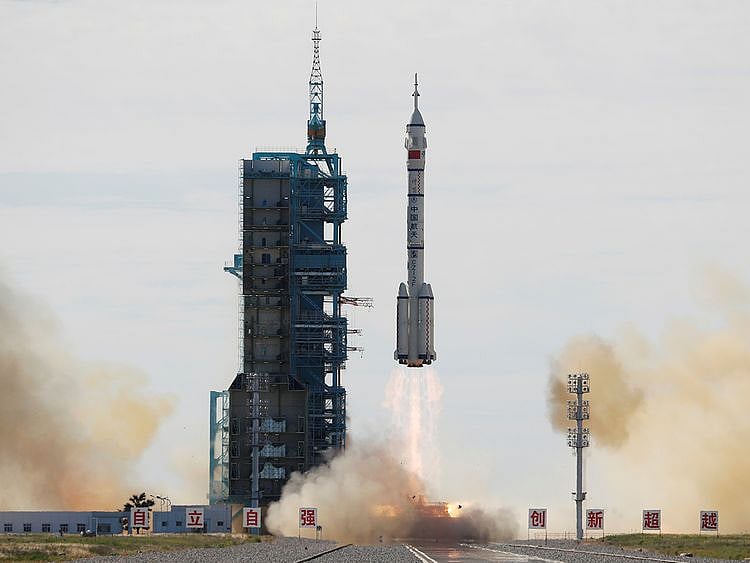
Dubai: Pakistan is preparing to make history on November 25 when its first astronaut is expected to travel into space aboard a Chinese spacecraft, marking a major milestone in the country’s space exploration ambitions.
Planning, Development and Special Initiatives Minister Ahsan Iqbal announced the date during the closing ceremony of World Space Week, according to Pakistani media reports.
The mission, being undertaken with China’s support, will make Pakistan part of a select group of countries whose citizens have travelled into space. “With China’s cooperation, Pakistan will reach new heights in the field of space research,” Iqbal said.
Moon mission
The minister also revealed that Pakistan has set an ambitious target of achieving a lunar landing by 2035, signalling the country’s determination to expand its presence in space exploration.
Two Pakistani pilots, Zeeshan Ali and Khurram Daud, have been selected as candidates for the historic mission and have undergone intensive training at the China Astronaut Research and Training Center in Beijing.
The two were shortlisted from approximately 20 finalists drawn from an initial pool of Pakistani pilots and scientists.
Their training includes learning Mandarin, understanding spacecraft systems and preparing for the challenging conditions of space travel, including microgravity and the intense gravitational forces experienced during launch.
China has not yet publicly confirmed which of the two pilots will undertake the mission.
Final selection
Amer Gilani, who oversees human space flight cooperation at Pakistan’s Space and Upper Atmosphere Research Commission (Suparco), previously told Reuters that a final selection decision was expected in mid-to-late October.
The selected astronaut is expected to become the first Pakistani to visit China’s Tiangong space station.
During an approximately week-long stay, the astronaut will serve as a “payload specialist”, conducting scientific experiments developed by Pakistan rather than operating the spacecraft.
The mission will use a Chinese-built spacecraft launched from a Chinese space centre, with the astronaut communicating in Mandarin while in orbit.
The flight represents a significant step in Pakistan-China scientific cooperation and could help Pakistan develop expertise in human space flight and advanced research.
Lunar rover
Beyond the upcoming astronaut mission, Pakistan is also working with China on lunar exploration.
A Pakistani-built lunar rover is expected to participate in China’s Chang’e 8 mission, currently planned for around 2028.
Iqbal said Pakistan aims to achieve a moon landing by 2035, although he did not provide details about the proposed mission or whether it would involve astronauts or robotic equipment.
Speaking at the World Space Week ceremony, Iqbal emphasised that space technology was no longer limited to scientific exploration but had become essential for everyday life and national development.
He highlighted its growing importance in agriculture, communications, climate monitoring, education and national security.
The minister warned that countries failing to invest in scientific research risked falling behind in technological advancement.
“If we do not conduct research, we will fall behind in the race for development,” he said.
Curiosity
Iqbal also urged young Pakistanis to develop scientific curiosity, ask questions and pursue careers in research and emerging technologies.
“Pakistan will have to regain the leadership in knowledge and research that was once our identity,” he said.
Pakistan’s first space museum planned
The minister also announced plans to establish what he described as Pakistan’s first space museum at the University of Narowal, saying resources had been arranged for the project.
He said construction of a centre for advanced technology and emerging sciences at the university would begin this year.
The announcements come as Pakistan seeks to strengthen its scientific capabilities and inspire a new generation of researchers, engineers and space scientists.
Network Links
GN StoreDownload our app
© Al Nisr Publishing LLC 2026. All rights reserved.