Cockroach Janta Party (CJP) supporters celebrate the resignation of India's Education Minister Dharmendra Pradhan, at Jantar Mantar in New Delhi on July 25, 2026 amid the ongoing protests over alleged NEET exam irregularities.
Inside CJP’s rise: How a viral ‘cockroach’ joke became India’s biggest Gen Z protest movement
How a satirical online ‘cockroach’ campaign became India’s loudest youth voice
Last updated:
6 MIN READ
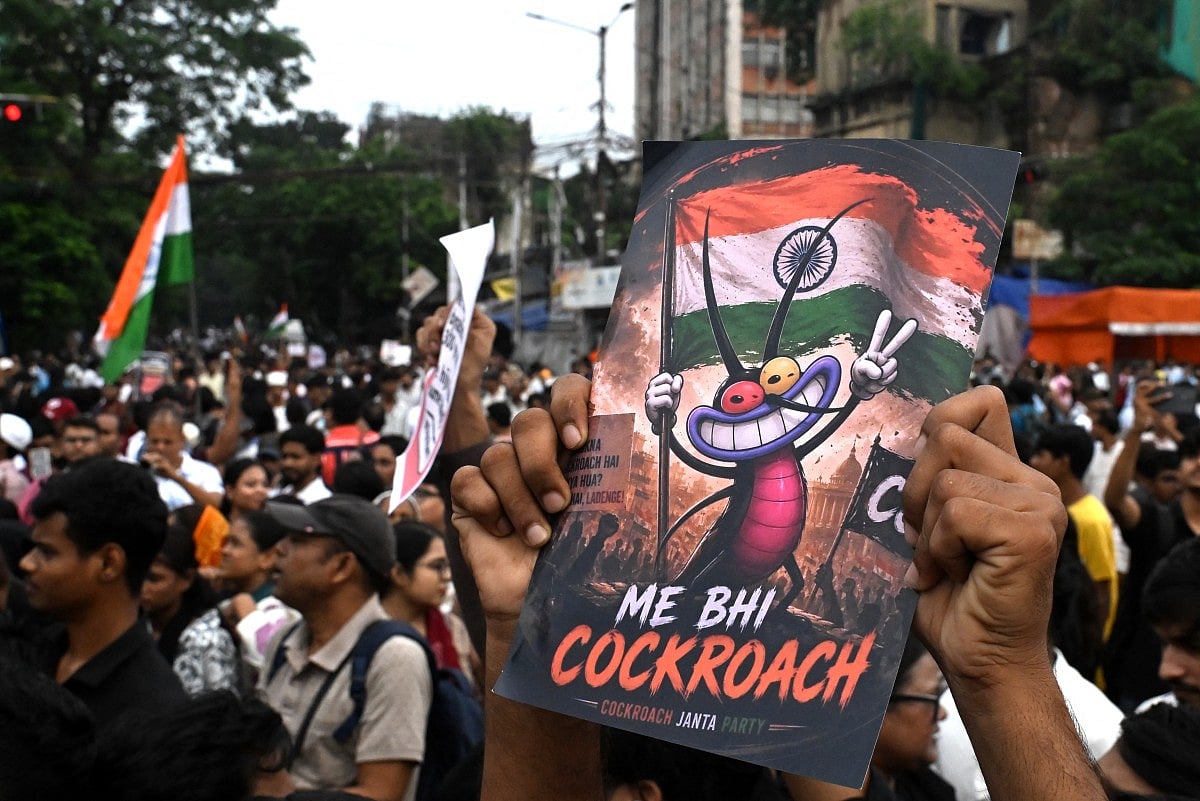
Inside the meme-fuelled student uprising reshaping India’s politics of education
AFP
A satirical online campaign became a nationwide student movement, leading to protests, government talks and the resignation of Education Minister Dharmendra Pradhan
What began as a sarcastic social media post quickly transformed into one of India’s most talked-about youth movements.
The Cockroach Janta Party (CJP), founded by political communications strategist Abhijeet Dipke, emerged from an online joke around the word “cockroach” and evolved into a Gen Z-led campaign demanding accountability over exam irregularities, education reforms and action against those responsible for student distress.
Get updated faster and for FREE: Download the Gulf News app now - simply click here.
The movement combined internet humour, AI-generated content, memes and street protests to create a new style of political mobilisation — one that moved from social media platforms to the streets of New Delhi.
Its biggest moment came on July 25, 2026, when Union Education Minister Dharmendra Pradhan announced his resignation following days of protests over alleged irregularities linked to competitive examinations.
From a Supreme Court remark to a political symbol
The origins of the CJP trace back to a remark during a Supreme Court hearing, where Chief Justice Surya Kant referred to unemployed youth and activists as “cockroaches” while discussing certain individuals entering public fields.
The comment triggered online debate. The judge later clarified that his remarks were aimed at people with fake qualifications and were not directed at unemployed youth as a whole.
But by then, the phrase had already become a rallying point.
On May 16, Abhijeet Dipke posted a satirical message asking:
“What if all cockroaches come together?”
The idea soon turned into the Cockroach Janta Party — a play on India’s political naming conventions and a symbol of resilience for young people who felt ignored.
Demonstrators holding posters take part in a protest rally in Mumbai on July 24, 2026 in solidarity with the ongoing protest by the Cockroach Janta Party (CJP) at New Delhi's Jantar Mantar demanding the resignation of the country's Education Minister Dharmendra Pradhan over alleged NEET examination irregularities.
How a meme became a movement
Unlike traditional political organisations, CJP built its identity around digital culture.
The movement used:
AI-generated images and videos
Memes and satire
Short-form social media content
Online mobilisation campaigns
Livestreams from protests
The group described itself as the “voice of the lazy and unemployed”, using humour to connect with young people frustrated over job opportunities, examination pressures and allegations of paper leaks.
Its social media presence grew rapidly, attracting millions of followers and turning the movement into one of the largest youth-driven digital campaigns in recent years.
Cockroach Janta Party (CJP) founder Abhijeet Dipke sits on an indefinite hunger strike demanding the resignation of India's Education Minister Dharmendra Pradhan over alleged NEET examination irregularities in New Delhi on July 19, 2026.
The face behind CJP: Abhijeet Dipke
Abhijeet Dipke, a 30-year-old communication strategist, became the public face of the movement.
A former social media strategist associated with the Aam Aadmi Party, Dipke built his political communication style around satire, humour and digital storytelling.
After the online campaign gained momentum, he returned to India from the US and joined protesters at Delhi’s Jantar Mantar.
At the protest site, Dipke emerged as a key organiser, urging supporters to maintain peaceful demonstrations while pushing for accountability from the government.
From online outrage to street protests
The turning point came when CJP moved beyond social media and organised physical demonstrations.
Students gathered at Jantar Mantar wearing cockroach masks and carrying messages demanding reforms in India’s examination system.
The movement received support from education reform activist Sonam Wangchuk, whose 26-day hunger strike added national attention to the protests.
As demonstrations grew, the issue expanded beyond examination irregularities to include concerns about unemployment, youth opportunities and institutional accountability.
How Sonam Wangchuk became a protest icon
Sonam Wangchuk, a renowned engineer, education reformer and activist from Ladakh, became a key figure in the CJP-led protests demanding reforms in India’s education system.
He joined the movement on June 28 by beginning an indefinite hunger strike at Delhi’s Jantar Mantar, surviving on salt and water while seeking accountability over alleged exam irregularities and paper leaks. His declining health raised concerns, and he was admitted to hospital on July 18.
Popularly known as “Sonam sir”, Wangchuk is the founder of the Students’ Educational and Cultural Movement of Ladakh (SECMOL) and received the Ramon Magsaysay Award in 2018 for his contributions to education and innovation.
He is also widely recognised as the inspiration behind Aamir Khan’s character Rancho in the Bollywood film 3 Idiots. His involvement brought greater attention to the youth-led CJP movement, linking Gen Z activism with a long history of education reform campaigns.
Security personnel stand guard as CJP supporters gather to stage a protest demanding the resignation of Union Education Minister Dharmendra Pradhan over the alleged NEET paper leak and examination irregularities, at Parliament Street in New Delhi on Thursday,
CJP protest timeline: From viral joke to minister’s resignation
May 3: NEET-UG 2026 paper leak allegations emerge
Allegations of irregularities and a paper leak surface after the nationwide NEET-UG 2026 examination. The investigation is later handed over to the CBI, leading to exam cancellations, rescheduling and plans to introduce future Computer-Based Test (CBT) formats.
June 6: Cockroach Janta Party launches protest movement
Founded by Abhijeet Dipke, the Cockroach Janta Party (CJP) holds its first major physical protest at Jantar Mantar in New Delhi. Demonstrators, many wearing cockroach masks, demand examination reforms and the resignation of Union Education Minister Dharmendra Pradhan.
June 28: Sonam Wangchuk joins protest and begins hunger strike
Education reformer and activist Sonam Wangchuk joins the CJP-led movement and starts an indefinite hunger strike at Jantar Mantar, demanding accountability over exam irregularities and justice for affected students.
July 16–20: Protests spread nationwide
Despite revised NEET-UG results being announced, student anger intensifies. Demonstrations expand beyond Delhi, culminating in the “Sansad Chalo” march. Police use tear gas and baton charges to disperse protesters during clashes.
July 22: CJP urges Wangchuk to end hunger strike
As Wangchuk’s health deteriorates on the 25th day of his fast, CJP leaders appeal to him to prioritise his health while promising that the movement’s demands will continue.
July 23: Wangchuk ends 26-day hunger strike
Wangchuk ends his fast at Medanta Hospital in the presence of Union ministers J.P. Nadda and Jitendra Singh after the government assures that concerns over paper leaks will be addressed in Parliament and compensation for affected families will be considered.
July 24: Nationwide protests continue, talks remain stuck
CJP organises a nationwide protest day, insisting that Wangchuk ending his fast does not change its key demand — the resignation of Education Minister Dharmendra Pradhan. Talks between the government and student representatives remain unresolved.
July 25: Dharmendra Pradhan resigns
Ahead of the scheduled third round of talks, Education Minister Dharmendra Pradhan announces that he has submitted his resignation to Prime Minister Narendra Modi.
CJP founder Abhijeet Dipke and Sonam Wangchuk hail the move as a “victory of democracy”, while the movement says it will continue until its remaining demands are addressed.
What happens next?
After Pradhan’s resignation, CJP founder Abhijeet Dipke said the protest would continue until the movement’s remaining demands were addressed.
The group’s two key demands are:
₹1 crore compensation for families of students who allegedly died following examination-related distress
Action against police officers accused of using excessive force during the July 20 protests
“This is democracy. He has resigned. We have two more demands. We won’t go like this,” Dipke told protesters at Jantar Mantar.
Why the CJP movement matters
The rise of the Cockroach Janta Party highlights a new form of youth activism in India — one built around digital identity, humour and rapid online mobilisation.
Unlike traditional youth wings linked to political parties, CJP operated as an internet-first movement with no conventional hierarchy.
Traditional youth movements
CJP model
Party-linked structures
Decentralised digital network
Formal speeches and rallies
Memes, satire and livestreams
Organised political messaging
Viral online campaigns
Electoral focusIssue-based mobilisation
The movement’s biggest impact may be the way it connected online culture with offline political pressure.
For India’s Gen Z generation, the CJP episode showed that a meme can become a movement — and that digital platforms can translate public frustration into political action.
With inputs from ANI, IANS and AFP
Network Links
GN StoreAbout Gulf NewsTerms & ConditionsReach by GNSitemapContact usPrivacy PolicyGN FocusHave your sayWork with usAdvertise with usGulf News epaperPrinting Services
Download our app
© Al Nisr Publishing LLC 2026. All rights reserved.