‘Bro is still employed’: Inside the Cockroach Janta Party’s viral meme war over India’s exam leak scandal
Two frontlines emerge as Delhi’s exam leak protests go full meme mode
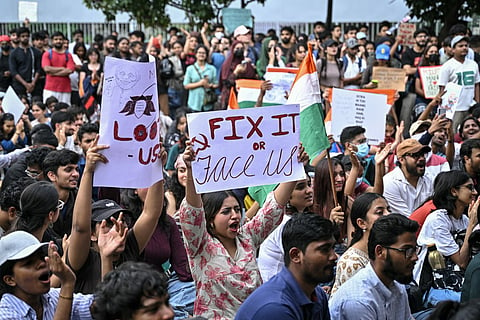
Dubai: India's Gen Z may have taken to the streets to protest repeated examination paper leaks, but they've also unleashed something else entirely: a meme storm that has swallowed social media whole.
Every march now spawns a hilarious, acerbic reel and every police chase becomes a cinematic edit. Welcome to India's 2026 youth-led protest in the age of the algorithm.
And let's not forget, every generation has found its language of dissent. The anti-war movement had protest songs, while the Arab Spring had Facebook and Twitter.
Hong Kong's pro-democracy protesters mastered viral memes and digital symbolism, while Black Lives Matter transformed hashtags into a global rallying cry. For Gen Z in India now, the language of resistance is the meme.
Going by the hilarious reels that are flooding our timelines, this generation doesn't simply march: It posts, edits, remixes and shares.
Protest no longer ends when demonstrators leave the streets. It continues on Instagram Reels, X and meme pages, where humour, satire and pop culture often travel faster than breaking news itself.
If previous generations marched shoulder to shoulder, this one marches meme to meme. The month-long demonstrations led by the Cockroach Janta Party (CJP) at Delhi's Jantar Mantar have become as much an internet phenomenon as a political movement.
Students demanding the resignation of Education Minister Dharmendra Pradhan over repeated examination paper leaks have weaponised the internet's favourite language: Bollywood edits, K-pop fancams, "Get Ready With Me" videos, superhero cosplay and enough savage memes to keep Instagram pages busy for weeks.
Because if Gen Z has one superpower, it's turning a news event into internet culture before the evening headlines land.
When police used batons and teargas to stop protesters marching towards Parliament on July 20, the internet barely blinked before doing what it does best. The footage was edited into endless Subway Surfers-style videos, complete with obstacle-course graphics that made sprinting from police resemble a mobile game.
Every chase came with its own soundtrack. Some protesters fled to the rousing beats of Chak De India. Others chose Bhaag Milkha Bhaag. The internet's favourite, however, was the gloriously chaotic Bhaag DK Bose, whose repeated chorus of "bhaag"—run—could hardly have been more perfectly timed.
The protest accidentally became a fitness challenge too. Students proudly posted Strava screenshots showing how many kilometres they had clocked while outrunning police, thanking officers for the surprise cardio session and joking that the lathi charge had doubled as interval training.
Even getting dressed for a demonstration became content. Forget skincare routines and coffee runs. This was "Get Ready With Me: Protest Edition"—complete with anti-teargas goggles, comfortable trainers and practical outfits designed for surviving a day that might include both slogans and sprinting.
And then came the memes. Because apparently nothing—and no one—is safe from Gen Z's meme economy.
Politicians were turned into reaction images within minutes. Internet users jokingly debated who looked thinner, who appeared to enjoy one too many meals and whose expressions deserved permanent meme status. Every photograph became a template waiting to happen.
Education Minister Dharmendra Pradhan found himself immortalised on a placard carrying perhaps the most devastating six words of the protest:
"Bro is still employed." Then came the savage one-liners.
"Even my ex hadn't ignored me this much."
Somewhere, every Gen Z group chat nodded in approval. Bollywood, naturally, became the unofficial creative director of the movement.
Scenes from the 2023 hit Tu Jhoothi Main Makkaar were remixed into political satire by replacing the film's romantic leads with political figures. A lyric originally about an inattentive lover -- "They may be mine, but they never listen to me" -- was repurposed into a biting commentary on students who feel ignored.
K-pop culture wasn't spared either. Editors created slick fancams featuring CJP leader Abhijeet Dipke, students ducking police batons and protesters charging through barricades, replacing polished footage of BTS idols with clips from Delhi's streets and soundtracking them with songs whose rebellious energy fit surprisingly well.
Even teargas became meme material. One viral joke suggested Delhi Police should stop firing teargas because the capital's pollution was already bad enough and people might soon start demanding the environment minister resign too.
Another reviewer declared the gas "100 per cent authentic and without adulteration", a cheeky swipe at India's ongoing debates over fuel quality.
Then came what the internet unanimously crowned the protest's defining meme. A demonstrator calmly picked up a smoking teargas shell and lobbed it straight back towards police.
Within minutes, social media had reached its verdict. Real-life Uno Reverse card.
The cosplay only added another layer to the spectacle. Batman. Spider-Man. Superman. Iron Man. Even Mahatma Gandhi and B.R. Ambedkar made appearances, making it look less like a conventional protest and more like every cinematic universe had unexpectedly crossed over into Indian politics.
By the time one protester joked that Jantar Mantar had become the ideal place to find a boyfriend or girlfriend, it was obvious the movement had escaped the confines of politics and entered internet folklore.
But beneath the memes, the fancams and the jokes sits a frustration that refuses to go away.
Students continue to demand accountability over repeated examination paper leaks, sweeping reforms to India's competitive examination system and the resignation of Dharmendra Pradhan.
Prime Minister Narendra Modi has since announced fast-track courts to prosecute those responsible for examination paper leaks, but the Cockroach Janta Party says that falls well short of what students are demanding and has vowed to continue its sit-in until broader reforms are introduced.
The memes may dominate the timeline and the jokes may win the algorithm, but for the students behind them, they're more than punchlines.
They're the newest form of protest. Because in 2026, the fastest way to get people talking isn't always through a slogan. Sometimes, it's through a meme.


