Modi vows tougher action as paper leak row deepens
PM seeks strict punishment for offenders as protests and political pressure mount
New Delhi: Prime Minister Narendra Modi has defended his government’s handling of India’s examination paper leak crisis, saying swift action had been taken against those responsible while urging tougher punishment for offenders as student protests and opposition attacks intensified.
Speaking at a meeting of National Democratic Alliance (NDA) leaders on Tuesday, Modi said paper leaks were “not limited” to any one state or the central government but were a national challenge requiring a united response across political parties.
According to Parliamentary Affairs Minister Kiren Rijiju, the prime minister said authorities acted immediately after reports of irregularities in the National Eligibility cum Entrance Test (NEET), leading to the arrest of 13 people.
“As soon as reports of the paper leaks emerged, the government took immediate action. Thirteen people were arrested and sent to jail,” Rijiju quoted Modi as saying.
He added that conducting the NEET re-examination without delaying results had been the government’s priority to ensure students’ futures were not disrupted.
Modi also appealed to the legal fraternity to help ensure “the strictest possible punishment” for those involved in paper leak rackets so that such crimes would serve as a deterrent in the future.
“The issue of paper leaks is not confined to any single state or the Central government but is a matter of concern for the entire nation,” Rijiju said, quoting the prime minister. “This is not a matter of partisan politics, but an issue concerning the future of the country and its youth.”
Protest movement gathers momentum
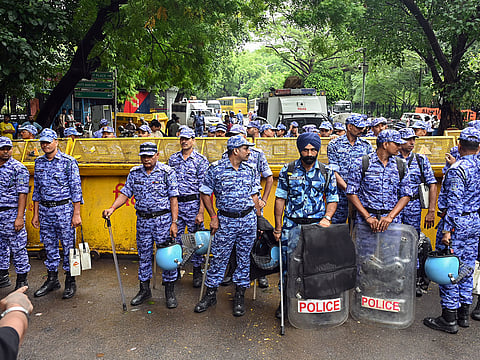
The remarks came a day after one of the largest student demonstrations in New Delhi in years, when thousands of protesters demanding the resignation of Education Minister Dharmendra Pradhan clashed with police near Parliament.
The protests were organised by the “Cockroach Janta Party” (CJP), an online movement that has rapidly built a following on social media after emerging in May.
Although the crowds were smaller on Tuesday, hundreds of demonstrators remained at Delhi’s Jantar Mantar protest site, vowing to continue their campaign.
“We won’t stop. Pradhan has to be sacked,” CJP spokesperson Ashutosh Ranka said.
The group’s founder, Abhijeet Dipke, urged supporters to remain determined.
“They want to break our spirit,” he told protesters. “Do not let them silence you.”
Clashes leave scores injured
Police used tear gas and batons on Monday to stop protesters marching towards Parliament, with Delhi Police saying 178 people were injured in the violence, including 118 police personnel.
Authorities accused protesters of “unruly, aggressive and violent behaviour”, while protest organisers alleged that police used excessive force against students demonstrating over the integrity of the country’s examination system.
“It’s a shameful day in the history of Indian democracy that people, honest students, who had come for a genuine issue were brutally beaten by the Delhi police,” Ranka told AFP.
One protester, Chandra Pratap Sishwi, said the police action had strengthened rather than weakened the movement.
“We have become even more fearless now,” he said. “When I saw people being beaten up by the police like that, my blood boiled.”
Opposition targets government
The protests have triggered a fresh confrontation in Parliament, with opposition parties demanding a debate on both the examination scandal and the police response.
Congress leader Rahul Gandhi accused the government of suppressing students raising legitimate concerns about their future.
“People are being beaten and thrashed; this is completely unacceptable,” Gandhi told reporters outside Parliament. “Why is the Prime Minister silent? He should speak up. He should apologise and stop this nonsense.”
In a post on X after meeting Lok Sabha Speaker Om Birla, Gandhi said Parliament should hold “a detailed discussion on the brutality unleashed on students yesterday and on the government’s complete lack of accountability for the examination crisis.”
Repeated disruptions over the paper leak controversy and other issues have already affected proceedings during the ongoing Monsoon Session.
Confidence shaken
The protests follow a series of examination controversies that have shaken public confidence in India’s testing system.
More than 2.2 million aspiring medical students were forced to sit a fresh NEET examination under tight security after the original test was scrapped because of a question paper leak. The controversy followed another dispute over the online marking system used in examinations taken by nearly two million high school students.
Addressing NDA leaders, Modi also highlighted the achievements of India’s youth, including the recent launch of the Vikram-1 rocket by Skyroot Aerospace, saying the government’s focus should remain on creating opportunities for young people.
Rijiju said the prime minister had called for a “foolproof system” to prevent future examination irregularities while assuring students that safeguarding the integrity of competitive examinations remained a priority.
With inputs from AFP and IANS


