Inside India’s Gen Z-led CJP movement: Why did Cockroach Janta Party protests turn violent in Delhi?
Youth-led Cockroach Janta Party turns satire into mass revolt over exam leaks
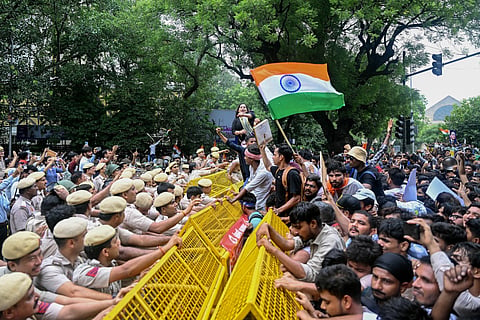
Thousands of young protesters have taken to the streets of Delhi as part of the Cockroach Janta Party (CJP) movement, demanding action over alleged exam paper leaks and calling for the resignation of India’s Education Minister Dharmendra Pradhan.
What started as a satirical online campaign months ago has grown into one of India’s most visible youth-led protest movements.
Get updated faster and for FREE: Download the Gulf News app now - simply click here.
CJP protests: Why thousands took to the streets
CJP vows to continue protests: The movement has said it will continue its agitation until Education Minister Dharmendra Pradhan resigns.
Thousands march in Delhi: Protesters gathered at Jantar Mantar and attempted to march towards Parliament, demanding education reforms and accountability over alleged exam irregularities.
Nearly 180 injured in clashes: Delhi Police said 178 people were injured, including 118 police personnel and around 60 protesters, after clashes broke out. Police used tear gas and baton charges to disperse crowds.
Protesters accuse police of excessive force: CJP leaders alleged a harsh crackdown on students, while police said some protesters became violent and attempted to break through barricades.
Key demands of CJP:
Resignation of Education Minister Dharmendra Pradhan
Reform of India’s examination system
Accountability over alleged NEET-UG paper leaks
Compensation for families of students who allegedly died following exam-related distress
Action over activist Sonam Wangchuk’s case
Police investigate clashes: Delhi Police are examining more than 250 videos, including CCTV, drone and body-camera footage, to identify people allegedly involved in violence and vandalism.
Sonam Wangchuk’s support: The activist and engineer, who supported the student protests through a hunger strike, was taken to hospital after his health deteriorated. He has said he would continue his protest.
What is the Cockroach Janta Party?
The Cockroach Janta Party was launched in May by Abhijeet Dipke, a 30-year-old political communications strategist and former Boston University student.
The movement began as a joke after remarks allegedly made by Chief Justice Surya Kant, who compared unemployed young people entering fields such as journalism and activism to “cockroaches” and “parasites”. He later clarified that his comments referred to people with fake degrees, not youth generally.
Dipke created the satirical Cockroach Janta Party — a play on India’s ruling Bharatiya Janata Party (BJP) — and invited people to join online.
The response was much larger than expected, with thousands signing up and the campaign evolving into a serious protest movement.
Why are young people protesting?
The protests are mainly driven by anger over alleged exam paper leaks and concerns about India’s education system.
The movement has focused on the National Eligibility cum Entrance Test (NEET), India’s medical college entrance examination.
Millions of students prepare for the highly competitive exam, often spending years and large amounts of money on coaching. Allegations of question paper leaks have triggered widespread anger among students and families.
The CJP is demanding:
A complete overhaul of the education system
Stronger accountability over exam leaks
The resignation of Education Minister Dharmendra Pradhan
The movement has also highlighted wider concerns over unemployment and limited job opportunities for young Indians.
How did the movement grow?
The CJP held its first major offline protest in Delhi in early June, demanding the education minister’s resignation.
The movement gained further attention after support from Sonam Wangchuk, a prominent engineer and education activist from Ladakh.
Wangchuk began a hunger strike at Jantar Mantar in support of students’ demands. After 20 days, he was taken to hospital by police, sparking further criticism and drawing more attention to the protests.
What happened during the Delhi march?
Thousands of CJP supporters gathered in Delhi to march towards Parliament despite police denying permission for the protest.
Police used barricades, tear gas and baton charges to stop protesters from moving beyond the permitted area. Several demonstrators said they were injured, while police alleged some protesters threw stones and damaged property.
The crowd included students, young professionals, activists and parents affected by exam controversies.
Why is the CJP movement significant?
The CJP has become one of the biggest youth-led challenges to the government in recent years.
Opposition leaders have supported the protesters, criticising the police response and calling for dialogue.
The government, however, has rejected the allegations. Education Minister Dharmendra Pradhan has dismissed the protesters’ claims, while officials have defended their handling of the situation.
What happens next?
The government held a brief meeting with CJP representatives after the protests, but the group said no commitments were made.
CJP leaders have vowed to continue their campaign until their demands, including the education minister’s resignation, are addressed.
The movement has transformed from an online satire campaign into a wider debate over India’s education system, youth unemployment and government accountability.
With inputs from IANS, ANI and AFP


