'Just the beginning': How CJP’s 37-day protest led to Dharmendra Pradhan’s exit — what’s next?
Government yields to CJP as NEET leak fury sparks reforms, minister’s exit
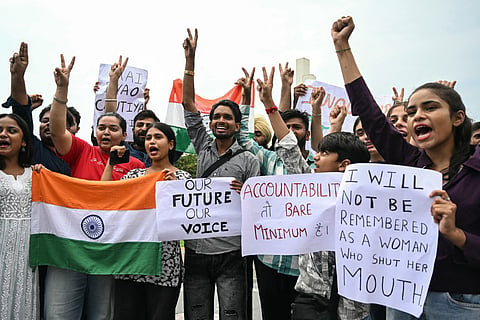
The Cockroach Janta Party (CJP) on Sunday celebrated the resignation of Union Education Minister Dharmendra Pradhan after a 37-day youth-led agitation over the NEET-UG 2026 paper leak controversy, calling it a victory for students.
Get updated faster and for FREE: Download the Gulf News app now - simply click here.
CJP founder Abhijeet Dipke thanked supporters across India, saying their trust and support made what he described as a “huge victory of the youth” possible.
In a video message shared on X, Dipke said the movement faced several challenges but credited supporters for standing with CJP despite criticism.
“This is just a beginning. The Cockroach Janta Party has a long way to go,” he said.
He also apologised for not meeting all protesters who remained at Jantar Mantar after the agitation ended, citing health issues.
CJP ends protest after government assurances
The CJP withdrew its Jantar Mantar protest after talks with the government and assurances on key demands.
The government agreed to:
Provide suitable compensation to families of NEET aspirants who died by suicide
Withdraw FIRs filed against protesters across India
Examine CJP’s five-point charter on examination reforms
The next round of discussions between the government and CJP is expected after four weeks.
Pralhad Joshi takes charge as education minister
Following Dharmendra Pradhan’s resignation, Union Minister Pralhad Joshi was given additional charge of the Education Ministry.
Joshi said he would fulfil the responsibility with “complete humility and responsibility” and thanked Prime Minister Narendra Modi for the opportunity.
Union Home Minister Amit Shah said Pradhan’s resignation reflected the BJP’s belief that the interests of the nation, students and youth were above any political position.
Opposition calls resignation a victory for students
Opposition leaders welcomed Pradhan’s resignation, describing it as a success for the youth-led movement.
Congress leaders also credited the wider student movement and Rahul Gandhi’s support for raising concerns over exam irregularities.
Congress leader Rahul Gandhi has demanded accountability over the alleged police crackdown on students protesting in Delhi on July 20.
In a letter to Union Home Minister Amit Shah shared on X, Gandhi questioned who authorised the use of force, including pellet guns and tear gas, against protesters.
He alleged that several students suffered serious injuries and called for answers over the deployment of security personnel and plain-clothed individuals seen during the clashes.
Gandhi said peaceful protests are a key part of democracy and urged the government to address students’ concerns through dialogue.
Delhi returns to normal after protest ends
After CJP withdrew its agitation, normal services resumed in Delhi.
The Delhi Metro reopened all stations that had faced security restrictions during the protests. The 18 affected stations, including Rajiv Chowk, Central Secretariat, Mandi House, ITO and New Delhi, were reopened after days of disruption.
Internet services were also restored around Jantar Mantar and nearby areas.
The protest site was vacated on Saturday, following which the New Delhi Municipal Council (NDMC) launched a cleanliness drive at Jantar Mantar and surrounding areas.
Bollywood backs Gen Z-led movement
The resignation triggered reactions from Bollywood celebrities, with several praising the role of young protesters and the power of collective action.
Prakash Raj congratulated protesters, praising Sonam Wangchuk and those who stood with the youth movement.
Speaking to PTI, Shabana Azmi, one of the prominent voices supporting the student movement, congratulated the protesters, saying their efforts had brought about change. “I am so proud of our youth. I am truly humbled. Thank you for reminding us that our Constitution is our greatest strength,” she said.
Alia Bhatt reacted on Instagram Stories, writing: “Gen Z showed up! The rest is history.”
Sonakshi Sinha praised Gen Z’s role in the protest and celebrated the youth movement.
Kriti Sanon wrote: “A true democracy doesn’t weaken when questioned. It strengthens when it listens.”
Ishaan Khatter also celebrated the development, describing it as a moment of collective action.
Priyanka Chopra Jonas reacted to a social media post about Pradhan’s resignation with heart and applause emojis.
Vir Das congratulated students, writing that they had restored faith in democracy and should celebrate their achievement.
How CJP turned a protest into a national movement
What started as a satirical name inspired by a viral moment transformed into a major youth-led movement demanding accountability and reforms in India’s examination system.
The protest gained momentum after allegations of irregularities in NEET-UG 2026, with students demanding action over exam integrity.
Sonam Wangchuk’s hunger strike boosted momentum
The agitation received wider attention after activist Sonam Wangchuk joined the protest and began a prolonged hunger strike demanding accountability over exam irregularities.
His participation brought national focus to the students’ demands and increased pressure on the government.
The government later held talks with protesters, with Wangchuk ending his hunger strike after receiving assurances.
Humour, memes and placards became CJP’s identity
Unlike traditional protests, CJP used satire, memes and creative messaging to connect with young audiences.
Handwritten placards featuring jokes, pop culture references and sharp messages became the defining symbol of the movement. Many of these images went viral, helping the protest reach audiences beyond Jantar Mantar.
From Jantar Mantar to social media
CJP combined street protests with digital mobilisation.
Photos of placards, protest videos and key moments from Jantar Mantar quickly spread across Instagram and X, turning local demonstrations into a nationwide conversation.
The movement’s digital-first approach helped attract support from students and young people across India.
A protest that changed the conversation
After weeks of demonstrations and negotiations, CJP ended its protest following government assurances.
For supporters, the movement showed how Gen Z used humour, social media and street mobilisation to challenge traditional protest methods and push education reforms into the national spotlight.


