Fighter jets sit on the flight deck of the Nimitz-class aircraft carrier USS Abraham Lincoln in a file photo, The drills follow the arrival of the USS Abraham Lincoln carrier strike group in the region, according to a CENTCOM announcement on Monday.
Trump warns Iran: Time running out for nuclear deal; next strike will be worse
US launches major air exercises amid military buildup and rising tensions
Last updated:
4 MIN READ
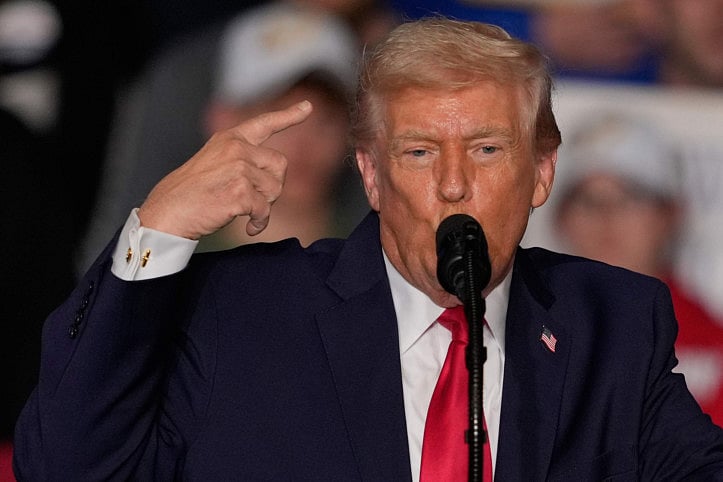
President Donald Trump speaks about the economy at a rally Tuesday, Jan. 27, 2026, in Clive, Iowa. (AP Photo/Charlie Neibergall) (Photo: AP)
Dubai: US President Donald Trump on Wednesday renewed threats of military action against Iran, warning that “time is running out” for Tehran to agree to a nuclear deal and vowing that any future strike would be far more devastating than previous attacks.
In a social media post, Trump urged Iran to return to negotiations, even as a major US military buildup unfolds across the Middle East.
“Hopefully Iran will quickly ‘Come to the Table’ and negotiate a fair and equitable deal — NO NUCLEAR WEAPONS — one that is good for all parties. Time is running out,” Trump said, adding that “a massive armada is heading to Iran.”
Referring to earlier US operations, he warned: “As I told Iran once before, MAKE A DEAL! They didn’t, and there was ‘Operation Midnight Hammer,’ a major destruction of Iran. The next attack will be far worse!”
The escalation in rhetoric came after Iran’s top diplomat rejected negotiations under military pressure.
“Conducting diplomacy through military threat cannot be effective or useful,” Foreign Minister Abbas Araghchi said in televised remarks. “If they want negotiations to take shape, they must set aside threats, excessive demands and illogical issues.”
Trump has repeatedly left open the possibility of fresh military action against Iran, particularly after Washington backed and joined Israel’s 12-day conflict in June aimed at weakening Iran’s nuclear and ballistic missile programmes.
Earlier this month, Trump also threatened strikes over Tehran’s violent crackdown on anti-government protests, though in recent days both sides had signalled a willingness to allow diplomacy a chance.
Even as Trump spoke of talks, the US has moved significant military assets into the region.
USS Abraham Lincoln aircraft carrier.
US military moves in the Middle East
Key developments at a glance
Multi-day US air power readiness exercises launched across CENTCOM region
USS Abraham Lincoln carrier strike group now deployed in the Middle East
F-15E Strike Eagle jets moved to the region; UK deploys Typhoon fighters
Drills focus on rapid deployment, dispersed operations and partner coordination
CENTCOM also conducting joint defensive exercises with Bahrain against drone threats
Backdrop
Protests in Iran over economic woes and political repression
Rights groups estimate more than 6,100 killed; some claim far higher toll
Trump threatens action but says Tehran wants talks
Iran warns any attack will be met with force
US Central Command (CENTCOM) confirmed that a carrier strike group led by the nuclear-powered USS Abraham Lincoln has arrived in Middle Eastern waters, though its precise location was not disclosed. The carrier is accompanied by guided missile destroyers and carries dozens of fighter jets along with nearly 5,000 sailors.
The United States has also deployed F-15E Strike Eagle fighter jets to the region, while the UK has reportedly moved Typhoon jets in what officials described as a defensive posture.
A Boeing F/A-18E Super Hornet landing on the Nimitz-class aircraft carrier USS Abraham Lincoln in the Indian Ocean on Jan. 22, 2026.
Military readiness
Alongside the naval buildup, CENTCOM announced the launch of multi-day military readiness exercises across the Middle East.
Air Forces Central (AFCENT), the air component of CENTCOM, said the drills aim to demonstrate the ability to rapidly deploy, disperse and sustain combat airpower across the region.
Lt. Gen. Derek France, AFCENT commander and Combined Forces Air Component commander for CENTCOM, said the exercises would prove US airmen can operate “under demanding conditions — safely, precisely and alongside our partners.”
“This is about maintaining combat-ready forces and ensuring airpower is available when and where it’s needed,” France said.
Shield against unexpected assaults
CENTCOM added that the drills are being conducted with host-nation approval and in coordination with civil and military aviation authorities, emphasising safety and respect for sovereignty.
However, military analysts told CNN that similar exercises in the past have sometimes served as cover for surprise attacks or as pressure tactics to force concessions from adversaries.
Trump himself acknowledged the scale of the deployment in an interview with Axios.
“We have a big armada next to Iran. Bigger than Venezuela,” he said. “I’d rather not see anything happen, but we’re watching them very closely.”
Sources told CNN that Trump is still weighing his options and that no final decision on military action has been made.
Tensions have been further fuelled by Iran’s deadly crackdown on protests that erupted late last month, initially triggered by economic grievances such as currency devaluation.
The US-based Human Rights Activists News Agency (HRANA) said more than 6,100 protesters have been killed so far, with over 17,000 deaths still under review. Iranian authorities have acknowledged thousands of deaths, though censorship and nationwide internet blackouts have made independent verification difficult.
As warships gather, fighter jets reposition and military drills intensify, Washington continues to juggle threats and diplomacy — while Tehran insists it will not negotiate under the shadow of force.

A Senior Associate Editor with more than 30 years in the media, Stephen N.R. curates, edits and publishes impactful stories for Gulf News — both in print and online — focusing on Middle East politics, student issues and explainers on global topics. Stephen has spent most of his career in journalism, working behind the scenes — shaping headlines, editing copy and putting together newspaper pages with precision. For the past many years, he has brought that same dedication to the Gulf News digital team, where he curates stories, crafts explainers and helps keep both the web and print editions sharp and engaging.
Sign up for the Daily Briefing
Get the latest news and updates straight to your inbox
Network Links
GN StoreAbout Gulf NewsTerms & ConditionsReach by GNSitemapContact usPrivacy PolicyGN FocusHave your sayWork with usAdvertise with usGulf News epaperPrinting Services
Download our app
© Al Nisr Publishing LLC 2026. All rights reserved.