From militant threats to US firepower: Why the Iran crisis is reaching a boiling point
Militias warn of attacks as US carrier moves closer and rhetoric intensifies
Dubai: Two Iranian-backed militias in the Middle East are signalling their willingness to launch new attacks, likely trying to back Iran on Monday as tensions rise over the US military buildup and President Donald Trump’s threats of action over Tehran’s violent crackdown on nationwide protests.
Yemen’s Iranian-backed Houthi militants signalled a readiness to resume attacks on shipping in the Red Sea. This came shortly after Iraq’s Kataib Hezbollah paramilitary group, long supported by Iran’s Revolutionary Guard, issued a direct warning late Sunday against any strike on Iran, saying it would trigger a “total war” across the region.
However, both the Houthis and Kataib Hezbollah largely sat out Israel’s 12-day war with Iran in June, when the United States bombed Iranian nuclear sites. Their earlier hesitation highlighted growing strain within Iran’s so-called “Axis of Resistance” following Israeli attacks on allied groups during the Gaza war.
Threats from Iraq, Yemen
A short video released by the Houthis showed images of a ship on fire with the caption “Soon.” The group later aired footage from its January 2024 attack in the Gulf of Aden on the Marshall Islands-flagged tanker Marlin Luanda, one of more than 100 vessels targeted during its campaign linked to the Gaza conflict.
While the Houthis halted attacks following a ceasefire, they have repeatedly warned they could resume operations.
Meanwhile, Kataib Hezbollah leader Ahmad “Abu Hussein” Al Hamidawi issued a stark threat in a statement.
“We affirm to the enemies that the war on the (Islamic) Republic will not be a picnic; rather, you will taste the bitterest forms of death, and nothing will remain of you in our region,” he said.
US carrier moves closer, UK boosts presence
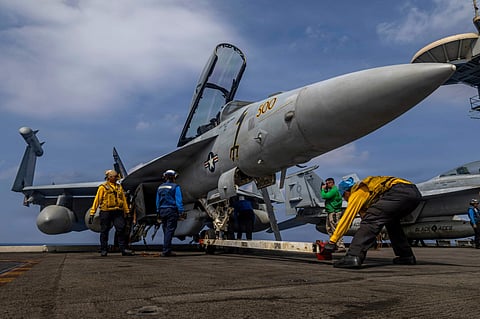
The threats come as the USS Abraham Lincoln carrier strike group and its accompanying guided missile destroyers move deeper into the region. CNN reported that the carrier group is now operating in the Indian Ocean, placing it closer to potential US operations targeting Iran and within the area of responsibility of US Central Command.
The group includes an aircraft carrier, guided missile cruisers, anti-aircraft warships and anti-submarine destroyers or frigates.
How the crisis has escalated
Late December 2025: Protests erupt across Iran after currency collapse and economic hardship
Early January: Demonstrations grow into mass anti-government movement; security forces launch violent crackdown
Mid-January: Rights groups report thousands killed and tens of thousands arrested; Trump warns Tehran against killing protesters or carrying out executions
Late January: US begins moving USS Abraham Lincoln carrier strike group toward the region; UK deploys RAF Typhoon fighter jets to the Gulf for defensive operations
Sunday (Jan 25): Iranian-backed Kataib Hezbollah in Iraq warns of “total war” if Iran is attacked
Monday: CNN reports the carrier group has entered the Indian Ocean, closer to Iran; Houthis in Yemen signal possible return of Red Sea shipping attacks; Iran unveils threatening mural targeting US carrier and Iranian officials warn of a “painful and decisive” response to any strike
Ongoing: Airlines avoid Iranian airspace amid security fears
US officials stressed the carrier is not necessarily in a final position for any strike, and that Trump continues to weigh options with no decision yet made.
Trump has said the ships were being moved “just in case,” after laying down two red lines — the killing of peaceful protesters and mass executions during the crackdown.
Britain has also stepped up its presence in the region, confirming the deployment of Royal Air Force Typhoon fighter jets to the Gulf for defensive purposes amid rising tensions.
Allies have meanwhile urged Washington to avoid military action.
Iran braces and escalates rhetoric
In Tehran, authorities unveiled a large mural in Revolution Square depicting fighter jets swarming over a blood-streaked US aircraft carrier, alongside the warning: “If you sow the wind, you will reap the whirlwind.”
During Friday prayers, a leading cleric warned Washington that US assets in the region were under threat from Iranian missiles.
Iranian Defence Ministry spokesperson Gen. Reza Talaei-Nik renewed warnings to both Israel and the US, saying any attack would be met with a “more painful and decisive” response, while stressing Iran’s “full and comprehensive preparedness.”
Iran has also banned small private aircraft from flying over its airspace, citing security concerns, while many Western airlines have begun avoiding Iranian skies altogether.
Rising toll from protest crackdown
The unrest began on December 28 after Iran’s currency collapsed, quickly spreading nationwide and morphing into a mass anti-government movement.
According to the US-based Human Rights Activists News Agency, at least 5,973 people have been killed and more than 41,800 arrested, figures that AP has not independently verified.
Iran’s government has reported a far lower death toll of 3,117, describing many of the dead as “terrorists.”


