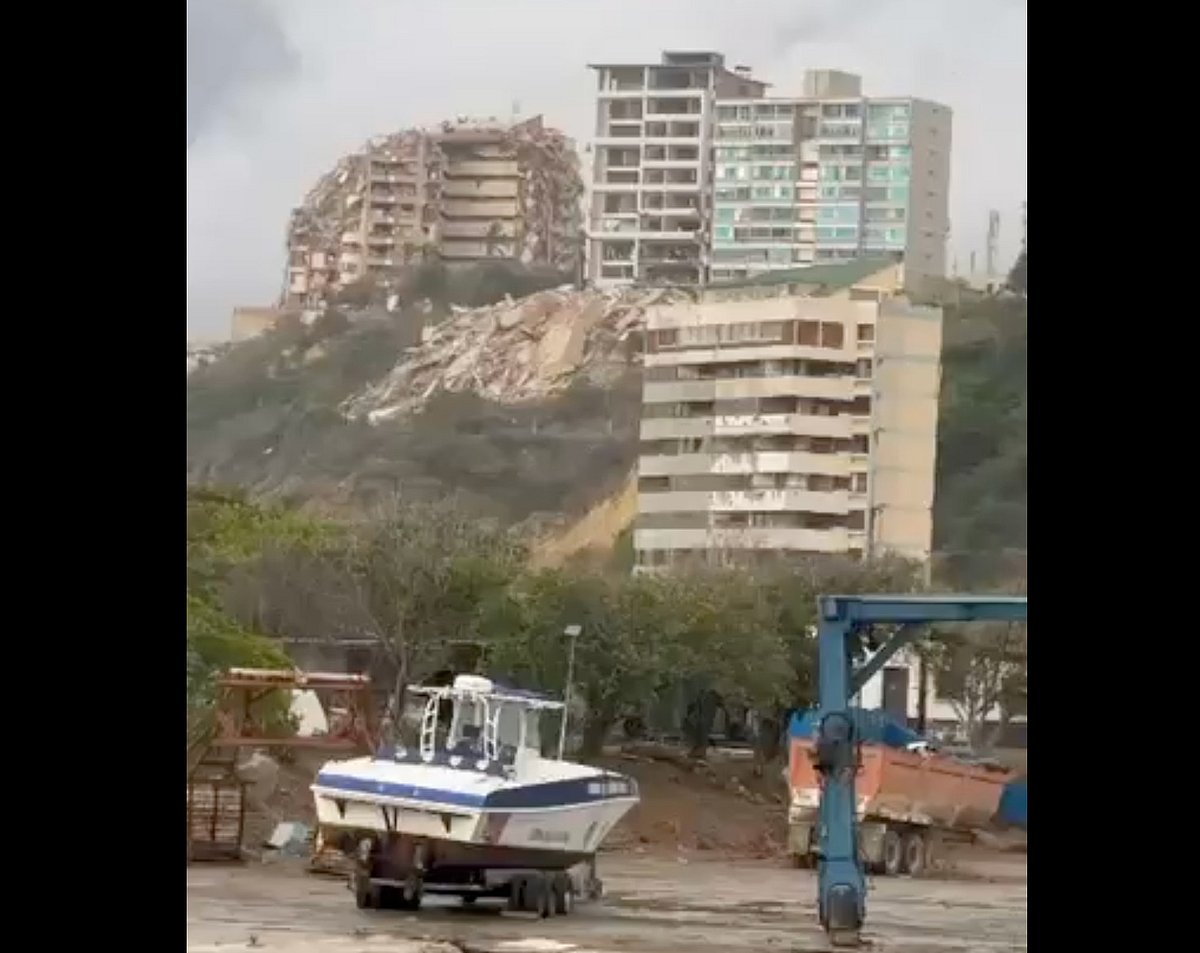
Two "unusually strong" earthquakes of magnitude 7.2 and 7.5 struck the same area of Venezuela on Wednesday evening, causing buildings to collapse, according to the United States Geological Survey (USGS) and AFP journalists.
The quakes drove residents of the capital, Caracas, into the streets.
Two earthquakes of magnitude 7.2 and 7.5 struck the same area of Venezuela on Wednesday evening, according to the United States Geological Survey (USGS) and AFP journalists.
Venezuela recorded 20 aftershocks after two powerful earthquakes, according to the presidency.
The government has declared a state of emergency.
The quakes sowed panic in the capital, Caracas, driving people into the streets.
Many people are feared dead as a number of buildings collapsed and roofs crumbled, Interior Minister Diosdado Cabello said.
An AFP journalist saw a 22-story building completely destroyed in the capital's Altamira neighborhood.
People outside shouted out the names of relatives as volunteers climbed over the rubble. "We need flashlights," one of them said.
The main airport over "serious damage" from earthquakes according presidency
Emergency workers rushed to the site of a collapsed building in Caracas
Rescue workers are searching for survivors at a collapsed building after an earthquake in Caracas, Venezuela, Wednesday, June 24, 2026.
Venezuela’s Maiquetía Airport has closed and classes canceled after earthquakes damaged several states across the country, acting President Rodríguez said in a news conference.
[Following is the earlier report]
Powerful tremors
The 7.2 and 7.5 magnitude earthquakes roiled the region, with buildings evacuated in cities as far away as Brazil’s Amazon about 1,700 kilometers (1,050 miles) away.
Late Wednesday, acting president Delcy Rodríguez said she was preparing to address the nation.
Rodríguez’s failure to address the nation within three hours of the earthquake, while her government did not give a report of injuries or fatalities in that time, was criticised by politicians and Venezuelans.
“The uncertainty becomes yet another layer of anguish,” Edmundo González, the opposition’s 2024 presidential candidate, said on X.
The US Geological Survey initially said the first earthquake had a magnitude of 7.1, later revising that to 7.2, and its epicenter was west of the community of Morón, located along the country’s Caribbean coast, about 168 kilometers (104 miles) west of Caracas. The quake had a depth of 22 kilometers.
Larger earthquake
The USGS reported an even larger 7.5-magnitude earthquake just a minute later. The second quake had a depth of 10 kilometers and its epicenter was 16 km (10 miles) southwest of Morón.
The quakes, among the strongest to strike Venezuela in more than a century, struck shortly after 6 pm.
People evacuated swaying buildings in the capital Caracas, many visibly shocked as they saw entire walls that had collapsed, making furniture visible from the street. Dust columns could also be seen in two neighborhoods of the capital, where restaurants and other businesses are typically busy.
‘We all had to leave our houses’
People remained on the streets for hours, even after sunset.
Some sat on the ground hugging their pets as dust gathered around them. Collapsed buildings, toppled electric poles and debris blocked streets. Parts of the capital lost power and cellphone signal.
“It started off gently and then gradually grew, and in the end, we all had to leave our houses, go outside and gather together,” Caracas resident Hector Ricci said.
The lack of cellphone signal in parts of Venezuela deepened the distress of many families, particularly those among the more than 7.7 million people who have left the country during its protracted crisis.
“May strength, serenity, and solidarity prevail among us in the face of this difficult time,” opposition leader Maria Corina Machado said from exile.
Impact felt throughout Venezuela
Interior Minister Diosdado Cabello said the quake could be felt in several states.
The Altamira neighbourhood in Caracas had “alarming situations” with collapsed homes and buildings, he said, suggesting people were injured in the earthquake and asking motorists to give way to ambulances and other emergency vehicles.
“We understand that some people may be desperate, but we are acting according to protocols to activate aid and rescue efforts to help those who need it most,” Cabello said on state television.
“Be very careful with children and the elderly; call each other and check that no one has been harmed.”
He also urged people to remain outside as aftershocks could further damage some structures.
“The building really shook from side to side. Unreal. The force was incredibly strong,” Caracas resident Roberto Gamas said. “We were walking and it was tossing us around. Everything in the apartment fell. Well, thank God we were able to get out.”
Expressions of support posted on social media
Reaction pouring in swiftly on social media.
Venezuela opposition leader Maria Corina Machado, in exile after leaving Venezuela in December, took to to X to send prayers and wish strength to Venezuelans.
“May strength, serenity, and solidarity prevail among us in the face of this difficult time,” she wrote on X.
El Salvador President Nayib Bukele expressed solidarity with Venezuela following the earthquakes, saying his country’s “heart is with the people of Venezuela during these difficult times.”
“We send you all our solidarity and our prayers. Stay strong, Venezuela,” Bukele wrote.
Republican Rep. María Elvira Salazar of Florida said her “thoughts and prayers” were with Venezuela and expressed support for families affected, those still waiting for answers and first responders.
“The strength of the Venezuelan people has been tested time and again,” she wrote. “I have no doubt they will face this moment with the same resilience, courage, and hope that have carried them through every challenge.”
Earthquake impacts the region
Buildings in Manaus, Belem and Macapá in Brazil’s Amazon were evacuated, according to reports on TV Globo.
The quakes also were felt in Colombia’s Caribbean and northeast regions, but there were no reports of damages or injuries. The Colombian Maritime Authority in a statement said the country’s Caribbean coast is at no risk of tsunami.
The U.S. Pacific Tsunami Warning Center issued a tsunami alert for Virgin Islands. Authorities in the Dominican Republic also issued one for the island. Another alert for Puerto Rico was quickly lifted.
Strong earthquakes are unusual in Venezuela.
While the country sits near multiple fault lines, its position straddling the South American and Caribbean plates make earthquakes much less common than in other parts of Latin America.
Along the Pacific coast — in Mexico and Chile, for example — earthquakes are frequent. The two countries sit along the seismically active tectonic belt known as the “Pacific Ring of Fire,” which is responsible for 90% of earthquakes, according to the USGS.
The quakes also were felt in Colombia’s Caribbean and northeast regions, but there were no reports of damages or injuries. The Colombian Maritime Authority said in a statement that the country’s Caribbean coast is at no risk of tsunami.
In Brazil’s Amazon, buildings in the cities of Manaus, Belem and Macapá also were evacuated.
Buildings collapse
Some buildings reportedly collapsed and roofs crumbled, according to Interior Minister Diosdado Cabello.
"The stairs came away, the whole wall cracked. Things fell from the ceiling. It was horrible," said 54-year-old bank employee Odalis Escalona in Caracas.
The first quake, with an epicenter 21 kilometers (13 miles) west of the coastal town of Moron, occurred at 2204 GMT, USGS said. Within a minute, a 7.5-magnitude quake struck about 45 kilometers away.
"This earthquake was the second event in a doublet. This magnitude 7.5 mainshock was preceded by 39 seconds by a 7.2 foreshock," USGS said.
Cabello asked people to leave their homes, adding that gas supplies had been cut to several buildings as a precaution.
"We have some damaged structures and we don't want any kind of accident involving gas to occur," Cabello said.
With a depth of 10 kilometers, the second tremor prompted screams of panic at a shopping center in Caracas, an AFP journalist observed.
"It was unbelievable, I don't even know how long it lasted," said shopkeeper Heidi Romero, who was on the top floor of the shopping center when the quake struck.
"We went out through the emergency stairs, that's how they got us out," the 42-year-old told AFP.
Dozens more in the capital exited buildings and waited outside before returning to their offices and homes.
With inputs from AFP, AP
Sign up for the Daily Briefing
Get the latest news and updates straight to your inbox
Network Links
GN StoreDownload our app
© Al Nisr Publishing LLC 2026. All rights reserved.