Hygroscopic flares are attached to an aircraft during a cloud seeding flight operated by the National Centre of Meteorology.
Natural weather or cloud seeding: What really caused the UAE’s record March rainfall
Heaviest UAE rains in 80 years were natural, not cloud seeding, NCM says
Last updated:
3 MIN READ
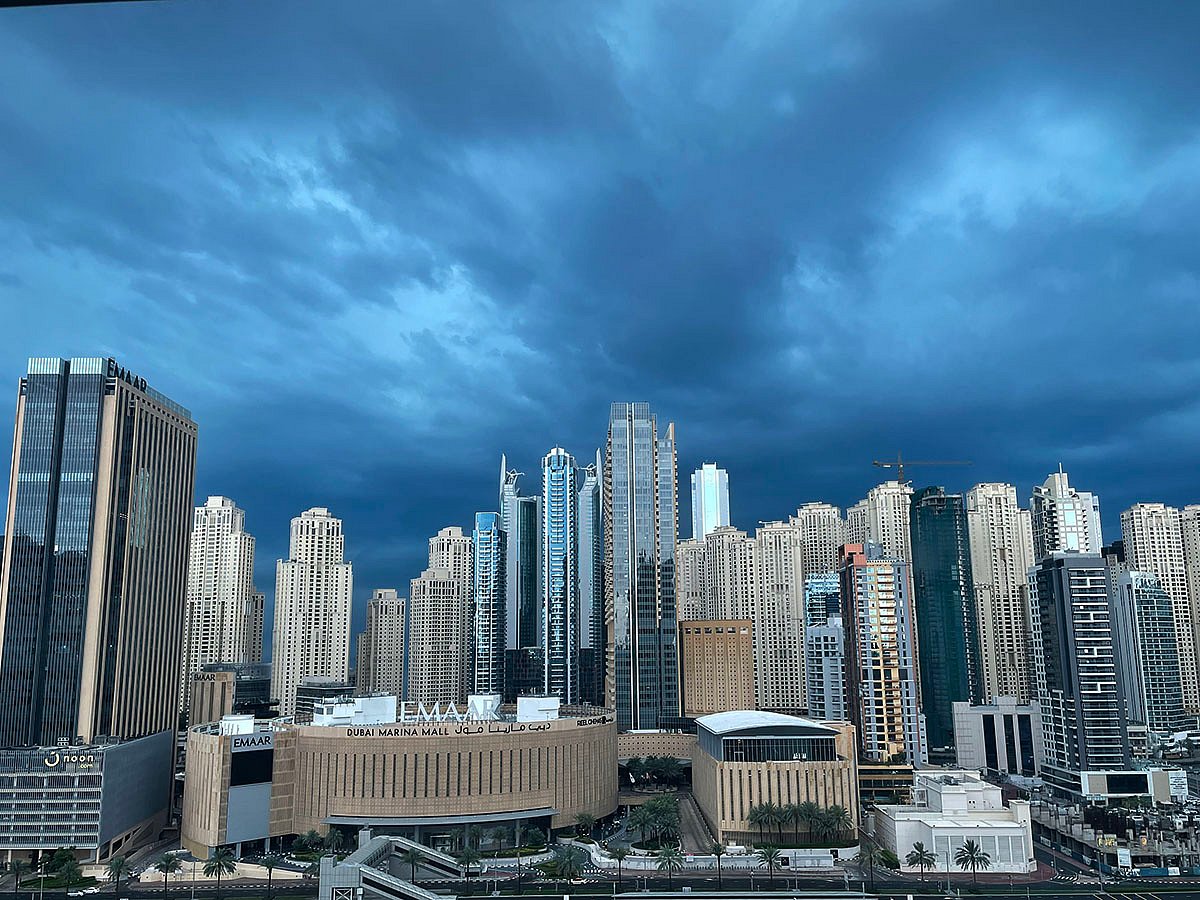
Rain clouds roll across Dubai’s skyline as towering skyscrapers of JLT and the Marina fade into a misty embrace, captured beautifully by Anupam Shivnani.
Anupam Shivnani
Dubai: After one of the heaviest rain episodes recorded in the UAE in decades, a familiar question quickly resurfaced across social media and public discussions: were the storms intensified by cloud seeding, or were they entirely natural?
Between March 21 and March 28, the UAE experienced intense rainfall driven by unstable weather conditions linked to a low-pressure system that brought widespread convective cloud formation and heavy downpours across multiple regions.
Get updated faster and for FREE: Download the Gulf News app now - simply click here.
Meteorological data indicates the episode ranks among the heaviest recorded since weather documentation began more than 80 years ago. Jebel Yanas in Ras Al Khaimah recorded the highest levels at 244mm, followed by Al Manama in Ajman at 234.7mm and Al Hayer in Al Ain at 234.1mm. Other notable readings included 229.7mm at Jebel Mebrah in Ras Al Khaimah and 226.6mm in Khatm Al Shakla in Al Ain.
The timing of the storms arriving in March rather than during the peak winter months prompted speculation about whether weather modification techniques such as cloud seeding had played a role.
In comments to Gulf News, the National Centre of Meteorology clarified that the rainfall was the result of natural atmospheric conditions linked to a low-pressure system and not the result of cloud-seeding operations. The centre confirmed that no cloud-seeding missions were carried out during the recent weather event and that none are planned in the near term.
What is cloud seeding?
Cloud seeding is a weather-modification technique designed to enhance rainfall by introducing specific particles into suitable clouds to encourage the formation of raindrops.
Typically, aircraft or ground-based generators disperse substances such as silver iodide, sodium chloride (salt) or potassium iodide into clouds.
These particles act as condensation nuclei tiny surfaces around which water vapour can gather. As moisture accumulates around these particles, droplets grow larger until they become heavy enough to fall as rain.
Why countries use cloud seeding
Cloud seeding is commonly used in arid and semi-arid regions as part of broader water security strategies. Countries typically use the technology to increase rainfall, mitigate the effects of drought, support agricultural production and, in some cases, reduce hail damage.
The UAE has previously invested in weather enhancement research as part of its long-term water sustainability strategy, although meteorologists stress that such operations can only be carried out under specific atmospheric conditions and cannot create storms independently.
Despite the intensity of the recent downpours, the storms passed without any reported loss of life, with damage largely limited to property and temporary disruption.
Across the country, emergency teams worked around the clock to pump out floodwater, clear roads and keep traffic moving.
The weather system swept across much of the UAE, bringing waves of heavy rain and fast-moving runoff, with some areas recording more than 244mm of rainfall.
Network Links
GN StoreAbout Gulf NewsTerms & ConditionsReach by GNSitemapContact usPrivacy PolicyGN FocusHave your sayWork with usAdvertise with usGulf News epaperPrinting Services
Download our app
© Al Nisr Publishing LLC 2026. All rights reserved.