Shobhika Kalra at the launch of her book -The World Wasn’t Built for Me, So I Built My Own at SIBF.
‘The world wasn’t built for me, so I built my own’: UAE resident’s journey from diagnosis to disability advocate
Shobhika Kalra turned her struggle with a rare disease into a mission to break barriers
Last updated:
7 MIN READ
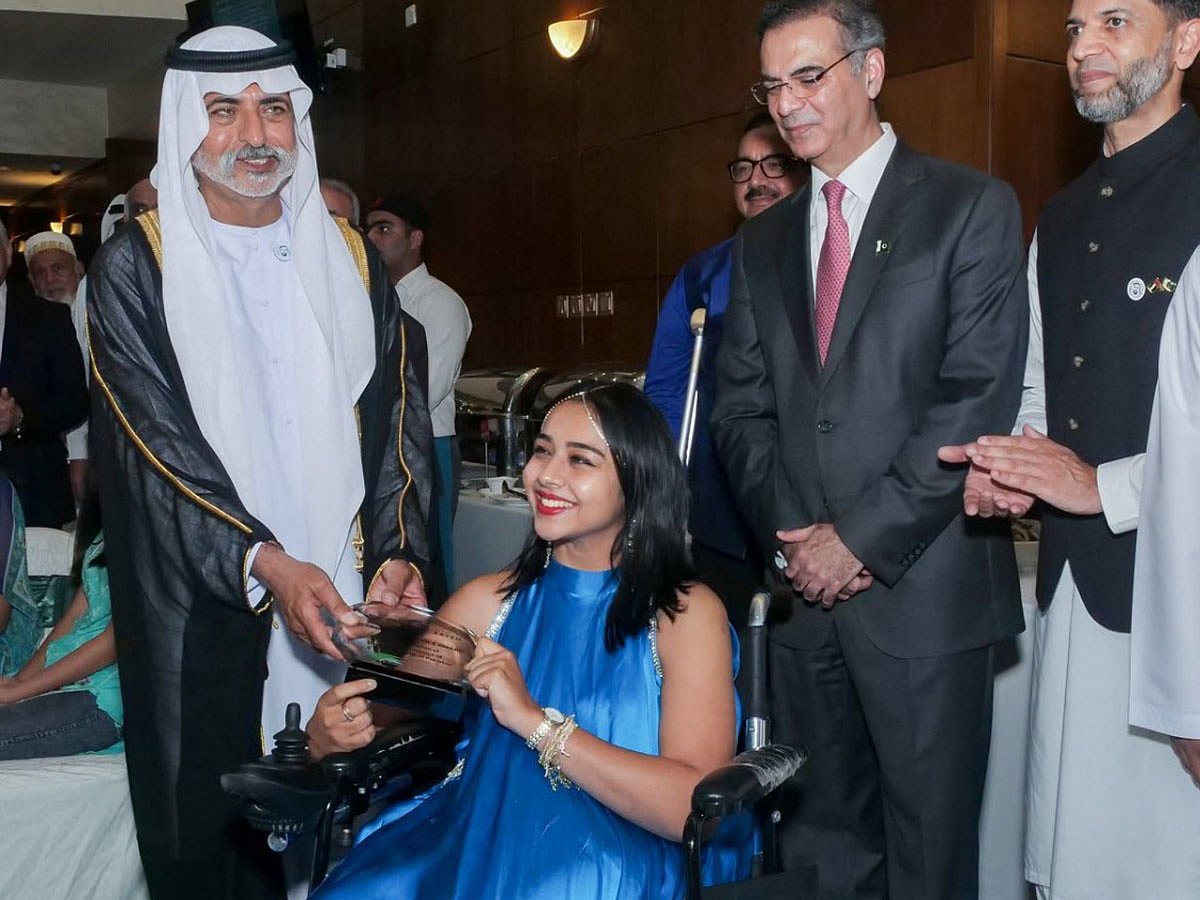
Shobhika Kalra, receiving an award from Sheikh Nahyan bin Mubarak Al Nahyan, Minister of Tolerance and Coexistence.
Supplied
Dubai: At 12, Shobhika Kalra was an energetic schoolgirl who loved dancing, sports and competitions. She enjoyed being on stage, winning awards and receiving applause. Her world was full of possibilities. Then, towards the end of Grade 7, she began falling frequently and struggling to walk in a straight line.
She was diagnosed with Friedreich’s ataxia, a rare, inherited degenerative disease that affects the nervous system, gradually impairing balance, coordination and mobility.
“The diagnosis completely changed my life. Physically, the condition gradually affected my balance, coordination, speech and mobility. Today, I use an electric wheelchair, and even simple everyday activities can be challenging,” said the 36-year-old disability advocate.
For years, she struggled to accept that the life she had imagined might never become reality. She held on to the hope of a cure, while gradually losing the physical abilities she once took for granted.
“Over time, I realised that although I could not control what was happening to my body, I could choose how I responded to it.”
Get updated faster and for FREE: Download the Gulf News app now - simply click here.
Today, Shobhika is a disability advocate, motivational speaker and founder of Wings of Angelz, an initiative that has helped make more than 1,000 places in Dubai wheelchair accessible.
Her journey, from a frightened schoolgirl struggling with her diagnosis to a woman determined to make the world more inclusive, is now the subject of her memoir, The World Wasn’t Built for Me, So I Built My Own, which she launched at the recently concluded Sharjah International Book Fair (SIBF).
The cinema experience that changed everything
For Shobhika, the struggle for accessibility began long before she became an advocate.
As her condition progressed, she had to leave mainstream schooling because the environment could not accommodate her needs. At the time, she was too young and still coming to terms with her diagnosis to challenge those barriers.
Years later, an experience at a cinema in India became a turning point.
“Wings of Angelz actually started after an experience I had while watching a movie in India with my sister. The cinema was not wheelchair accessible, and I had to be physically carried to my seat by four men I did not even know. I found the experience very disturbing.”
Her sister approached the cinema manager to raise the issue, but his response left them even more unsettled.
“He suggested that we were facing this difficulty because we had come from outside India.”
For Shobhika, the experience raised a bigger question - why should something as ordinary as watching a film be so difficult for someone with a disability?
“Accessibility should never depend on where someone comes from. It should be a basic consideration for everyone. That experience made us question why something as simple as enjoying a movie should be so difficult for a person with a disability.”
Rather than accept these experiences as an unavoidable part of her life, she decided to challenge the barriers that caused them.
That determination became Wings of Angelz, an initiative built around the belief that people with disabilities deserve equal opportunities, independence and accessible surroundings.
Diagnosed with a rare degenerative condition at 12, Shobhika Kalra has helped make more than 1,000 places in Dubai wheelchair accessible. Now, she is sharing her story of resilience and finding purpose.
Helping make Dubai Metro more accessible, one ramp at a time
Back in Dubai, Shobhika began noticing obstacles that many people walked past without a second thought. One of her earliest efforts involved the Dubai Metro.
Although Metro stations were designed with accessibility in mind, she realised that getting inside a station was not always the problem. Sometimes, the real challenge was reaching it.
“At one of the Metro stations, there was no proper ramp connecting the footpath to the road, making it difficult for wheelchair users to access the station independently. I approached RTA and explained the problem.”
An engineer from Dubai's Roads and Transport Authority (RTA) visited the location, and once the difficulty was understood from a wheelchair user's perspective, a ramp was constructed within a week.
What seemed like a small infrastructure improvement was, for Shobhika, proof that speaking up could lead to change. Encouraged by the response, she began identifying similar barriers at other Metro stations, with RTA supporting her efforts.
“I became their eyes on the ground, highlighting issues that might otherwise go unnoticed. This collaboration helped bring attention to accessibility improvements across the Metro network. It also showed me how much difference can be made when authorities listen to the people who experience these challenges.”
More than 1,000 places made wheelchair accessible
What began with identifying individual barriers has since grown into a wider community effort. Through Wings of Angelz, Shobhika and her community have worked with businesses and organisations to improve accessibility across Dubai.
“We have helped make more than 1,000 places in Dubai wheelchair accessible by highlighting barriers and encouraging businesses and organisations to introduce practical changes.”
Their efforts have focused on ramps, accessible entrances, wheelchair-friendly pathways and better access to public facilities.
“Sometimes, what seems like a very small change, such as installing a ramp or removing an unnecessary step, can completely change someone's experience. Accessibility is not about creating special privileges. It is about ensuring that everyone can participate in everyday life with dignity and independence.”
‘We are not helpless, and we do not need pity’
While improving physical accessibility remains central to her work, Shobhika believes genuine inclusion requires something deeper - changing how society views disability.
“One of the biggest misconceptions is that people with disabilities are helpless or constantly need sympathy. We are individuals with dreams, ambitions, emotions and the desire to live independently, just like everyone else.”
She says people often see a wheelchair and immediately make assumptions about what someone can achieve. Sometimes, they address the person accompanying a wheelchair user rather than speaking directly to the individual.
For her, these attitudes can be just as limiting as physical barriers.
“Sometimes the biggest barriers are not physical but social. People often underestimate what someone with a disability can achieve. Instead of making assumptions, society needs to listen, provide opportunities and allow individuals to make their own choices.”
Her own experience of leaving mainstream schooling has also shaped her belief that inclusion must extend beyond public spaces.
“Physical accessibility is only one part of inclusion. We also need to focus on education, employment, social acceptance and equal opportunities. Children with disabilities should not have to leave schools simply because the infrastructure cannot accommodate them.”
Adults with disabilities, she believes, must also have opportunities to work, contribute and become financially independent.
Finding a life she never imagined
Over the years, Shobhika's journey has taken her far beyond the limitations she once feared.
She became the youngest Indian in the Middle East to receive an honour at the 15th Pravasi Bharatiya Divas and has received recognition for her community work. She has also embraced adventures such as scuba diving and skydiving.
Yet, some of her greatest achievements have been personal - learning to accept herself, letting go of expectations and discovering meaning in a life that unfolded differently from the one she had planned.
“I realised that life could still be meaningful in ways I had never imagined. Writing this book was also a way of sharing the people, experiences and lessons that shaped me.”
Her message to readers is one of hope and self-acceptance.
“I want readers to understand that life does not have to be perfect to be beautiful. You do not need to have everything figured out, and your circumstances do not determine your worth. My biggest message is simple - even if the world is not built for you, you can still create a life that belongs to you.”
What she would tell her 12-year-old self
Before her diagnosis, applause and validation had been an important part of her identity. As her condition progressed and she could no longer fit society's expectations, that applause gradually faded. But the woman she has become no longer measures her worth by other people's approval.
“I would tell her that even the people closest to you may advise you to fit in, not because they want anything bad for you, but because they want to protect you but you don't always have to listen, even to them. Trust yourself because you are a wild soul, and you were never meant to fit into someone else's idea of perfection.”
And to the girl who once feared that her diagnosis had taken away her future, she would offer one final reminder:
“You don't have to fit into the world's picture of perfection to have a beautiful and meaningful life. Be yourself, trust your journey and never forget your worth.”
Network Links
GN StoreAbout Gulf NewsTerms & ConditionsReach by GNSitemapContact usPrivacy PolicyGN FocusHave your sayWork with usAdvertise with usGulf News epaperPrinting Services
Download our app
© Al Nisr Publishing LLC 2026. All rights reserved.