Sheikh Abdullah bin Zayed Al Nahyan presents First Class Order of Zayed II to Navdeep Singh Suri
EXCLUSIVE
India-UAE relations: Former Indian Ambassador reveals untold stories in new book
First Class Order of Zayed II recipient traces centuries of ties, key diplomatic moments
Last updated:
5 MIN READ
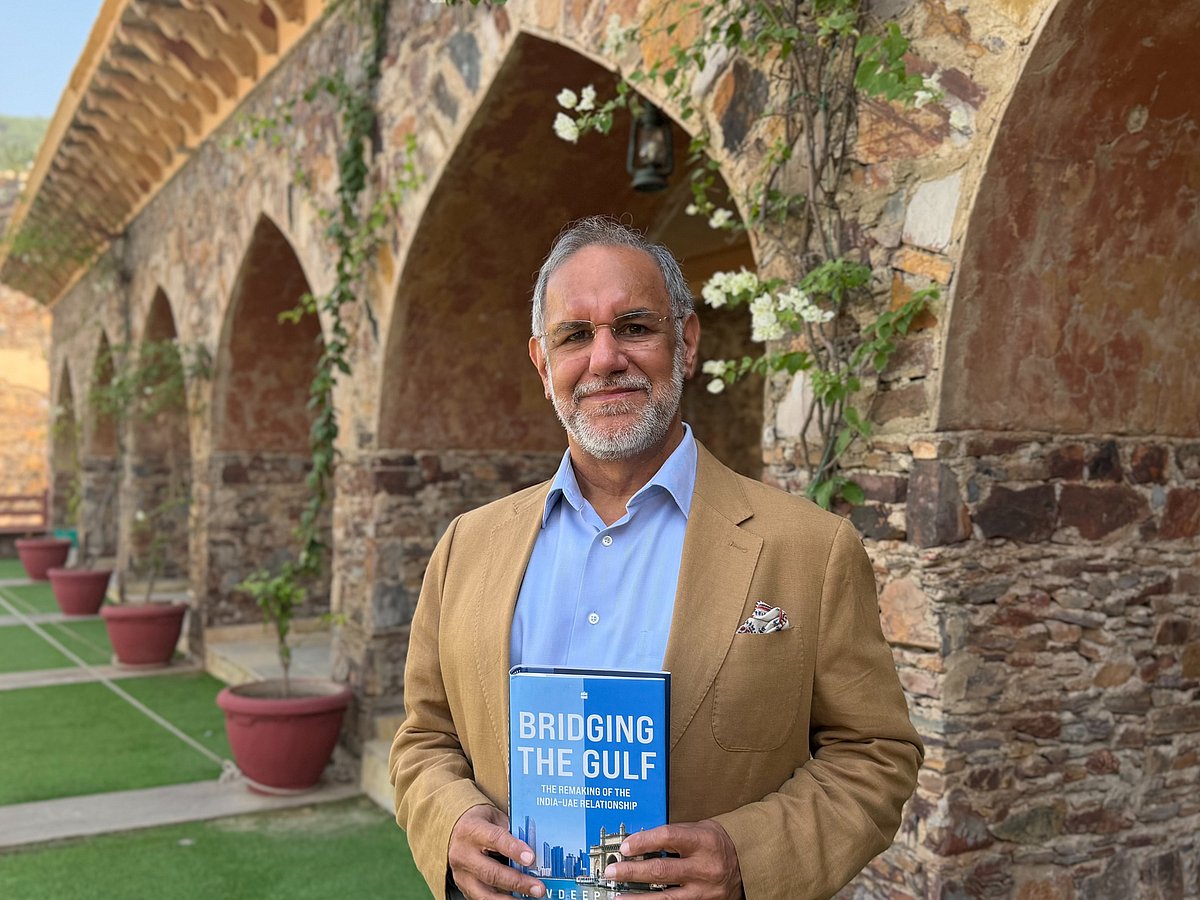
Navdeep Singh Suri with his new book 'Bridging the Gulf: The Remaking of India-UAE Relations'
Supplied
Dubai: Former Indian Ambassador to the UAE Navdeep Singh Suri was back in the news this week here after Gulf News recalled his receipt of the UAE’s First Class Order of Zayed II, the same honour conferred on flydubai Captain Smit Machchhar and fellow crew members on October 27 for their courage and professionalism in ensuring passenger safety during an alleged cockpit terror attack on September 30.
Suri was the first Indian to receive the second-highest civilian honour of the UAE on September 11, 2019, in recognition of his contribution to strengthening India-UAE relations.
Now, he has another reason to be in the spotlight: his new book, which delves into the history, personalities and behind-the-scenes diplomacy that helped shape one of India’s most important international partnerships.
Titled Bridging the Gulf: The Remaking of India-UAE Relations, the book, launched on October 25, draws on Suri’s diplomatic experience, interviews with key participants and archival research.
Get updated faster and for FREE: Download the Gulf News app now - simply click here.
Why the book
“People would ask me why I had not written about the transformational period during which I served as India's Ambassador to the UAE because there was not a single serious book on the subject,” he told Gulf News in an exclusive phone interview.
Suri was India’s envoy to the UAE from 2016 to 2019. He said he initially planned to focus on the decade from 2015 to 2025.
However, conversations with Dr Anwar Mohammed Gargash, Diplomatic Adviser to the UAE President, and Sheikh Abdullah bin Zayed Al Nahyan, Deputy Prime Minister and Minister of Foreign Affairs, encouraged him to explore the relationship’s centuries-old roots as well. And he spent two years working on the book.
Shared history
The book traces connections across the Arabian Sea to the period of British rule in India, when Bombay, now Mumbai, served as a key administrative and trading hub for the Gulf.
Suri examines how the pearl trade brought Indian and Arab merchants closer, prompting families from the Gulf to establish homes and offices in Bombay. Interviews with members of longstanding Indian and Emirati families helped him capture personal accounts of these enduring connections.
The history of the Indian rupee in the Gulf also features prominently. A chapter titled Gold Fever explores the controversial gold trade between Dubai and India during the 1950s and 1960s, alongside the economic circumstances surrounding the transition from the Indian rupee to the Gulf rupee and the current currencies in Gulf countries.
The book also looks beyond western India. The Malabar Connection explores Kerala’s historical links with the Gulf, while a section titled City of Pearls examines Hyderabad’s connections with the region.
Suri describes the work as part history and part diplomatic memoir, rather than an encyclopaedic account.
“I have limited myself to things I knew well because this is not Wikipedia. It is also a personal account,” he said.
Behind diplomacy
Among the diplomatic episodes explored is former Indian External Affairs Minister Sushma Swaraj’s historic participation in a foreign ministers’ conference of the Organisation of Islamic Cooperation (OIC). Suri offers a ringside view of the diplomacy surrounding the event, including how her participation unfolded.
Suri also offers a behind-the-scenes account of the BAPS Hindu Mandir in Abu Dhabi, exploring how a commitment to Prime Minister Narendra Modi became part of the UAE’s broader policy of religious tolerance, and the role played by senior UAE ministers in bringing the project to fruition.
The book also addresses the challenges of translating economic ties into investment. In the chapter The $75 Billion Conundrum, Suri examines the obstacles facing Emirati investment in India and offers a behind-the-scenes look at major investment projects involving prominent UAE companies.
“There is a lot that has happened, but it is important for readers to understand the distinction between trade and investment,” he said, highlighting the scale of bilateral trade, which reached US$101.25 billion in 2025–26.
The relationship, he argues, extends well beyond familiar images of Dubai’s skyline, Bollywood and cricket. India and the UAE increasingly collaborate in areas including defence, security, energy and technology. The book also looks ahead to emerging fields of cooperation, including artificial intelligence, supercomputing and advanced healthcare technologies.
Beyond stereotypes
Suri also wants Indian readers to understand the UAE beyond its modern skyline and economic achievements.
In a video announcing the book, he reflected on the contrast between images of the country in the 1960s and the skyscrapers of Dubai and Abu Dhabi today. He said the book highlights the UAE’s transformation in governance, technology, artificial intelligence and healthcare.
A chapter titled Beyond the Abaya focuses on Emirati women leaders Suri had the privilege of meeting during his diplomatic career. He hopes it will challenge stereotypes by highlighting their personalities, achievements and leadership rather than assumptions based on traditional dress.
The book has two broad aims, he said: to explore the historical and contemporary dimensions of India-UAE relations and to give Indian audiences a deeper understanding of modern Emirati society.
“Few would have imagined in 2014 that the BJP-led government of Prime Minister Narendra Modi would bring about such a profound transformation in India’s ties with an Arab, Muslim state like the UAE,” Suri said.
UAE launch events
Suri’s UAE book tour will include a series of events for readers and diplomatic audiences.
The first launch is scheduled for November 7 at 4pm at the Sharjah International Book Fair. An event at the Anwar Gargash Diplomatic Academy is planned for November 9, followed by an Abu Dhabi event organised by IBPG Abu Dhabi on November 10.
IBPC Dubai is scheduled to host an event on November 13, while the book will also feature at the ICAI annual event in Expo City Dubai on November 14.
Suri retired from the Indian Foreign Service in 2019 after a 36-year career that included postings in Cairo, Damascus, Washington, Dar es Salaam and London. He also served as India’s consul general in Johannesburg and high commissioner to Australia, as well as ambassador to Egypt.
Beyond diplomacy
He has co-edited publications on India’s economic diplomacy, the I2U2 grouping of India, Israel, the UAE and the US, and the India-Middle East-Europe Economic Corridor. He has also translated several works by his grandfather, celebrated Punjabi novelist Nanak Singh, into English.
Published by HarperCollins India, Bridging the Gulf is being distributed in the UAE by Jashanmal and is also available through Amazon and Suri’s website.
Isha Banerji, commissioning editor at HarperCollins India, said the book traces how historical commercial links, including the circulation of the Indian rupee and Bombay’s role as a trading hub, helped lay the foundations for one of India’s most important contemporary partnerships.
Despite the growth of social media and digital content, Suri believes books remain essential to understanding complex subjects.
“Even as all of us use today’s social media tools and videos, the written word is still irreplaceable,” he said.
Network Links
GN StoreAbout Gulf NewsTerms & ConditionsReach by GNSitemapContact usPrivacy PolicyGN FocusHave your sayWork with usAdvertise with usGulf News epaperPrinting Services
Download our app
© Al Nisr Publishing LLC 2026. All rights reserved.