UAE exporters must stand out to win overseas, says Orbitworks executive
Differentiation key for Emirati exporters in competitive global markets
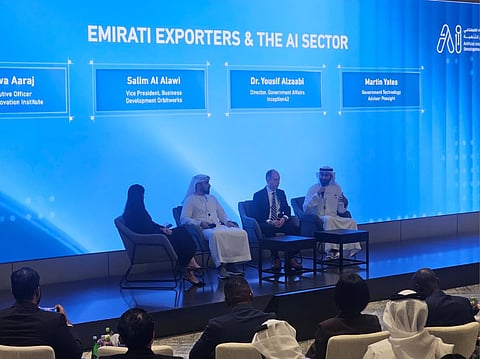
Abu Dhabi: Build something, differentiate it, because if you compete with whatever exists in performance, that’s not a long-term game, according to Salim Al Alawi, Vice President and Business Development at Orbitworks, told Emirati companies taking technology abroad for the first time. “You need to be differentiated.”
He was speaking at a panel titled “Emirati Exporters and the AI Sector: Real-World Stories” at AI for Development Forum organised by Abu Dhabi Exports Office (ADEX), which brought together representatives from Presight, Inception42 and Orbitworks.
Drawing on their experience of developing, commercialising and exporting technology, panellists discussed the opportunities for UAE-developed AI solutions in international markets and the practical challenges of moving from innovation to implementation.
The session began with the moderator citing figures showing UAE non-oil exports reached 450 billion dirhams in the first half of 2026, up 24% year on year. The discussion focused on how companies can turn that momentum into sustainable, repeatable growth.
France as a customer
Al Alawi described France as one of the leading nations in space, with no shortage of space companies. It is nonetheless the biggest customer for Orbitworks’ UAE-built and UAE-operated satellite constellation, he said. “There is no other AI-enabled operational constellation at that scale globally,” he said. “So, you are the only option.” The claim was not independently verified.
Space products are very hard to sell without flight heritage, he said. Orbitworks lined up partners before its first satellite, Altair One, launched in October, including UAE entities such as Abu Dhabi Fund for Development (ADFD) and ADMA, along with the French space agency.
He said those partnerships helped convince customers, and that growing trust in what the UAE is building in technology and services helped the company win those partners.
Trade seen differently
According to Al Alawi, the satellites carry optical, thermal and other sensors and run AI on board to detect changes and anomalies. He said they can monitor infrastructure and maritime activity and report findings to customers in near real time. ADFD plans to use the imagery to track the progress of projects it finances overseas.
“Trust is everything with data,” said Martin Yates, Government Technology Adviser at Presight. The point was backed by Dr Yusif Alzaabi, Director, Government affairs, Inception42, who spoke of trust being integral amid a recent wave of cyber-attacks, “trust, trust, trust is the most important thing.”
Alzaabi said companies working with UAE government entities should expect to make concessions on intellectual property. Adding to that he said governments now have advisers who can access what works and what doesn’t, so vendors can’t simply bring a technology and expect to win.
“The government will want the IP,” he said. He argued that regulation and innovation work together in the UAE: “Regulations do not hinder innovation. In fact, it actually boosts it.”
“Vendors can no longer expect to win business simply by bringing a product,” he added says that companies must also make a business case in terms of public value, that could potentially be harder to measure than commercial return.
He argued that regulation and innovation work together in the UAE: “Regulations do not hinder innovation. In fact, it actually boosts it.”
Presights international push
Yates said at least 40% of Presight’s market is now international. He said the company is deploying cloud data centres, sovereign AI, agentic platforms and smart-city systems, with Africa a major focus. Citizens may not see the technology itself, but they notice faster turnaround times and clearer government processes, according to him.
For companies expanding abroad, the experts had several advices, to differentiate, employ people who speak the language and understand the culture, because “no country is the same, use the ecosystem provided and look for partners.


