UAE and France deepen strategic ties in landmark Abu Dhabi talks
Leaders boost cooperation on AI, energy, defence, culture and regional security
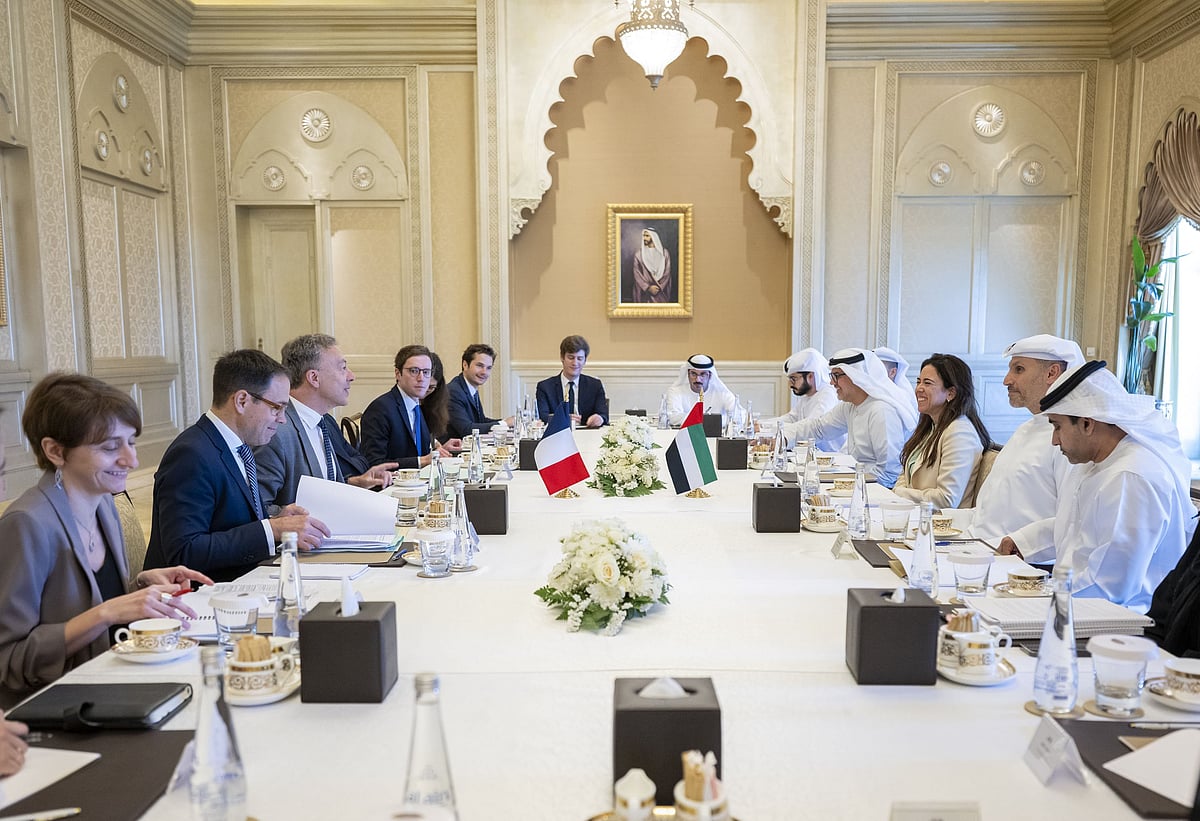
Abu Dhabi: Building on the longstanding strategic partnership between the United Arab Emirates and the French Republic, and under the guidance of President His Highness Sheikh Mohamed bin Zayed Al Nahyan, and Emmanuel Macron, President of France, the 18th session of the UAE–France Strategic Dialogue convened in Abu Dhabi on the 6th of May, 2026.
Co-Chaired by Khaldoon Khalifa Al Mubarak, Chairman of the UAE’s Executive Affairs Authority, and Martin Briens, Secretary-General of the French Ministry for Europe and Foreign Affairs, the Dialogue underscored the shared commitment of both countries to strengthening a comprehensive and forward-looking bilateral partnership across a wide range of areas.
Get updated faster and for FREE: Download the Gulf News app now - simply click here.
The UAE - France Strategic Dialogue witnessed the participation of Dr. Anwar Gargash, Diplomatic Adviser to the UAE President, Lana Nusseibeh, Minister of State, Fahad Al Raqbani, UAE Ambassador to the French Republic, and Nicolas Niemtchinow, Ambassador of France in the UAE, in addition to a number of officials from both sides.
During the Dialogue, the two sides reaffirmed the strength of their longstanding strategic partnership and their shared commitment to further advancing bilateral cooperation across key areas, with a shared ambition to deepen and expand collaboration.
On the current regional developments, the two sides condemned in the strongest terms Iran’s egregious, unjustifiable attacks on the UAE, the GCC States, Jordan, and other regional States, which deliberately and indiscriminately targeted civilians and civilian infrastructure, in clear breach of their sovereignty and territorial integrity and in flagrant violation of international law, including the UN Charter.
Recalling UN Security Council resolution 2817 (2026), both sides condemned Iran's actions and threats aimed at closing, obstructing, and interfering with international navigation through the Strait of Hormuz and threatening maritime security in the Bab al-Mandab, and affirmed that any attempts to impede lawful transit passage or freedom of navigation in these international waterways constitutes a serious threat to international peace and security. They rejected Iran's attempts to use these corridors as tools of coercion or to hold the global economy and energy security hostage through unilateral, illegal measures. They emphasized that the Strait of Hormuz must remain open to international shipping without charges or other impediments. They welcomed international initiatives aimed at restoring freedom of navigation, including further action by the United Nations Security Council, the International Maritime Organization and the international mission proposed by France and the UK.
The two sides held a productive discussion on priority issues of regional and international significance. Both sides reaffirmed their shared commitment to achieving a comprehensive, just, and lasting peace between Israelis and Palestinians based on the two-State solution and welcomed France’s efforts in this regard. They welcomed the ceasefire agreement between Lebanon and Israel, and stressed their support for Lebanon’s unity, sovereignty, and territorial integrity. They reaffirmed their full solidarity with the people of Lebanon and support to the Lebanese government and armed forces in their efforts to restore peace and the State monopoly on arms. They reiterated their call for an immediate and unconditional humanitarian truce in Sudan and peaceful resolution to the war that leads to a civilian-led government and reaffirmed the principles outlined in the 12 September QUAD statement in this regard. Both parties underlined their commitment to supporting a just and lasting solution to the war in Ukraine in line with international law and the principles of the UN Charter, including respect for sovereignty, independence, and territorial integrity. They welcomed the most recent UAE facilitation of prisoner exchanges between Ukraine and the Russian Federation, bringing the total number of prisoners exchanged to 6,691.
On economic cooperation, both sides welcomed advancing cooperation across trade, investment, financial services, infrastructure, aviation, artificial intelligence, energy, and food security. They highlighted successful collaborations between UAE and French entities, including Mubadala and Bpifrance, MGX and G42 with Bpifrance and other French stakeholders on AI infrastructure, and Masdar, ENEC, ADNOC, EWEC, and MOEI with their French counterparts in renewable energy, nuclear energy, LNG, low-carbon solutions, and power and water infrastructure. The two countries also recognized the aviation sector as an important pillar of their economic relationship, emphasizing the importance of enhanced cooperation and the development of cutting-edge infrastructure, including the Al Maktoum International Airport project, where French expertise and solutions could contribute to shared ambitions. In addition, both sides supported the discussions being held between both civil aviation authorities regarding the development of air traffic between the two countries, where airlines would grow services if agreed. They further identified opportunities to deepen cooperation in intellectual property, food security, agricultural research, and third-market partnerships, and agreed to continue engagement on priority areas to support the implementation of strategic projects and deliver tangible outcomes.
On cultural cooperation, both sides identified the continued success of Louvre Abu Dhabi as a cornerstone of the UAE and France partnership, referencing recent exhibitions such as “Mamluks: Legacy of an Empire” and “Picasso, the Figure.” They also advanced discussions for the preparation of the Louvre Abu Dhabi museum’s 10th anniversary in 2027. Delving further into the culture and creative field, participants highlighted growing cooperation in crafts, publishing, gaming, and cinema, with active initiatives aligned with shared priorities related to talent development, ecosystem structuring, and local content creation. Both sides committed to explore opportunities to further deepen cultural cooperation in 2026 with a focus on institutional alignment, capacity-building, and the long-term development of sustainable cultural ecosystems and cultural exchange.
On nuclear energy cooperation, both sides reaffirmed their commitment to continued cooperation in the field of nuclear energy, with particular emphasis on regulation, operations, fuel cycle, waste management, R&D, and industrial partnerships. Participants noted that cooperation in this area is transitioning into a more advanced phase focused on localization, sustainability, and technological leadership. Further areas of progress in relation to nuclear cooperation noted in the discussions included expanded technical capacity building, continued alignment in regulatory and scientific work, and strong advancement in waste management cooperation.
On space cooperation, both sides also reaffirmed their intention to continue deepening collaboration across space exploration, advanced technologies, and commercial space activities, while fostering closer ties between French and Emirati stakeholders. They highlighted progress achieved in key areas, including the Rashid lunar missions, continued coordination on Space Situational Awareness (SSA) under United Nations Office for Outer Space Affairs, and advancements in satellite manufacturing, propulsion technologies, and emerging domains such as optical communications and space life sciences. More broadly, both sides reaffirmed their commitment to developing an integrated and competitive space ecosystem by enhancing collaboration between government entities, industry, research institutions, and start-ups. They welcomed ongoing discussions on talent development initiatives, including the Space Tech Program with Aspire.
On health cooperation, both sides reaffirmed their commitment to the One Health approach, building on the joint declaration endorsed at the recent Lyon summit, supported by institutional and private sector cooperation. Emphasis was placed on expanding research and development partnerships, including those enabling technology and R&D transfer between UAE and French healthcare departments. Participants also commended the Emirati-French medical residency program, calling for its continuation and expansion into health technology fields, and highlighted ongoing hospital collaborations advancing clinical research in oncology, neurogenetics, and pediatrics. Participants welcomed efforts to increase economic cooperation in healthcare, noting the increased participation of French healthcare companies at events such as WHX Dubai and plans for further engagement at the Abu Dhabi Future Health Summit. Discussions also highlighted emerging opportunities for enhanced cooperation in Global Health and Medical Innovation.
On educational cooperation, both sides recognized the substantial progress made towards the 2020–2030 French Language Roadmap target, with nearly 20,000 students now learning the French language in UAE public schools. Both sides reaffirmed their commitment to strengthening the program through continued investment in curriculum development and teacher training. Participants also welcomed growth in the French school network in the UAE, now serving more than 13,500 students across nine accredited institutions, representing a 6.5% increase in one year. Furthermore, following the visit of a delegation from the Emirati Ministry of Education to Paris in September 2025, representatives of both sides have expressed an interest in exchanging insights and expertise regarding innovation and the use of new technologies in the education sector.
In relation to higher education specifically, both sides commended the continued success of Sorbonne University Abu Dhabi (SUAD) on its 20th anniversary, highlighting its rising enrolment numbers, expanding research output, and strategic cooperation with Zayed Military University. Participants also noted that Sorbonne University Abu Dhabi hosted the France-UAE Forum on Research and Innovation in February 2026, in partnership with the UAE Ministry of Higher Education and Scientific Research, and the French Ministry of Higher Education, Research and Space. The Forum brought together academia, research institutions, and industry from both countries, demonstrating strong alignment in strategic fields such as artificial intelligence, quantum technologies, and space.
Representatives of both sides further welcomed the continued expansion of offerings by French higher education institutions in the UAE, including ESMOD’s new undergraduate fashion design program, and the progress of Rubika’s video game design program at Abu Dhabi University, which enrolled its first cohort in 2025 with support from the Abu Dhabi Department of Culture and Tourism.
At the conclusion of the 18th UAE–France Strategic Dialogue, both sides reaffirmed their commitment to further strengthening their longstanding strategic partnership and to advancing shared interests through continued close cooperation.
Network Links
GN StoreDownload our app
© Al Nisr Publishing LLC 2026. All rights reserved.